About the Book
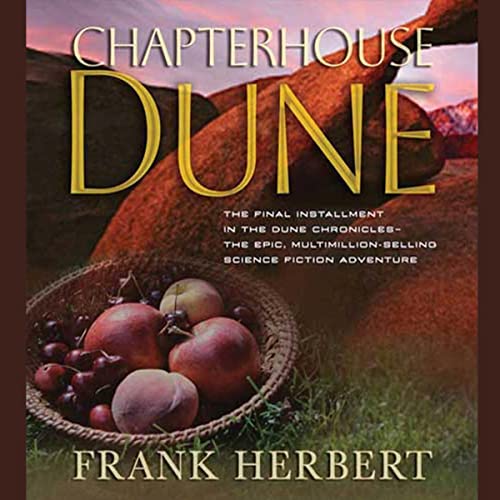
Chapterhouse: Dune is the sixth and final novel Frank Herbert completed before his death in 1986. It picks up directly from Heretics of Dune and serves as the concluding chapter of Herbert's own vision for the saga, the two posthumous continuations by Brian Herbert and Kevin J. Anderson come after this, but this is where the original author's story ends.
The planet Arrakis is gone. The Honored Matres, a violent, expansionist faction that emerged from the Scattering, have overrun much of the known universe. The Bene Gesserit, the ancient sisterhood of trained human women with near-superhuman physical and mental abilities, are the last organized power capable of resisting them. Under Mother Superior Darwi Odrade, the Sisterhood retreats to Chapterhouse, a green world they are systematically converting into desert in order to breed sandworms and regain control of the spice melange.
At the same time, the Bene Gesserit are sheltering Duncan Idaho, a ghola who has lived through many iterations across the series, and a captive Honored Matre whose knowledge may be the key to understanding their enemy. The novel is less about action than about negotiation, philosophy, and institutional survival. Herbert is working through questions about power, religion, gender, and what any civilization owes to its future. Readers expecting the large-scale conflict of earlier Dune novels may find this slower and more interior.
Because this is the sixth book in a long, continuous series, listening to Chapterhouse without the preceding novels, particularly Heretics of Dune, is not practical. Characters, factions, and concepts from across the series are referenced without re-introduction.
Narration & Audio Performance
Scott Brick has narrated multiple books in the Dune series and is closely associated with Herbert's work in audio form. His style is deliberate and measured, he reads with authority and keeps a consistent pace that suits the novel's philosophical weight. He does not rush through the dense internal monologue passages that make up much of the text, which is the right call for this material.
Character differentiation is present but modest. Brick tends to work with tonal shifts rather than distinct character voices, which means some dialogue-heavy scenes require closer attention to follow who is speaking. This is not unusual for a single narrator handling a large cast, but listeners who prefer clearly marked voice distinctions may notice it. His handling of Herbert's invented terminology, accumulated across six novels, is consistent and confident, which matters for a series this deep.
Production quality from the 2019 Penguin release is clean and free of obvious issues. There is no score or sound design; this is a straight narration. That suits the book's format. The main caveat is that Chapterhouse is dense with internal reflection and philosophical dialogue, and Brick's calm, unhurried delivery can feel slow during stretches where little is happening externally. This is a listening experience that rewards patience rather than background play.
The Audible Verdict
Chapterhouse: Dune is a rewarding read for anyone who has followed Herbert's saga, but the audio format is a specific fit. Scott Brick is a capable narrator and handles the material professionally, but the novel's density, long internal monologues, abstract philosophical exchanges, minimal action, makes it harder to absorb on audio than in print. If you've already listened to the earlier Dune novels with Brick and found that experience worked for you, this is a natural continuation. If you haven't, sample the audio first to gauge whether his pacing suits how you process this kind of writing.
Listen on AudibleIs This Book a Good Fit for Audio?
Herbert's later Dune novels are more introspective than the first few. Chapterhouse in particular is heavy on internal dialogue, characters spend long stretches reasoning through doctrine, memory, and strategy inside their own heads. This works well on the page because readers can set their own pace and re-read passages. On audio, those same passages can blur together if attention drifts, and there's no easy way to re-check a paragraph the way you might flip back in a book.
The linear narrative structure is an advantage, the story moves forward without heavy non-linear jumps, and there are no charts, maps, or appendices that would be lost in audio form. Listeners who have built familiarity with Herbert's vocabulary across the series will follow along reasonably well. Those who are newer to the later books may find the audio harder to track than the print edition.
This is not a commute-friendly listen for most people. It rewards undivided attention, and the slower stretches are easier to sit with if you're not also doing something else. Long listening sessions at home with headphones will serve the material better than fragmentary listening.
Popular Listener Questions
Is this the final Dune book?
It is the final Dune novel written by Frank Herbert. Two posthumous sequels, Hunters of Dune and Sandworms of Dune, were written by Brian Herbert and Kevin J. Anderson after his death, based on his notes.
Can Chapterhouse: Dune be listened to as a standalone?
No. It picks up directly from Heretics of Dune and assumes knowledge of events and characters from across the series. Starting here without the earlier books would be disorienting.
Has Scott Brick narrated the other Dune books?
Yes. Brick has narrated multiple titles in the Dune series, so if you've listened to earlier entries with him, the narration style here will be consistent with what you've already heard.
Is the audiobook unabridged?
The 2019 Penguin release is presented as the standard edition of the novel, though abridgment status is not confirmed in available metadata. Checking the Audible product page directly will confirm the runtime and format.
Who are the Honored Matres?
They are a faction that emerged from the Scattering, the mass human exodus into the wider universe that followed the God Emperor's reign. By Chapterhouse, they have conquered most of the known universe through a combination of extreme violence and sexual conditioning.
Similar Audiobooks
The direct predecessor to Chapterhouse, listening to this first is effectively required, and it is also narrated by Scott Brick.
The first novel in Herbert's saga and the logical starting point for anyone new to the series before reaching Chapterhouse.
The Left Hand of Darkness
Ursula K. Le Guin's novel shares Herbert's interest in using science fiction to examine gender, power, and institutional behavior at a civilizational scale.
Foundation
Isaac Asimov's series deals with large-scale institutional power, long historical arcs, and strategic survival, themes that run through the later Dune novels.
Vernor Vinge's novel operates at a similarly large scale and demands close attention from listeners, making it a natural recommendation for readers who engage with Herbert's later work.
Audiobook Details
| Title | Chapterhouse: Dune |
|---|---|
| Author | Frank Herbert |
| Narrator | Scott Brick |
| Genre | Science Fiction |
| Year | 2019 |
| Publisher | Penguin |
| Abridged | Unabridged |
| Cast | Single narrator |
| Author-narrated | No |
Ready to listen?
Chapterhouse: Dune is available on Audible, if you've already been listening to the series with Scott Brick, this is the expected way to finish it. New listeners should sample the audio before using a credit, given the novel's density.
Open on Audible