About the Book
Dopamine Nation is a psychology book by Stanford psychiatrist Anna Lembke that examines how modern life has flooded our brains with high-dopamine stimuli, social media, food, gambling, pornography, drugs, and what that constant overstimulation does to us. The central argument is that pleasure and pain are processed in the same brain circuits, and that chasing pleasure relentlessly tips the balance toward compulsion and misery.
Lembke draws on her clinical work with patients struggling with addiction to ground the theory in real case studies. The book moves between the neuroscience of the dopamine system and individual patient stories, using those cases to make abstract concepts tangible. It's not a self-help book in the conventional sense, though it does offer a framework for managing compulsive behavior, what Lembke calls a "dopamine fast."
The book sits in the same space as works like The Pleasure Trap or Stolen Focus: pop-science writing that translates clinical or academic research into something a general reader can apply. It is not a dense academic text, but it does engage seriously with the underlying science rather than just skimming the surface.
Narration & Audio Performance
Lembke narrates her own book, and it works reasonably well here. Her delivery is calm, measured, and clinical without becoming cold. She reads at a deliberate pace, which suits both the patient case studies and the neurological explanations. There's no performance artifice, what you get is close to how she probably speaks in a lecture or consultation room.
The one limitation worth noting: Lembke is not a trained voice actor, and it shows occasionally. When voicing patient dialogue or quoting others, the distinction between her authorial voice and the patient's voice is minimal. Listeners who are sensitive to flat character differentiation may find these transitions a little abrupt. That said, this is a nonfiction book, the expectation for character performance is lower than in fiction, and it rarely becomes a real problem.
Overall, the author narration adds something genuine here. When she describes her own relationship with romance novels as a form of compulsive escape, there's a candor in her delivery that a professional narrator reading the same passage probably wouldn't replicate. The Audible sample is worth a listen before committing, but most listeners should find the narration easy to stay with.
The Audible Verdict
Dopamine Nation is a well-regarded psychology book and the author narration is functional and honest, but it doesn't elevate the material in any dramatic way. The audio format works fine for the narrative sections and case studies, but listeners who like to flip back and reread a passage when a concept doesn't land immediately may find print slightly easier to use. A free trial credit is a reasonable match, strong enough book, serviceable narration, no reason to spend a paid credit when the audio advantage over print is modest.
Listen on AudibleIs This Book a Good Fit for Audio?
This book fits the audio format well enough. The structure is linear, alternating between neuroscience explanation and patient case studies, which translates cleanly to listening. There are no charts, diagrams, or footnotes that would get lost in audio. The case study sections in particular work well as audio because they read almost like short narratives.
Where the format is slightly less ideal: Lembke occasionally references specific neurological mechanisms or introduces terminology that benefits from being able to re-read. If you're listening in the car or while exercising, you may miss a key concept and not be able to catch it again easily. This isn't a dealbreaker, the explanations are not so dense that a single pass won't give you most of what the book is offering, but it's worth knowing before you choose the format.
Popular Listener Questions
Is the audiobook narrated by the author?
Yes. Anna Lembke MD narrates the audiobook herself. Her delivery is calm and direct, consistent with how she likely speaks in a clinical or academic context.
Is Dopamine Nation part of a series?
No. It is a standalone book and can be listened to without any prior reading.
Is this book more about addiction science or self-help?
It's primarily grounded in clinical research and patient case studies, but it does conclude with practical frameworks for managing compulsive behavior. Readers looking for pure self-help may want to temper expectations; those interested in understanding the science behind compulsion will find more here.
Is the content suitable for someone with no background in psychology or neuroscience?
Yes. Lembke writes for a general audience and explains technical concepts without assuming prior knowledge. The case studies help anchor the more abstract neuroscience.
Similar Audiobooks
Stolen Focus
Johann Hari's book examines how digital environments erode attention, a closely related argument to Lembke's case against dopamine overstimulation. Both books are pop-science and audio-friendly.
In the Realm of Hungry Ghosts
Gabor Maté's book on addiction also blends clinical case studies with neuroscience, and readers drawn to Lembke's patient-centered approach will find familiar ground here.
Charles Duhigg's exploration of habit formation covers overlapping ground on brain loops and compulsive behavior, written at a similar level of accessibility.
Irresistible
Adam Alter's book on behavioral addiction specifically addresses screen-based compulsions, making it a natural companion to Dopamine Nation.
Never Enough
Judith Grisel's memoir-inflected look at addiction science takes a similar approach, personal experience alongside clinical explanation, and appeals to the same type of reader.
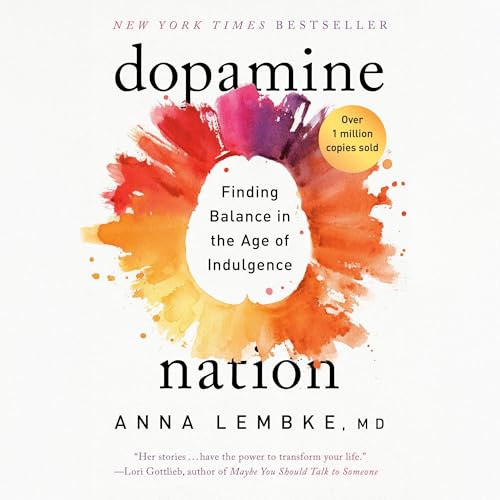
Audiobook Details
| Title | Dopamine Nation |
|---|---|
| Author | Anna Lembke, MD |
| Narrator | Anna Lembke MD |
| Genre | Psychology |
| Year | 2023 |
| Publisher | Penguin |
| Abridged | Unabridged |
| Cast | Single narrator |
| Author-narrated | Yes |
Ready to listen?
Dopamine Nation is available on Audible and is a reasonable choice for a free trial credit, particularly if you want to listen through the case study sections during a commute or routine task.
Open on Audible