About the Book
Neuromancer is William Gibson's 1984 debut novel and the book that effectively defined the cyberpunk genre. Set in a near-future world of corporate sprawl, black-market body modification, and a globally networked virtual reality called the Matrix, it follows Henry Dorsett Case, a washed-up data thief whose nervous system has been deliberately damaged, leaving him locked out of the cyberspace he once navigated with ease. When a mysterious new employer offers to repair the damage in exchange for one final job, Case finds himself pulled back into a world of high-stakes digital espionage alongside a street-samurai named Molly.
The central run Case and Molly are tasked with is aimed at an artificial intelligence of enormous power, and the plot moves fast, accumulating layers of corporate conspiracy, identity confusion, and technological menace as it goes. Gibson's world-building is dense and delivered largely through implication rather than exposition. He drops readers into the deep end and trusts them to keep up, which is part of what made the book so influential and also what makes it genuinely challenging on first read.
This is the foundational text for cyberpunk as a genre. It won the Hugo, Nebula, and Philip K. Dick Awards in 1985, the first novel ever to win all three, and its influence on science fiction, film, and internet culture is difficult to overstate. The Penguin audiobook edition (2016) accompanies the Penguin Galaxy hardcover release.
Narration & Audio Performance
Robertson Dean is an experienced audiobook narrator with a wide catalog across fiction and non-fiction. His delivery here is measured and controlled, he keeps a consistent pace through Gibson's famously dense prose without over-dramatizing or leaning into affectation. That restraint is mostly the right call for this material.
Where Dean's narration earns credit is in handling Gibson's fragmented, hyper-stylized sentences. The prose can feel deliberately disorienting on the page; Dean's steady rhythm helps listeners orient themselves even when the content is abstract or technically layered. Character differentiation is present but not especially distinct, voices are shaped more by tone and cadence than by strong individual characterization. That's a reasonable trade-off given how much of the novel lives in internal monologue and world-description rather than dialogue.
One honest caveat: Neuromancer's prose style is genuinely dense, and the audiobook format amplifies that. When Gibson piles up neologisms, jargon, and fragmented imagery in quick succession, audio gives you no chance to slow down or re-read a sentence. Listeners new to Gibson may find themselves lost in a way that flipping back a page would have prevented. The Audible sample is worth checking before committing, Dean's style suits the material, but whether the audio format suits this particular book depends on the listener.
The Audible Verdict
Dean's narration is technically competent and well-suited to Gibson's tone, but Neuromancer is one of the denser, more challenging texts in genre fiction. The prose style, compressed, jargon-heavy, deliberately disorienting, is harder to track in audio than on the page. If you've already read the novel and want to revisit it, the audiobook works well. If this is your first time with Gibson, you may want to try the sample and honestly assess whether you're ready to absorb it purely by ear.
Listen on AudibleIs This Book a Good Fit for Audio?
Neuromancer is a linear narrative in structure, which works in audio's favor. There are no charts, diagrams, or footnotes pulling you away from the story, and the plot moves forward consistently without the non-linear fragmentation that makes some literary fiction hard to follow in audio form.
The complication is Gibson's prose style itself. The novel's language is intentionally alien, it invents terminology, compresses ideas, and withholds explanations in ways that reward close reading. On the page, readers can pause, re-read, and let the vocabulary accumulate over time. In audio, you move at the narrator's pace. Listeners who are already familiar with cyberpunk as a genre, or who have read Neuromancer before, will likely follow along without friction. First-time Gibson readers might find audio a genuinely harder entry point than print.
For re-listens or for those already comfortable in the genre, this is a solid audio experience. For newcomers, the print version probably gives you a better chance of actually following what's happening.
Popular Listener Questions
Is this audiobook unabridged?
The metadata does not confirm abridgement status. Check the Audible product page before purchasing if this matters to you.
Is Neuromancer part of a series?
Neuromancer is the first book in Gibson's Sprawl trilogy, followed by Count Zero and Mona Lisa Overdrive. It reads as a standalone, the sequels are set in the same world but follow different characters.
Is this suitable for listeners new to cyberpunk?
It depends on your tolerance for being dropped into unfamiliar territory. Gibson doesn't ease you in, he expects you to absorb the world through context. New cyberpunk readers can handle it, but the print version may be a gentler entry point than audio.
Who narrates this audiobook?
Robertson Dean narrates this edition. He is a professional audiobook narrator with a broad catalog; his delivery here is calm and controlled, which suits Gibson's detached, stylized prose.
Similar Audiobooks
Count Zero
The direct sequel to Neuromancer, set in the same Sprawl universe. If the first book works for you in audio, this is the natural next listen.
Neal Stephenson's 1992 novel covers overlapping territory, virtual reality, corporate dystopia, hacker culture, and is often cited alongside Neuromancer as a defining cyberpunk text. Generally considered slightly more accessible on first read.
Do Androids Dream of Electric Sheep?
Philip K. Dick's novel shares Neuromancer's interest in artificial intelligence, identity, and the blurring line between human and machine. Audiobook editions are widely available.
The Peripheral
Gibson's 2014 novel shows how his style evolved over three decades, still dense, still prescient, but with a slightly more accessible narrative structure. A good companion listen for those who connect with Neuromancer.
Burning Chrome
This collection of Gibson's short stories includes early work that prefigures Neuromancer's world and characters. Useful context for listeners wanting to understand where the novel came from.
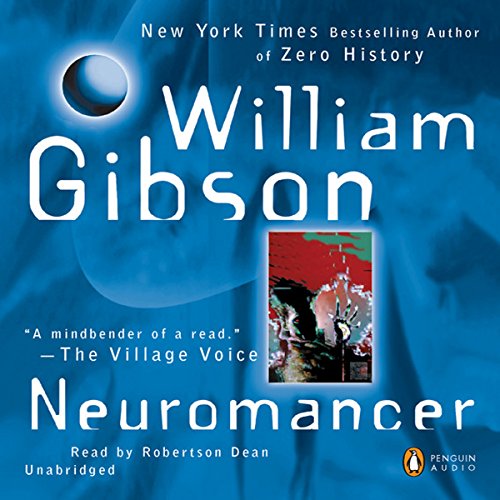
Audiobook Details
| Title | Neuromancer |
|---|---|
| Author | William Gibson |
| Narrator | Robertson Dean |
| Genre | Cyberpunk Science Fiction |
| Year | 2016 |
| Publisher | Penguin |
| Abridged | Unabridged |
| Cast | Single narrator |
| Author-narrated | No |
Ready to listen?
Neuromancer is available on Audible, if you're unsure about audio for this one, the free trial credit is a low-risk way to find out whether Dean's narration works for you.
Open on Audible