About the Book
Nuclear War: A Scenario is a non-fiction book by investigative journalist Annie Jacobsen that walks through, minute by minute, what would happen if a nuclear missile were launched toward the United States. Rather than covering the history of nuclear weapons in broad strokes, Jacobsen structures the book as a real-time scenario, a single incoming missile and the cascade of decisions, systems, and failures that would follow in the 72 minutes before impact and beyond.
The book draws on interviews with military officials, nuclear scientists, policy experts, and former government insiders. Jacobsen covers launch detection systems, the decision chain that reaches the President, the mechanics of retaliation, and what happens to civilian infrastructure, communications, and human life. The scenario format is deliberate, it forces the material to stay concrete rather than abstract, turning what could be a policy-heavy slog into something closer to a procedural.
Published in 2024, it landed on the New York Times bestseller list immediately and was shortlisted for the Baillie Gifford Prize, which is awarded to non-fiction that enriches public understanding of the world. It sits alongside a small tradition of deep-access nuclear journalism, the kind of book that takes readers inside the architecture of systems most people assume they don't need to think about.
Narration & Audio Performance
Jacobsen narrates her own work here, which tends to be either a significant advantage or a mild liability depending on the author. In this case it works. Her delivery is measured and controlled, she doesn't editorialize with her voice, which is the right call for material this serious. The pacing reflects the book's structure: calm and methodical during the background sections, more clipped and urgent as the scenario accelerates through its timeline.
Her voice is clear and easy to follow over long sessions. She doesn't attempt character voices for the officials and experts she quotes, which keeps the narration consistent but means the transitions between reported speech and analysis rely entirely on your attention to context. That's a minor friction point in a dense book, but not a dealbreaker.
Production quality is clean and professional, as expected from a Penguin release with a high-profile title. There are no distracting audio artifacts reported. If you've listened to any of Jacobsen's previous audiobooks, Area 51, Operation Paperclip, The Pentagon's Brain, her narration style here is consistent with those, so prior familiarity is a reasonable guide.
The Audible Verdict
The audiobook is a solid listen and Jacobsen's narration suits the material, but this is a book where the print version has real advantages, particularly for readers who want to revisit specific sections, follow up on sourcing, or absorb the book's more technical passages at their own pace. The audio format works, but it doesn't add anything the print version lacks. For listeners who prefer to consume long-form journalism on the go rather than at a desk, a free trial credit is a fair use here.
Listen on AudibleIs This Book a Good Fit for Audio?
The scenario format that Jacobsen uses is genuinely well-suited to audio. The 72-minute countdown structure gives the book a linear, forward momentum that plays well when you're listening rather than reading. It doesn't require you to flip back to earlier chapters or cross-reference maps, which is a common problem with military and policy non-fiction.
That said, the book does include substantial sourcing and references that you simply cannot access in audio form. Jacobsen's journalism is heavily documented, and readers who want to follow the trail of her claims will find that the print or ebook version gives them something the audio doesn't. For a book about a topic this consequential, that matters to some listeners more than others.
Overall, if your goal is to understand the scenario and its implications, and you're comfortable processing dense reported information by ear, the audiobook is a reasonable way to take this in. If you expect to read critically or want to engage with the sourcing, the print version is the better tool.
Popular Listener Questions
Is this book author-narrated?
Yes. Annie Jacobsen narrates the audiobook herself. Her delivery is calm and direct, consistent with her narration on her previous titles.
Is Nuclear War part of a series?
No. It's a standalone book. However, Jacobsen has written several other non-fiction books on related topics, military programs, intelligence, and national security, that cover adjacent ground.
Is this a history book or more of a speculative scenario?
It's both. The scenario itself is hypothetical, but it's built entirely from documented real-world systems, protocols, and expert testimony. It reads more like serious investigative journalism than speculation.
Who is this book best suited for?
Readers interested in nuclear policy, Cold War infrastructure, or military journalism will find the most value here. It's written for a general audience rather than specialists, so no prior knowledge of nuclear weapons or military protocol is required.
How does this compare to Jacobsen's other audiobooks?
If you've listened to Area 51 or Operation Paperclip, the narration style and journalistic approach are similar. Nuclear War is more tightly structured around a single scenario, which makes it feel more urgent and focused than her broader historical surveys.
Similar Audiobooks
The Dead Hand
David Hoffman's Pulitzer Prize-winning account of the nuclear arms race covers the same infrastructure and decision-making systems from a historical angle. Good companion listen for anyone who wants the Cold War context behind Jacobsen's scenario.
Area 51
Jacobsen's earlier deep-access investigation into classified military programs. Same narration style, same journalistic approach. If you like how she handles this material, that book transfers directly.
Command and Control
Eric Schlosser's investigation into nuclear weapons accidents and safety failures in the US arsenal. Covers the technical and institutional vulnerabilities that Jacobsen's scenario depends on. Dense but well-documented.
Operation Paperclip
Another Jacobsen title narrated by the author. Covers the US government's post-WWII recruitment of Nazi scientists, including those involved in weapons development. Consistent quality and format.
The Bomb
Fred Kaplan's account of the history of US nuclear war planning covers the policy decisions and institutional logic that Jacobsen's scenario puts under pressure. Useful for readers who want the strategic history alongside the real-time scenario.
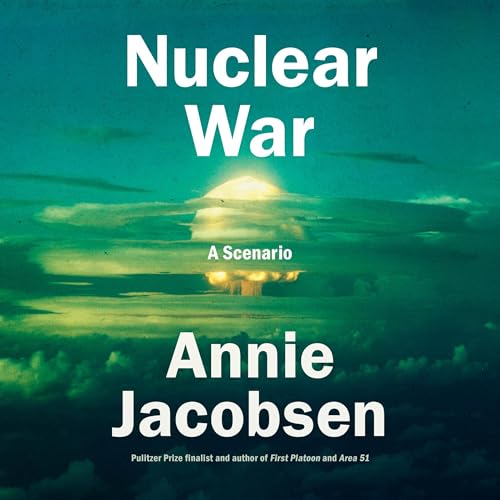
Audiobook Details
| Title | Nuclear War |
|---|---|
| Author | Annie Jacobsen |
| Narrator | Annie Jacobsen |
| Genre | Military & National Security Journalism |
| Year | 2024 |
| Publisher | Penguin |
| Abridged | Unabridged |
| Cast | Single narrator |
| Author-narrated | Yes |
Ready to listen?
Nuclear War is available on Audible and is a reasonable choice for a free trial credit, particularly for listeners who follow long-form military or policy journalism. The author narration holds up well over the course of the book.
Open on Audible