About the Book
The 48 Laws of Power is a self-help and strategy book by Robert Greene, first published in 1998 and released on audio in 2000. The book distills patterns of power, manipulation, and political maneuvering drawn from historical figures, Machiavelli, Cardinal Richelieu, P.T. Barnum, Henry Kissinger, into 48 discrete laws, each illustrated with historical examples and cautionary tales about those who violated them.
The tone is deliberately cold and amoral. Greene isn't prescribing a moral code, he's describing how power actually operates, drawing on three thousand years of recorded history. Each law is structured the same way: the law stated plainly, historical examples, an interpretation, and a section on how to reverse or defend against the law. That rigid, encyclopedic structure is central to how the book works.
This is not a book with a narrative arc. It doesn't build toward a conclusion. You can read Law 15 without having read Law 7. That matters a great deal when evaluating the audio format.
Narration & Audio Performance
Richard Poe is an experienced audiobook narrator with a deep, steady voice that suits the book's authoritative and clinical tone. He reads with gravitas and doesn't oversell the material, the prose already does that on its own. Poe's pacing is measured and deliberate, which works for the denser historical passages.
The narration doesn't present major problems in terms of clarity or delivery. Poe handles the variety of historical names and contexts without stumbling, and there's no obvious inconsistency across the recording. That said, this is a narration that does its job without being particularly notable. Listeners who find Greene's style cold on the page will find it equally cold here, Poe reflects rather than elevates the material.
If the narration quality is your primary concern, the Audible sample is worth checking before committing.
The Audible Verdict
The 48 Laws of Power is structured as a reference book, not a linear read. Each of the 48 laws functions as a self-contained entry with sub-sections, historical examples, reversals, and interpretation. In audio, that structure flattens, you lose the ability to skim, flip back, cross-reference, or pause on a passage and actually think. The print edition also includes historical artwork and visual design that are part of the experience. Richard Poe's narration is solid, but no narrator can compensate for a format mismatch this significant. If you're buying this for the first time, the physical or ebook edition will serve you better.
Listen on AudibleIs This Book a Good Fit for Audio?
The 48 Laws of Power has a structure that actively resists the audio format. Each law is a discrete, multi-part unit, stated rule, historical examples, interpretation, reversal, and the book is explicitly designed to be navigated non-linearly. Most readers return to specific laws for reference rather than listening or reading cover to cover. Audio makes that kind of use nearly impossible.
The book is also dense with proper nouns: historical figures, courts, battles, and political maneuvers spanning multiple centuries and cultures. In print, you can slow down, re-read a sentence, or look something up. In audio, a listener who misses a name or loses the thread of a historical example has to rewind and re-listen, which becomes tedious across 48 laws.
There is one case where the audio version makes sense: if you've already read the print edition and want to revisit the material passively, during a commute or workout, the audio works reasonably well as a refresher. For a first encounter with the book, it's not the right format.
Popular Listener Questions
Is this the author-narrated version?
No. Robert Greene does not narrate this audiobook. Richard Poe provides the narration.
Can you listen to The 48 Laws of Power out of order?
Technically yes, but the audio format makes this difficult in practice. In print, skipping to a specific law is easy. In audio, finding a specific law requires manually scrubbing through the recording, which most listeners will find frustrating.
Is this book appropriate for someone new to Robert Greene's work?
Yes, it's the book Greene is best known for, and it doesn't require prior familiarity with his other titles. That said, the tone is deliberately cold and amoral, which surprises some readers expecting conventional self-help advice.
Is there a shorter or abridged version available?
Greene also published The Concise 48 Laws of Power, a significantly trimmed version of the original. If you want a shorter audio experience, that edition may be worth checking separately on Audible.
Similar Audiobooks
The Laws of Human Nature
Robert Greene's follow-up work applies a similar historical case-study method to understanding and influencing human behavior. Shares the same analytical, amoral tone.
Mastery
Another Greene title narrated with the same structural approach, historical figures used to illustrate principles. Listeners who engage with the audio of 48 Laws will find Mastery familiar in format.
The Art of War
Greene draws directly on Sun Tzu throughout 48 Laws. The audiobook version of The Art of War is short and works well in audio, making it a useful companion.
The Prince
Machiavelli is a direct source for Greene's framework. The audiobook of The Prince is brief and pairs naturally with 48 Laws for anyone interested in the historical roots of power strategy.
Influence: The Psychology of Persuasion
Cialdini's book covers persuasion and social power from a psychology angle. It's a more linear read than 48 Laws, and the audio format actually suits it better.
The 33 Strategies of War
Another Robert Greene title using the numbered-laws format and historical case studies. Listeners who want more Greene after 48 Laws typically go here next.
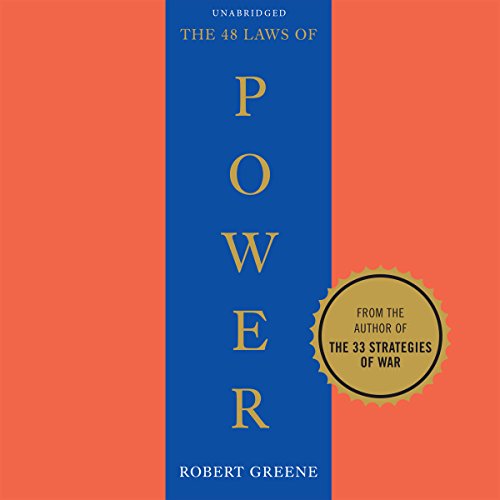
Audiobook Details
| Title | The 48 Laws of Power |
|---|---|
| Author | Robert Greene |
| Narrator | Richard Poe |
| Genre | Strategy & Power |
| Year | 2000 |
| Publisher | Penguin |
| Abridged | Unabridged |
| Cast | Single narrator |
| Author-narrated | No |
Ready to listen?
The 48 Laws of Power is available on Audible, though the print edition is the more practical choice for most readers. If you want to use a free trial credit on a Robert Greene title, this one or Mastery are the natural starting points.
Open on Audible