About the Book
The Almanack of Naval Ravikant is a curated collection of ideas, interviews, and reflections from entrepreneur and investor Naval Ravikant, compiled by Eric Jorgenson. The book is organized around two broad themes: building wealth and achieving happiness. Rather than presenting a step-by-step framework, it assembles Naval's thinking across a decade of interviews, tweets, and conversations into something closer to a philosophy of living and working.
Naval's core arguments center on the idea that both wealth and happiness are learnable skills rather than fixed outcomes. On wealth, he emphasizes specific knowledge, leverage, and equity over trading time for money. On happiness, he draws from Stoic and Eastern philosophical traditions, arguing it's largely a matter of choosing how you interpret your circumstances. Neither topic is argued at length in any single passage, the book reads more like a collection of principles and observations than a traditional business book.
This is not a narrative book. There is no story, no character arc, no linear argument that builds from chapter to chapter. It reads more like a curated transcript, which is exactly what much of it is. That structure has implications for how well it translates to audio, which are addressed below.
Narration & Audio Performance
Vikas Adam handles the material cleanly. His delivery is measured and unhurried, which suits a book that's designed to be read slowly rather than absorbed in bulk. The prose, largely aphorisms, short reflections, and interview excerpts, benefits from a calm, deliberate read, and Adam doesn't oversell the content with artificial gravitas.
The main limitation here isn't the narrator but the format. The book frequently shifts between Naval's direct words, Jorgenson's framing, and quoted interviews. In print, this is easy to follow visually. In audio, the transitions between voices and contexts can blur without visual cues. Adam doesn't use dramatically different registers for these shifts, which keeps the tone consistent but can occasionally make it harder to track who is speaking.
Production quality is standard for a Simon and Schuster release, clean audio, no distracting background noise or editing issues. If you're uncertain whether Adam's style suits you, the Audible sample is worth checking before committing.
The Audible Verdict
The audiobook is a serviceable way to take in Naval's ideas, and Vikas Adam narrates without any obvious problems. But the book's non-linear, aphoristic structure means you lose the ability to scan, re-read a passage, or quickly return to a specific idea, all things that matter more with this type of content than with narrative nonfiction. It's worth a free trial credit, but most readers who engage seriously with the material will probably want the print version alongside it.
Listen on AudibleIs This Book a Good Fit for Audio?
Books built around aphorisms and short reflections present a specific challenge in audio: the format works best when you can pause, sit with a line, and re-read it. Audio doesn't naturally accommodate that. You can pause a recording, but you can't skim back to a phrase the way you'd flip back a page, and the lack of chapter-level structure means navigation is harder than with a linear book.
That said, the content here is not technical, no charts, no data tables, no footnotes that require visual reference. The ideas are expressed in plain language and short bursts, which does translate reasonably well to listening. If you're planning to use it as ambient listening during commutes or exercise, it works. If you're hoping to use it as a reference you return to repeatedly, the print or ebook version will serve you better.
Listeners who have already read the book and want a second pass in audio form may find the format more useful than first-time readers, familiar material is easier to follow without the visual scaffolding.
Popular Listener Questions
Is this the same content as the original self-published edition?
The original Almanack was self-published by Eric Jorgenson and available for free online. This 2025 Simon and Schuster edition is a commercial release of the same core material. The substantive content is the same, though the publisher may have updated or expanded it.
Is the audiobook narrated by Naval Ravikant himself?
No. The audiobook is narrated by Vikas Adam, a professional narrator. Naval Ravikant did not narrate this edition.
Can this be listened to without any prior knowledge of Naval Ravikant?
Yes. The book doesn't assume familiarity with Naval's background. Jorgenson provides context throughout, so new listeners can follow the ideas without needing to know his prior work.
Is this book better suited to audio or print?
Print or ebook is likely the better primary format for most readers. The aphoristic, non-linear structure rewards re-reading and annotation more than continuous listening. Audio works as a supplement or for casual listening.
Does the book cover business strategy in a practical, actionable way?
Not in a step-by-step sense. Naval's approach is philosophical, focused on mental models and principles rather than tactics. Readers expecting a business framework or productivity system will find it more abstract than that.
Similar Audiobooks
Poor Charlie's Almanack
Another almanack-style collection of a notable investor's wisdom, curated and compiled by a third party rather than written as a traditional book.
The Courage to Be Disliked
Covers Adlerian psychology through dialogue, like Naval's work, it approaches happiness as a learnable orientation rather than a fixed personality trait.
Peter Thiel's book shares Naval's interest in contrarian thinking about wealth creation and building things that matter. Readers drawn to Naval's entrepreneurial philosophy often read this alongside it.
The Bed of Procrustes
Nassim Taleb's collection of aphorisms is structurally similar to Naval's, short, standalone observations rather than continuous argument. Audio listeners who enjoy one often appreciate the other.
Skin in the Game
Taleb and Naval share overlapping ideas about incentives, risk, and how to think clearly about uncertainty. Readers engaged with Naval's worldview frequently cite Taleb as adjacent reading.
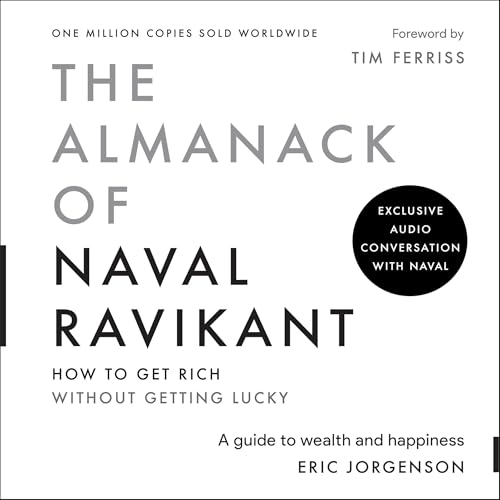
Audiobook Details
| Title | The Almanack of Naval Ravikant |
|---|---|
| Author | Eric Jorgenson |
| Narrator | Vikas Adam |
| Genre | Personal Development |
| Year | 2025 |
| Publisher | Simon and Schuster |
| Abridged | Unabridged |
| Cast | Single narrator |
| Author-narrated | No |
Ready to listen?
The Almanack of Naval Ravikant is available on Audible and is a reasonable choice for a free trial credit, particularly if you want to sample the ideas before committing to the print version.
Open on Audible