About the Book
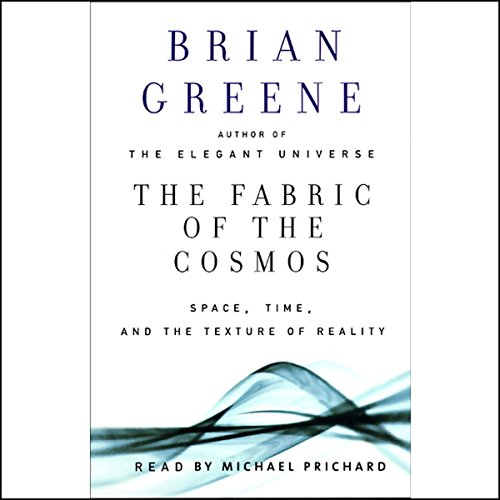
The Fabric of the Cosmos is Brian Greene's follow-up to The Elegant Universe, published in 2004. Where The Elegant Universe focused primarily on string theory, this book casts a wider net, covering the nature of space and time, quantum mechanics, cosmology, and what physicists mean when they talk about the structure of reality itself. Greene is a theoretical physicist at Columbia, and this is a serious work of popular science aimed at general readers with no assumed background in physics.
The book moves through a sequence of big questions: What is space, and is it a real thing or just the absence of objects? What is time, and why does it seem to move in only one direction? How do quantum entanglement and the uncertainty principle challenge our everyday intuitions about cause and effect? What does modern cosmology say about the shape and origin of the universe? Greene spends considerable time on topics like entropy, the arrow of time, inflationary cosmology, and the possibility of a holographic universe.
At over 500 pages in print, this is a long and dense book. Greene uses analogies extensively to explain concepts that are genuinely difficult, and the print edition includes 146 illustrations that support those explanations. That detail is relevant when deciding whether audio is the right format here.
Narration & Audio Performance
Michael Prichard is a veteran audiobook narrator with a long track record in non-fiction, and his work here is clean and professional. His voice is authoritative without being stiff, he reads Greene's prose at a measured pace that suits the material and avoids the breathless enthusiasm some science narrators bring to this kind of content. Clarity is not an issue; Prichard is easy to follow over long sessions.
The challenge with this audiobook has less to do with Prichard and more to do with the source material. Greene's analogies are detailed, and several of them build on visual scaffolding, diagrams, spacetime graphs, illustrations of quantum states, that simply don't exist in the audio version. When Greene writes something like "as shown in Figure 4," the listener is left to reconstruct a mental image from description alone. Prichard handles this as well as any narrator could, but some passages require more concentration to follow in audio than they would on the page.
If you're on the fence, the Audible sample is worth checking. Prichard's pacing and tone are consistent throughout, so a few minutes of the sample will give you an accurate read on whether his delivery works for you.
The Audible Verdict
The narration is solid, but whether this audiobook works for you depends heavily on how you handle abstract physics explained without visual support. The 146 illustrations in the print edition exist for a reason, several of Greene's core arguments are built around them. If you have prior familiarity with the topics (special relativity, quantum mechanics, cosmology), the audio version is a reasonable way to revisit the material. If this is your first encounter with these ideas, the print version will likely serve you better. Listen to the sample to gauge how Prichard's pacing sits with you before committing a credit.
Listen on AudibleIs This Book a Good Fit for Audio?
The Fabric of the Cosmos is a mixed case for audio. On the positive side, Greene is a skilled explainer who writes in clear prose, and the book follows a broadly linear structure, each chapter builds on the previous one rather than jumping between unrelated topics. The conversational tone of popular science generally works well when read aloud, and Prichard's delivery keeps the material moving.
The problem is the visual component. The print edition includes 146 diagrams, and several of them are load-bearing, they illustrate spacetime diagrams, quantum probability distributions, and cosmological models that would take multiple paragraphs to describe in words alone. Audio strips those out entirely. Greene does work to verbalize these concepts, but some passages, particularly those dealing with quantum mechanics and the geometry of spacetime, ask the listener to hold more in working memory than the page version would require. This is manageable if you're already comfortable with the broad outlines of the physics. It's harder if you're encountering these ideas for the first time.
Popular Listener Questions
Is this book related to The Elegant Universe?
Yes. The Fabric of the Cosmos is Brian Greene's second major popular science book. The two books are independent, you don't need to have read The Elegant Universe first, but they share similar scope and style, and readers who enjoyed one typically find the other accessible.
Do you need a physics background to follow this audiobook?
No formal background is required, but some familiarity with basic physics concepts will help. Greene explains everything from the ground up, but the audio version removes the diagrams, which means some of the more abstract sections require closer attention than the print version would.
Is this the same as the PBS documentary series?
The PBS Nova series The Fabric of the Cosmos is based on this book. The series covers similar ground but is a separate production. The audiobook is the full text of the 2004 book.
Is this audiobook narrated by the author?
No. Brian Greene does not narrate this edition. The narrator is Michael Prichard, a professional audiobook narrator.
Similar Audiobooks
Brian Greene's first major popular science book, covering string theory and extra dimensions. Very similar scope, style, and level of accessibility, the natural companion to The Fabric of the Cosmos.
Stephen Hawking's overview of cosmology and theoretical physics covers overlapping territory, space, time, and the nature of the universe, at a similar level of accessibility for general readers.
Something Deeply Hidden
Sean Carroll's popular account of quantum mechanics tackles some of the same foundational physics Greene covers, with a similar emphasis on making difficult concepts legible to non-specialists.
The Order of Time
Carlo Rovelli's short book on the nature of time covers territory Greene addresses in depth. It's a much shorter listen and the audio version translates better than most physics books in this category.
Surely You're Joking, Mr. Feynman!
Readers drawn to Greene's accessible approach to serious physics often find Feynman's memoir a natural companion, lighter in tone but written by someone thinking at the same level.
Audiobook Details
| Title | The Fabric of the Cosmos |
|---|---|
| Author | Brian Greene |
| Narrator | Michael Prichard |
| Genre | Popular Science |
| Year | 2004 |
| Publisher | Knopf |
| Abridged | Unabridged |
| Cast | Single narrator |
| Author-narrated | No |
Ready to listen?
The Fabric of the Cosmos is available on Audible and is a reasonable choice for a free trial credit, particularly if you have some prior familiarity with the physics. If you're new to the subject, consider checking the sample before committing.
Open on Audible