About the Book
Think and Grow Rich is Napoleon Hill's 1937 personal success manual, built around interviews and case studies of wealthy industrialists from the early twentieth century, figures like Andrew Carnegie, Henry Ford, and Thomas Edison. Hill distills his observations into a set of principles he argues are common to financial success, covering mindset, goal-setting, persistence, and what he calls the "mastermind" concept of collaborative thinking.
The book sits at the foundation of the modern self-help genre. Whether you find it useful or dated depends largely on your tolerance for early twentieth-century writing conventions and Hill's rather confident tone. The core ideas are simple enough: desire, belief, and persistent action are treated as prerequisites for accumulating wealth. The framework is loose by contemporary standards, there's more philosophy than method here.
It's worth noting this is a product of its era. Some content reflects attitudes common in 1937 that don't hold up well today. Readers coming to it for the first time should approach it as a historical artifact in the self-help lineage rather than a modern how-to guide.
Narration & Audio Performance
Erik Synnestvedt narrates in a measured, deliberate style that suits the book's formal, slightly old-fashioned prose. His pacing is steady and his enunciation is clear, which matters here, Hill's writing is dense with rhetorical flourishes and repeated emphasis, and a rushed delivery would make the content harder to absorb.
Synnestvedt doesn't dramatically differentiate voices or use theatrical range; this is a straight read, not a performance. For a book that is essentially one long argument rather than a narrative, that approach is appropriate. He keeps consistent energy across what is a long text, avoiding the flatness that plagues some classic-text recordings.
Production quality from Aldo Press is functional. If you're unsure whether Synnestvedt's tone works for you, he can come across as slightly stiff to some listeners, the Audible sample is worth checking before committing.
The Audible Verdict
Think and Grow Rich is a historically significant book, and the Synnestvedt recording is a competent version of it. The audio format works for this material, it's a linear argument you can absorb passively, and the narration is clear enough to follow during commutes or walks. That said, this isn't a case where the audio adds something the print version lacks. If you already own a copy or can borrow it easily, the audiobook doesn't offer a meaningfully different experience. Use a free trial credit rather than a paid one.
Listen on AudibleIs This Book a Good Fit for Audio?
Think and Grow Rich is structured as a linear series of principles with illustrative anecdotes, which translates reasonably well to audio. There are no charts, diagrams, or exercises that require you to look at the page, and the prose, while occasionally dense, doesn't require the kind of close reading that makes some non-fiction difficult to follow in audio form.
The main limitation is that Hill's writing is repetitive by design, he circles back to the same ideas across chapters, often in similar language. In print, you can skim. In audio, you sit through each pass. For listeners who find the repetition motivating rather than frustrating, this isn't a problem. For listeners who prefer efficiency, it can drag.
Overall, this is a reasonable audio choice for a long drive or a workout playlist, where the slower, more reflective pacing of the narration actually suits the format well.
Popular Listener Questions
Is this the full, unabridged version of the book?
The metadata does not confirm whether this edition is abridged or unabridged. Check the Audible product page or sample before purchasing if this matters to you, the full 1937 text runs to roughly 230 pages in print.
Is Think and Grow Rich part of a series?
No. It is a standalone title, though Hill wrote other books including The Law of Success, which covers similar ground in greater detail.
Who is this book most useful for?
Listeners new to the self-help genre who want to understand where many modern ideas about mindset and success originate. It's also useful for anyone who studies the history of American business philosophy. It's less useful if you're looking for a structured, actionable framework, the book is more philosophical than practical.
Is the content dated?
Yes, in places. The book was written in 1937 and reflects the social attitudes of that period. The core principles Hill advocates are still widely referenced, but some framing and examples won't resonate with contemporary readers.
Similar Audiobooks
The Law of Success
Hill's earlier and more expansive work covering the same philosophical framework in greater depth. A natural next listen if Think and Grow Rich resonates.
How to Win Friends and Influence People
Dale Carnegie's 1936 classic sits alongside Think and Grow Rich as a founding text of the self-help genre. Similar tone, similar vintage, similar appeal.
The Richest Man in Babylon
George Clason's 1926 personal finance parables share Think and Grow Rich's focus on wealth-building principles and work well in audio format.
Outwitting the Devil
A posthumously published Napoleon Hill title that covers mindset and self-mastery. Listeners who engage with Hill's voice will find it familiar territory.
As a Man Thinketh
James Allen's short essay on the relationship between thought and circumstance is a direct philosophical ancestor to Hill's ideas. Short enough to pair with Think and Grow Rich in a single listening session.
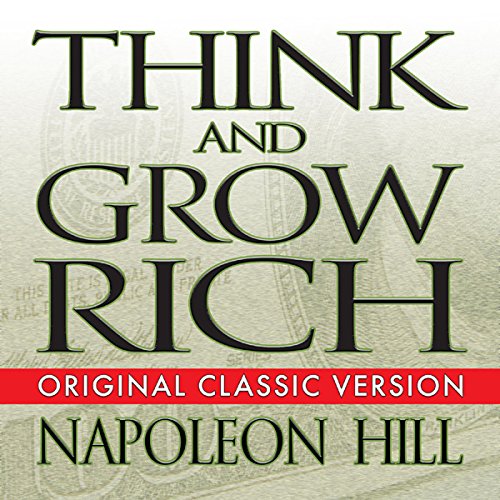
Audiobook Details
| Title | Think And Grow Rich |
|---|---|
| Author | Napoleon Hill |
| Narrator | Erik Synnestvedt |
| Genre | Self-Help |
| Publisher | Aldo Press |
| Abridged | Unabridged |
| Cast | Single narrator |
| Author-narrated | No |
Ready to listen?
Think and Grow Rich is available on Audible and is a reasonable choice if you have a free trial credit to use. It holds up as an audio listen for commutes or passive sessions.
Open on Audible