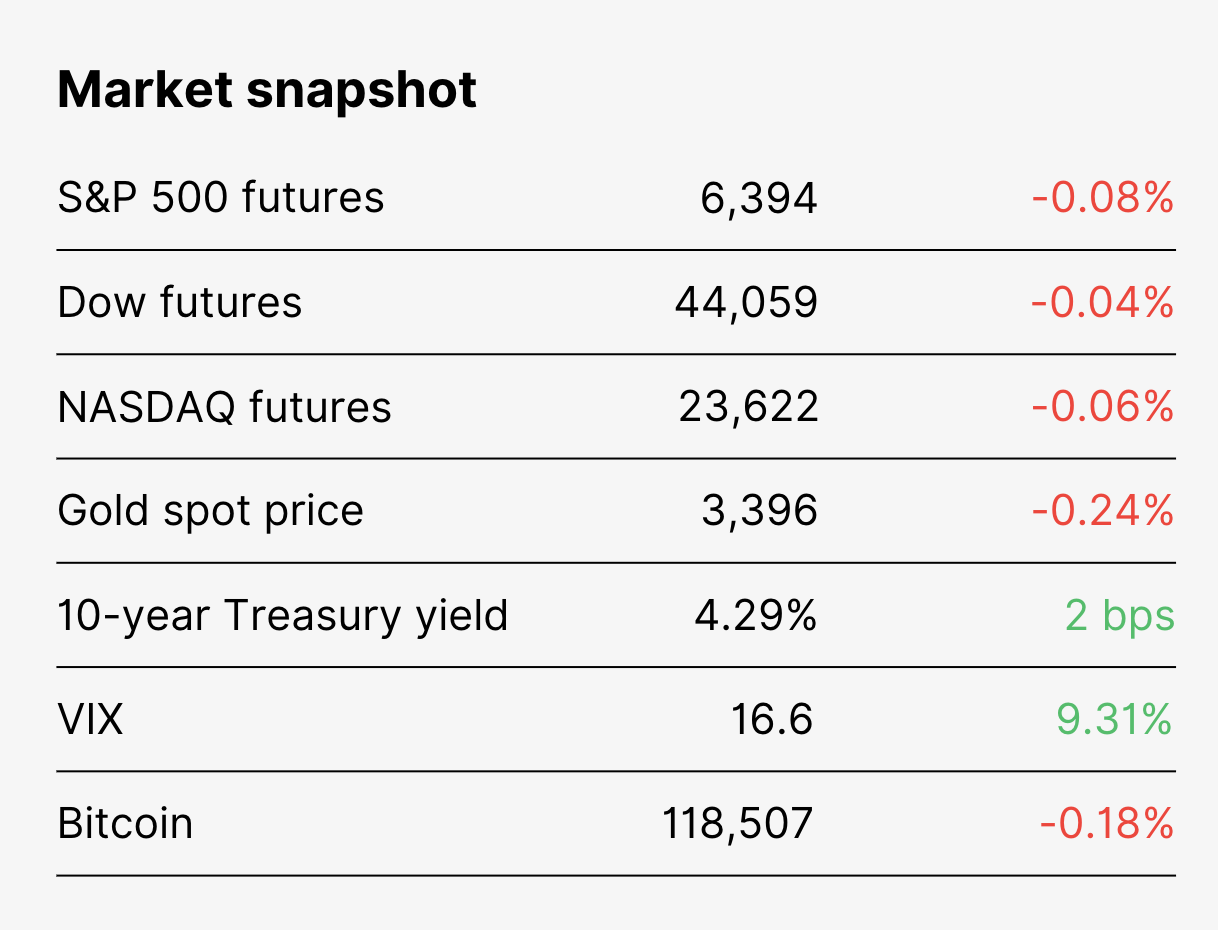
| | Good morning, Wall Street is waking up to a trade truce that just got China another 90-day extension, but Wells Fargo is already warning about the toll on importers. Over in commodities, lithium prices are ripping after China shut down a mine that feeds 6% of global supply, soybeans popped on a Trump demand tweet, and oil’s stuck in limbo ahead of his “feel-out” summit with Putin in Alaska. Meanwhile, Micron’s strong AI demand outlook boosted chip stocks, and Intel’s CEO scored a White House invite after a very public spat. And while earnings season was strong enough to push some S&P 500 targets to all-time highs, more than 90% of fund managers still think this market is too expensive. That’s a setup I like to call “FOMO bullish.” Let’s dig in.
| | | | | Hang tight, Dan Runkevicius, Chief Editor | |  | | | | | "The initial effect of tariffs on consumer goods prices has been blunted by some pull-forward of inventories and reluctance among businesses to immediately pass on higher costs with tariff rates not yet settled. Yet, the toll on U.S. importers is becoming clearer." — Wells Fargo economists led by Sarah House | | | | | Six things to know before opening bell | | |
🇺🇸 Trump hits snooze on China tariffs Trump just extended the pause on tariffs for Chinese goods another 90 days, pushing the truce through Nov. 10 and shelving a hike set for Tuesday. The de-escalation dates back to when Washington and Beijing agreed to dial back tit-for-tat hikes and loosen export restrictions on rare earth magnets and other tech. ⚡ Lithium rips on China mine shutdown Lithium prices surged after China shut down a mine supplying roughly 6% of global output, following the expiration of its license. The move targeted CATL — one of China’s battery giants — and has traders worried Beijing could hit other operations next. 🌱 Trump tweet boosts soybeans Soybean futures spiked after Trump posted that China is “worried” about shortages and should “quadruple” its US orders. The comment fed hopes of bigger agriculture exports, even without a formal trade deal on the table. 💸 Tariff costs heading for shoppers Companies can only swallow so much of Trump’s tariff bill before passing it on. JPMorgan’s Meera Pandit pegs consumer pass-through at ~60% for now, but Yale’s Ernie Tedeschi says it could hit 80–90% within months. Translation: more sticker shock ahead. 📉 BofA trims rate outlook Bank of America (BofA) cut its year-end yield forecasts to 3.5% for two-year Treasuries and 4.25% for 10-years, both down 25 bps from prior estimates. BofA strategists bank on weak labor data and political pressure on the Fed, which, they warn, could tolerate higher inflation and keep rates lower for longer. 📊 CPI could bring fresh bout of inflation Tomorrow’s CPI is expected to tick up 0.1–0.2%, pushing annual inflation to its highest since February. That’s still unlikely to sway the Fed from a September cut, with nearly 90% of traders betting on it. Pantheon Macroeconomics chief economist Samuel Tombs said the report probably won’t change the easing calculus. | | | | 🖥️ Chips start the week sizzling
| | | | The Nasdaq may have ended Monday fractionally lower, but don’t blame the chipmakers. The sector came out swinging, with several headlines driving early-week gains. 📈 Micron’s AI demand upgrade Micron Technology lit up the tape after hiking its fiscal Q4 non-GAAP revenue forecast by roughly $500 million and bumping EPS expectations from $2.50 to $2.85. The company also dropped a jaw-dropping $200 billion plan to expand U.S. manufacturing and R&D over multiple decades. Micron's chief business officer Sumit Sadana flagged AI as a major growth engine. “As you see some compelling user applications leveraging AI rolling out over the next year, and then accelerating from there over the next two, three years, you’ll see some significant upgrades happening,” he said. 🏛 Intel’s CEO gets a White House invite Last week, Trump blasted Intel CEO Lip-Bu Tan on social media, telling him to “resign immediately” and calling him “highly CONFLICTED.” Trump's comments landed after Republican claims Tan holds stakes in multiple China-based companies. Tan pushed back, citing “misinformation,” and Intel leaned into its America First credentials, touting investments that “advance US national and economic security interests.” The optics apparently worked. News that Tan will meet Trump at the White House sent INTC shares up, erasing last week’s drop. | | | | 🛢 Trump-Putin summit keeps oil in limbo | | | | Oil has been on a roller coaster all year thanks to trade and geopolitical uncertainty, and this week, one of the biggest wild cards is back on the table: Russia. 🇷🇺 A “feel-out” in Alaska After sliding 5% last week on fears supply would keep outpacing demand, crude hovered near two-month lows Monday ahead of a planned meeting between Trump and Vladimir Putin. Russian sanctions have kept exports muted, but any progress in Alaska could open the door to easing those restrictions. The White House is pouring cold water on the hype, though. Trump is calling it an informal “feel-out meeting,” not a summit likely to produce concrete deals. 📈 What's next? Most analysts think oil will tread water until Friday, when the meeting happens, and virtually no one sees fresh US sanctions on Russian oil while peace talks are in motion. “This is not a deal which will be closed on Friday, but rather the start of a process. Trump is very, very unlikely to slap sanctions on Russian oil while this process is ongoing, i.e., no disruption in Russian oil in sight,” said SEB AB chief commodities analyst Bjarne Schieldrop. Even if you take geopolitics out of it, supply concerns are high thanks to an OPEC+ production hike scheduled for next month. Meanwhile, all eyes are on today’s OPEC monthly market analysis and the US Energy Information Administration’s short-term outlook, with the International Energy Agency’s monthly report due tomorrow. Crude closed Monday around $64 a barrel, down more than 12% year-to-date. | | | | 📈 Overvalued and loving it | | | | Despite a wall of macro worries — from sticky inflation to trade flare-ups — corporate America has largely delivered. Even better for the bulls, many CEOs are still talking up the road ahead. 🐂 Wall Street is raising targets Corporate America's upbeat tone has kept S&P 500 forecasts trending higher. Citi just lifted its year-end target to 6,600 from 6,300, a 4% bump from here and a 33% rebound from the post-Liberation Day lows. Scott Chronert, Citi’s head of US equity strategy, told clients he expects earnings strength to persist into next year, putting the index on track to hit 6,900 by the end of 2026. “While we are increasingly confident in the fundamental set up for the index, we remain wary that much is already priced in,” he wrote in a note. “Thus, as we’ve been arguing, volatility should be expected — and bought into.” Chronert also flagged potential upside from tax reform in the Big, Beautiful Bill. “The key takeaway here is that after steady downward revisions to consensus over the past year, we are now seeing a positive inflection.” Oppenheimer chief market strategist John Stoltfus is even more bullish, citing progress in US-China trade talks as removing “an uncertainty that had weighed on our market outlook.” He raised his 2025 year-end target from 5,950 to 7,100. 📈 Just how good has it been? So far, 90% of S&P 500 companies have reported: -
Earnings growth is tracking +11.8%, more than double the 5% forecast in June. -
Full-year profit growth estimates have climbed from 9.1% to 10.3%. Those numbers have been strong enough to offset plenty of macro red flags. “Not only has Q2 earnings season been strong, but it has also been enough of a surprise to the Street to push S&P 500 earnings estimates higher for the year," said Nicholas Cola, co-founder of DataTrek. "This is an unusual, and very bullish, development which goes a long way to explaining why US large caps are so resilient right now.” But despite lofty targets, Bank of America’s latest fund manager survey shows over 90% believe the US market is overvalued, the highest reading in nearly 25 years. | | | | Rate this newsletter | | | Your feedback matters! Before you go, please rate this newsletter and share your thoughts. | | | | | | | | | | | | InvestorsObserver | | You received this email because you signed up on our website or made a purchase from us. | | | | |