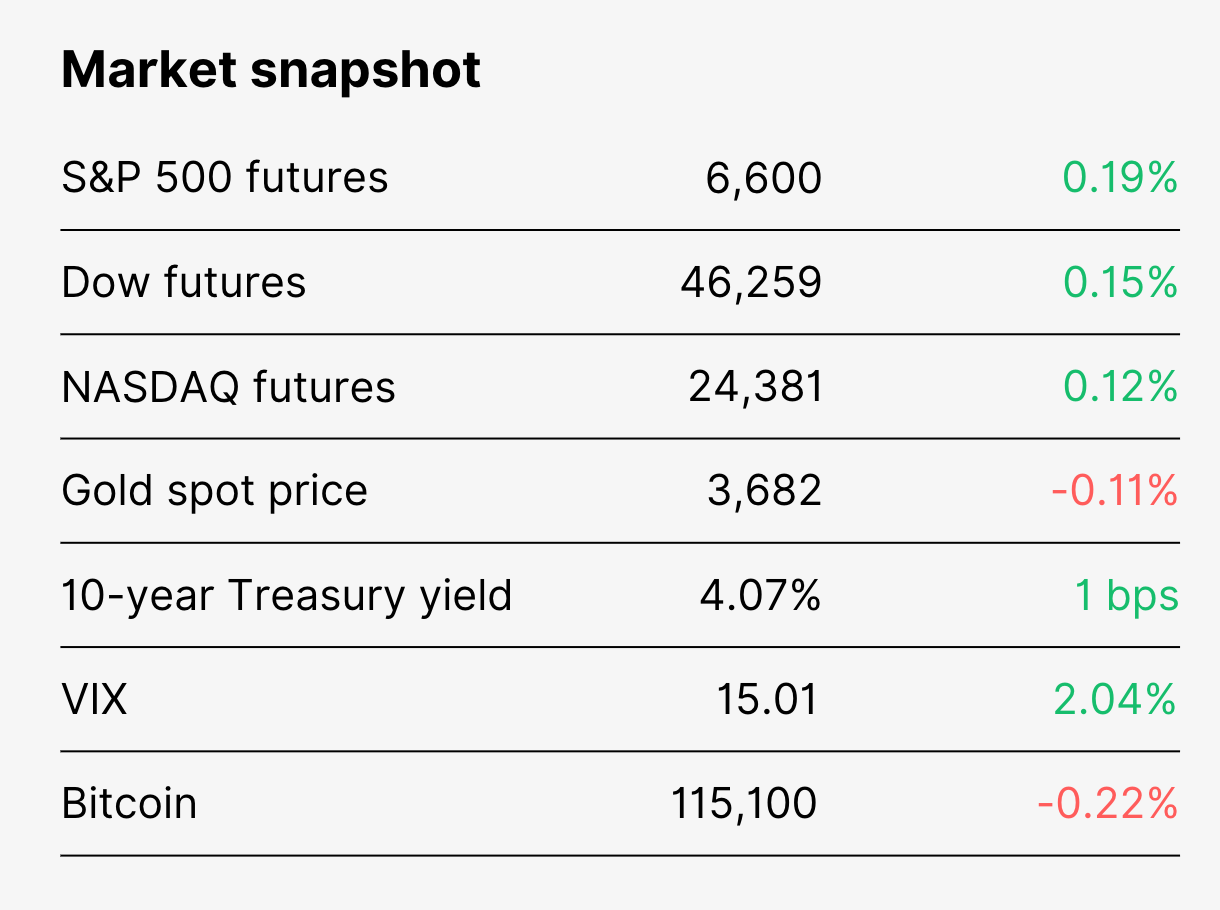
| | Good morning, Trump told NATO over the weekend to cut off Russian oil or “stop wasting my time,” while his team preps fresh talks with China in Madrid. TikTok, tariffs, and maybe even a Trump–Xi summit in October are on the table. Back on Wall Street, IPO fever just delivered its biggest week in four years with $4.4 billion raised, Tesla finally clawed back into the green for 2025 after an 11% surge, and precious metals are smashing new records. Meanwhile, all eyes are on Wednesday’s Fed cut, but the question is no longer if a cut is coming; it’s whether we get 25 bps or 50 bps. For what it’s worth, Trump called for a “big cut.” Whether that unlocks a $7 trillion “wall of cash” from money markets or just proves another sell-the-news moment is anyone’s guess. Not if you ask Conference Board economist Mitchell Barnes, who is apparently very pessimistic about the economy because job stayers are now out-earning job switchers for the first time in years. Plenty to unpack this week, starting with New York manufacturing data out today. Let’s dive in. | | | | | Hang tight, Dan Runkevicius, Chief Editor | |  | | | | | "Yes, you're going to get your rate cut out there in trading land. But I have to tell you, the underlying tenor of the data doesn't suggest that it's a lock that you're going to get three rate cuts before the end of the year." — RSM chief economist Joe Brusuelas | | | | | Five things to know before opening bell | |
🇷🇺 Trump turns up heat on Russian oil Trump took to social media over the weekend with a blunt message for NATO: stop buying Russian oil or “stop wasting my time.” He singled out Turkey for undercutting sanctions and claimed that if allies followed his lead, the war in Ukraine would “end quickly.” 🇨🇳 US–China talks in Madrid Treasury Secretary Scott Bessent and China’s Vice Premier He Lifeng meet today in Madrid with TikTok, national security, and trade on the docket. The talks are also laying groundwork for a possible Trump–Xi summit as soon as October. 📈 IPO fever is back It wasn’t just Klarna. Six companies raised more than $100M apiece last week, making it the busiest IPO stretch in four years. In total, $4.4B hit the tape, bringing 2025’s haul to $25B so far. More listings are queued up, though Renaissance Capital’s Avery Marquez warns, “The pickup is here… but things could change very fast.” 🏭 Manufacturing data kicks off the week Before Wednesday’s Fed spectacle, eyes are on New York’s first September manufacturing readout. Economists expect a soft 3.0 print, down from August’s 11.9 but still technically in growth mode. 🪙 Gold and silver smash records Precious metals aren’t just about rate-cut hype. Gold is up 38% YTD and silver 43%, both hitting fresh highs last week. Analysts at Metals Focus flagged tightening silver supplies, especially shrinking liquidity in London, which is driving this summer’s breakout. And Morgan Stanley says gold is sniffing out "something bigger." | | | | 🔥 Expansion or just 'vibespansion'
| | | | Wall Street ended last week on a mixed note, but the major indexes are still hovering near record highs. The Nasdaq even pulled off a perfect week of daily gains, closing at a fresh all-time high. The question is whether this rally is built on fundamentals or... just feelings. 🤔 Bubble talk Bulls are laser-focused on Wednesday’s Fed decision. But bears warn it could turn into a classic “sell-the-news” moment, with little bearing on the market’s true strength. David Rosenberg of Rosenberg Research is leaning harder into his bearish stance, pointing to frothy valuations and rising unemployment. “This is what a euphoric state looks like; we’re seeing it in real time," he said. "We are in a gigantic price bubble that is ongoing. And you know it’s a price bubble when prices move up in the face of negative fundamentals.” Meanwhile, the S&P’s 1.6% gain last week was enough to push it into “extreme overbought” territory, according to analysts at Bespoke. But Garzarelli Capital’s Elaine Garzarelli — famous for calling the 1987 crash — isn’t raising alarms yet. Instead, she sees room for confidence to climb further: “Even though the S&P 500 is a bit overvalued, irrational exuberance is not yet here.” 🏦 Wall Street double down Wall Street remains bullish. Analysts at Deutsche Bank and Barclays are still betting on more upside, lifting their year-end S&P 500 targets last week. Deutsche in particular is leaning bullish, citing tariff impacts as “modest and likely to remain manageable,” with earnings growth pegged at 9.5% this year and 14% in 2026. That outlook comes with a caveat: politics. Deutsche warned that Trump’s trade and immigration stance could shift if markets wobble. “If the perceived risks to growth or inflation rise and presidential job approval ratings fall as they did post Liberation Day, we expect relents on policy,” analysts wrote. | | | | 💸 Pay raises could be the next shoe to drop | | | | American workers are on pins and needles, and not without reason. A slowing economy and AI-driven disruption are raising hard questions about whether even those with secure jobs can count on raises keeping pace with inflation. 📉 Employers hint at a pullback Conference Board economist Mitchell Barnes called the labor market “one of reorientation,” noting that while raises are still planned, the mix is shifting.“ "Some companies are scaling back, including signing and retention bonuses.” Payscale’s Ruth Thomas sides with Barnes, pointing to volatility, inflation, and higher rates: “Organizations are prioritizing cost control.” Indeed, economist Allison Shrivastava added that the old playbook of job-hopping for higher pay is losing steam. “Fewer job openings mean slower wage growth for job switchers. For the first time in years, wage growth for job stayers is higher,” he said. 📝 What surveys say... According to the latest data, pay raises in 2026 are expected to fall short compared to this year’s increases: According to Payscale, only 16% of companies plan bigger raises than in 2025, and 60% cite economic uncertainty as the main brake on wages.
“It’s not surprising that pay budgets are trending lower this year… What is maybe more surprising is just how much economic concerns have overtaken labor competition as the primary driver of compensation decisions,” said Thomas. | | | | 💰 $7T ‘wall of cash’ hangs in the balance | | | | It’s no secret the Fed drives where investors park their money... and with $7.6 trillion piled into money market funds, the stakes couldn’t be higher. 🧱 The “wall of cash” theory The idea is simple: lower yields push investors out of cash and into stocks. Bank of America’s Savita Subramanian is one of the optimists, arguing that this giant reserve could fuel the next leg of the rally. “We’ve still got a lot of cash and a lot of fixed income on the plate,” she said. But the pace and scale are anyone’s guess. In fact, as Strategas strategist Todd Sohn pointed out, there’s no one-size-fits-all playbook. “Once money market fund rates start flirting with the lower 3% area, your after-tax yield isn’t great. But there are those who are risk-averse and just want to keep it there,” he said. 🪓 The skeptics Not everyone buys it. Peter Crane of Crane Data thinks the “wall of cash” hype is overblown. “The rates matter but much less than most people believe… Dream on Wall Street. The $7 trillion is not going anywhere but up.” He pointed out that MMFs have only dipped twice in their 50-year history and both times when rates were slashed to zero. Even if yields fall back to ~3%, funds would still beat bank deposits. And with more than half of MMF assets tied to institutional and corporate investors, it’s not up to mom-and-pop traders where most of that money flows. 📌 The bottom line A 25-bp trim (maybe 50?) is expected Wednesday, which won’t crater MMFs right away. But string together a few cuts, and risk-on stocks could start looking more tempting.
| | | | Rate this newsletter | | | Your feedback matters! Before you go, please rate this newsletter and share your thoughts. | | | | | | | | | | | | InvestorsObserver | | You received this email because you signed up on our website or made a purchase from us. | | | | |