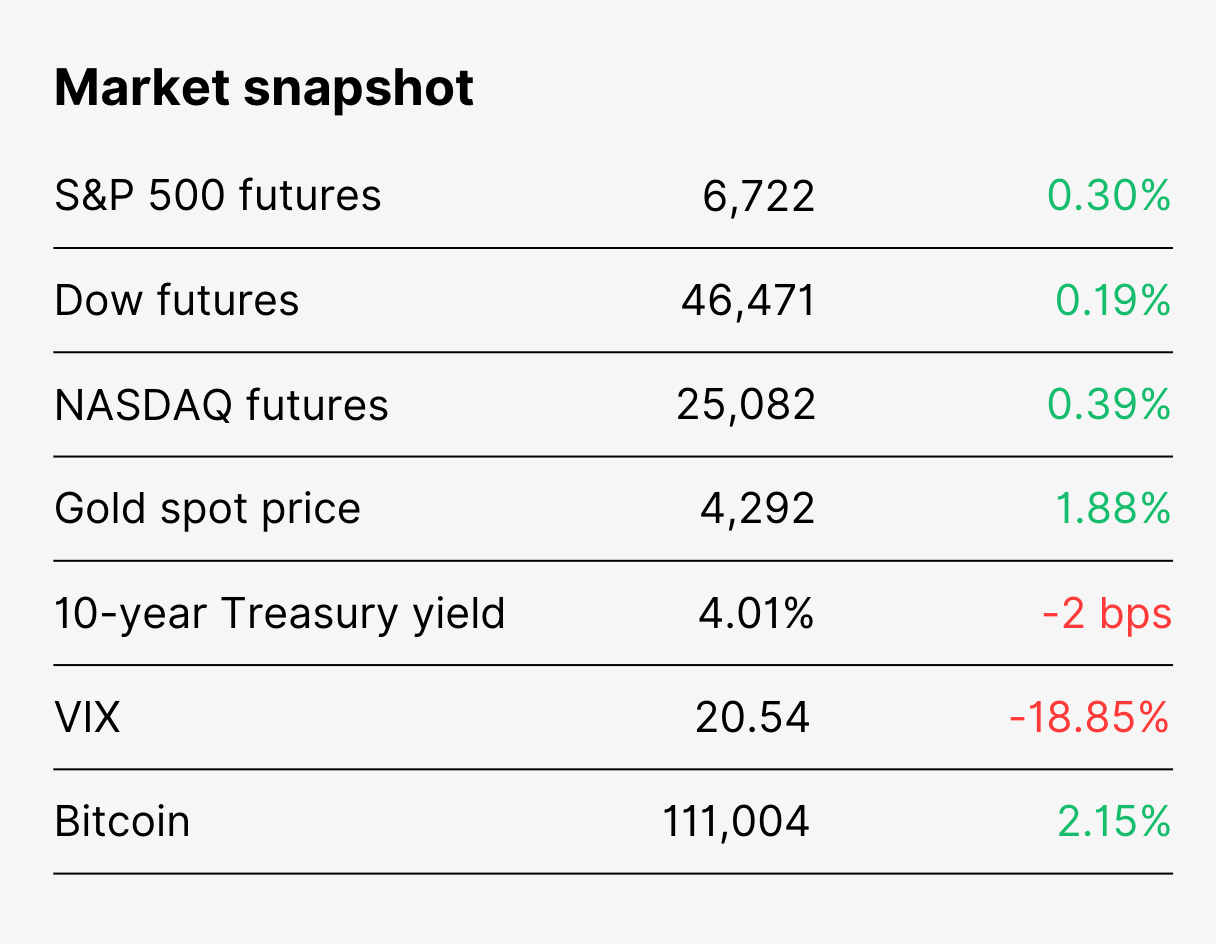
| | Good morning, Jamie Dimon sees cockroaches, but investors aren’t scattering yet. After last week’s selloff, regional banks clawed back losses Friday despite the JPMorgan chief’s warning that “when you see one cockroach, there are probably more.” The KBW Regional Banking Index rebounded 1.7% as analysts called the panic “overdone” and the Fed worked to soothe investors. Futures are also well in the green this morning. Meanwhile, Wall Street is eyeing the next CPI print later this week, but coffee prices are already up 21% year-over-year thanks to tariffs hitting Brazil, Vietnam, and Colombia. On the corporate front, BlackRock’s diving deeper into digital assets with a new stablecoin liquidity fund, while Nvidia’s exit from China is reshaping the AI calculus. American chipmakers are losing market share as Beijing’s homegrown players like Huawei and Cambricon close the gap fast. And in crypto land, Bitcoin’s bull run has hit a wall. The world’s largest cryptocurrency is testing $100K support after a wave of institutional selling wiped out $1.2 billion in positions in a single day. It’s a big week ahead for earnings, with Netflix, Coca-Cola, Texas Instruments, and GM all set to report. Let’s dig in!
| | | | | Hang tight, Dan Runkevicius, Chief Editor | |  | | | | | “It’s been a good start, I mean we’re barely into earnings season. The banks have been good. 82% of companies are beating. There’s a lot more visibility of demand and then less concerns about tariffs because we’re kind of working our way through it. So, companies have a better sort of visibility over the next 12 months. I think the outlooks are going to be good and I think that’s going to help stocks and, I think there’s a lot of room for multiples to still expand. So, I don’t think this market’s that demanding.” — Fundstrat head of research Tom Lee | | | | | Five things to know before opening bell | | |
🪳 Regional banks rebound after Dimon’s “cockroach” warning The KBW Regional Banking Index jumped 1.7% after plunging 6% earlier in response to lawsuits filed by two institutions over allegedly fraudulent borrowers. Once the dust settled, analysts said the selloff looked “overdone.” Jefferies called the panic "excessive", and the Fed assured invesors the financial system can handle some defaults. Jamie Dimon begged to disagree, warning, “When you see one cockroach, there are probably more.” 🦃 Could the shutdown stretch to Thanksgiving? DC is bracing for what could be a record government shutdown, with analysts now expecting it to drag well past Halloween and possibly into Thanksgiving. The funding lapse that began earlier this month is already among the longest in U.S. history. If it extends beyond November 4, it’ll surpass the 2018–19 record. The economic toll is adding up fast (up to $15 billion a day by government estimates) and the longer it lasts, the greater the risk of holiday travel chaos. 💰 BlackRock bets big on stablecoins BlackRock is doubling down on digital assets with a new money market fund designed for stablecoin reserves. The Select Treasury Based Liquidity Fund will comply with the new Genius Act. The move follows reports that BlackRock recently bought $1 billion in Bitcoin, underscoring how seriously Wall Street’s banks are taking crypto. ☕ Coffee prices surge on tariffs Retail coffee prices are up 21% year over year, driven by new tariffs on top suppliers... 50% on Brazil, 20% on Vietnam, and 10% on Colombia. Since the U.S. imports 99% of its coffee, the hit has been widespread, especially for small roasters who can’t absorb higher costs.The next CPI report lands Friday, but for now, your morning cup is already a little pricier. 📊 Earnings take center stage again The Conference Board Leading Economic Index is due today after a drop last month, and a packed Tuesday lineup will put Wall Street's optimism to the test. Reports from Netflix, Coca-Cola, Philip Morris, Texas Instruments, Capital One, 3M, and General Motors will offer a fresh read on how both consumers and corporations are holding up in this economy. | | | | 💡 Most investors miss out on $1,000,000+ in the long run… here’s how to fix that
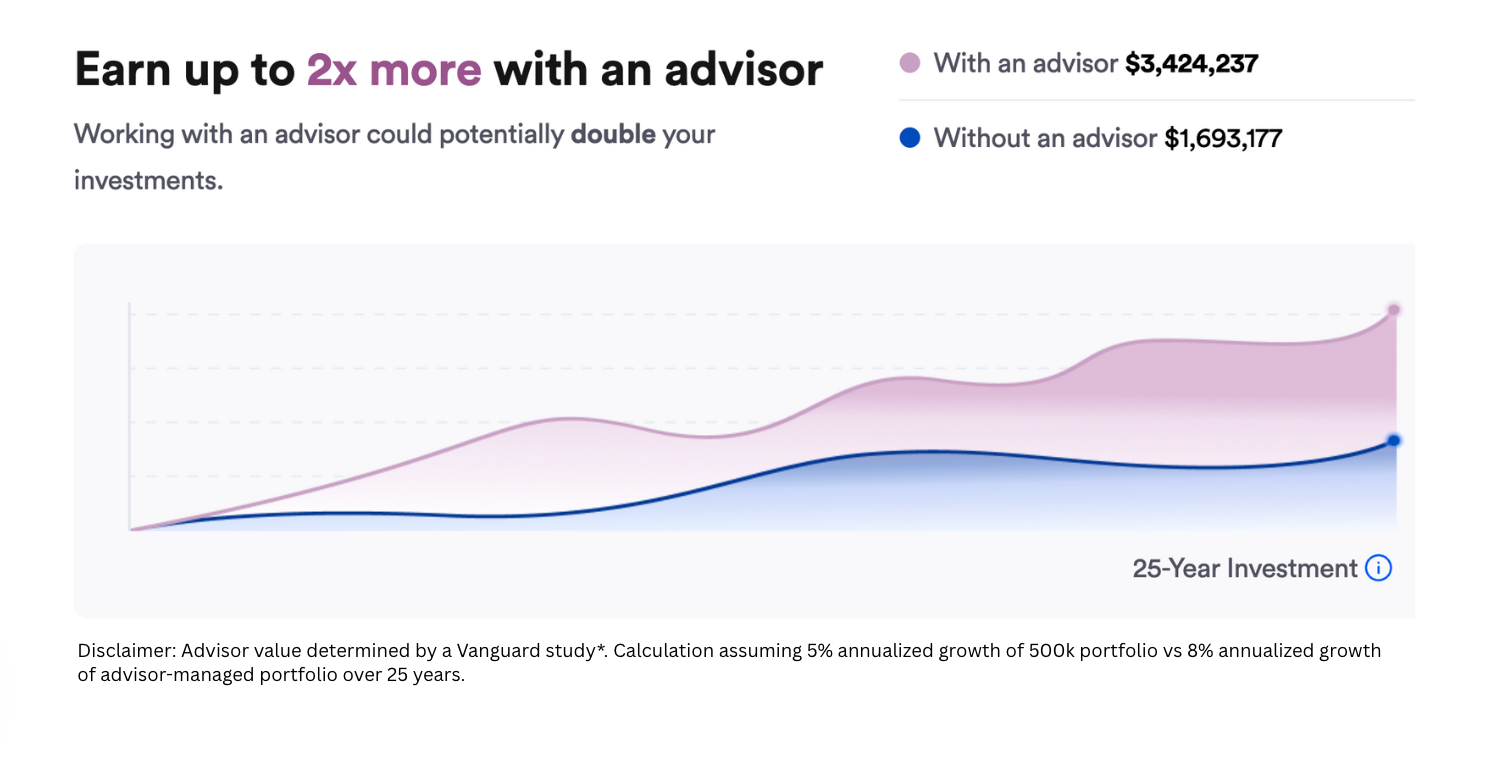
| | | | Here’s the hard truth... Most investors think they’re doing fine, but data shows the average investors earns far less than the market’s long-term returns. And that gap could get even wider as we enter an era that’s stress-testing everything we know about investing. Digital assets are going mainstream, speculative stocks are hitting records alongside gold, bond and stocks out of whack… … and the investment playbook that worked for the past 50 is no longer cutting it. The good news is you don’t need to be a millionaire to get expert help anymore. With Bankrate’s free AdvisorMatch, you gan paired with a vetted, fiduciary financial advisor who works in your best interest… all in under 5 minutes. 💰 The payoff can be huge Data shows that working with an advisor could potentially double your long-term investment returns. Over 25 years, that’s the difference between $3.4 million and $1.7 million... just by having expert guidance on your side. 💡 Here’s how it works: - ✅ Take a quick quiz: answer a few questions about your goals and situation
- ✅ Review your free match: see certified advisors who fit your budget and needs
- ✅ Start planning your future: connect in person or remotely, on your terms
It’s completely free, and more than 3,000 people have already used AdvisorMatch to find an expert near them. Whether you’re planning for retirement or figuring out your ideal portfolio, the right advisor can help you make smarter, more confident financial decisions. 👉 Find your advisor today and take the guesswork out of your future. Disclaimer: Just so you know, we’re sharing this because we genuinely think it’s a great service worth your time. If you sign up through our link, we may earn a commission. That’s one way you can support us and help keep this newsletter free.
| | | | | The world’s two biggest AI powerhouses are running into a wall: geopolitics. And Nvidia is bearing the brunt of the collateral damage... 🚫 Nvidia gets cut off
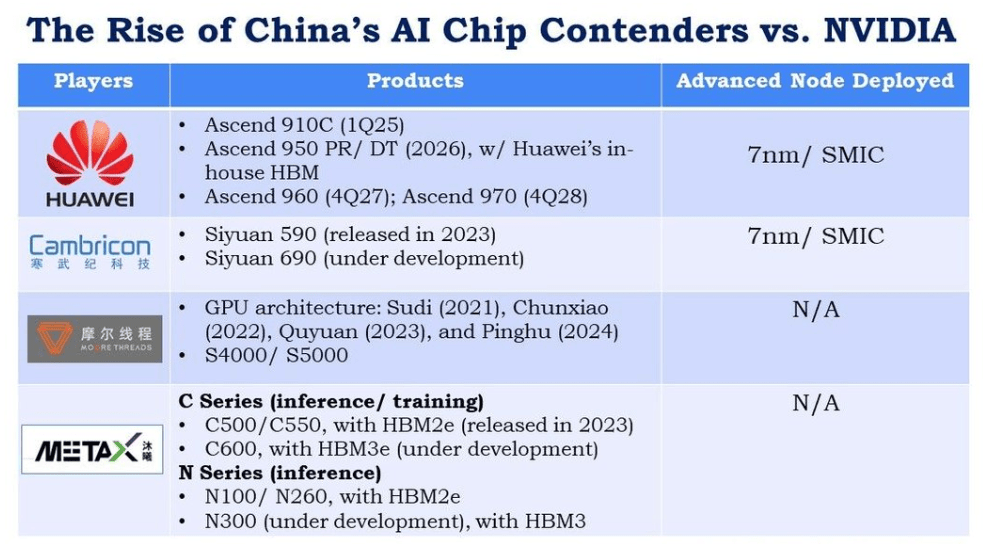
Beijing is tightening the screws on US chip imports, forcing Nvidia to pull out of China entirely. CEO Jensen Huang said the company’s market share there has fallen “from 95% to zero,” calling the trade fallout bad for both sides. “I can’t imagine any policymaker thinking that’s a good idea,” he added. Nvidia now assumes “zero for China” in its financial outlook, treating any future recovery as a bonus. But it’s not just Nvidia. China reportedly told its top tech firms, including ByteDance and Alibaba, to stop buying Nvidia chips, even modified ones. Instead, companies are turning to domestic players like Huawei and Cambricon, which are closing in on Nvidia-level performance. Micron Technology is following suit, pulling entirely out of China’s data-center market.
📊 The road ahead Analysts warn that losing the Chinese market could eat into US leadership in AI hardware. But China is executing a methodical plan to become self-sufficient: -
Core AI industry could hit $140B by 2030 -
Including related sectors, potential 10x growth -
Profitable AI trade could emerge by 2028 -
Returns exceeding 50% by 2030 -
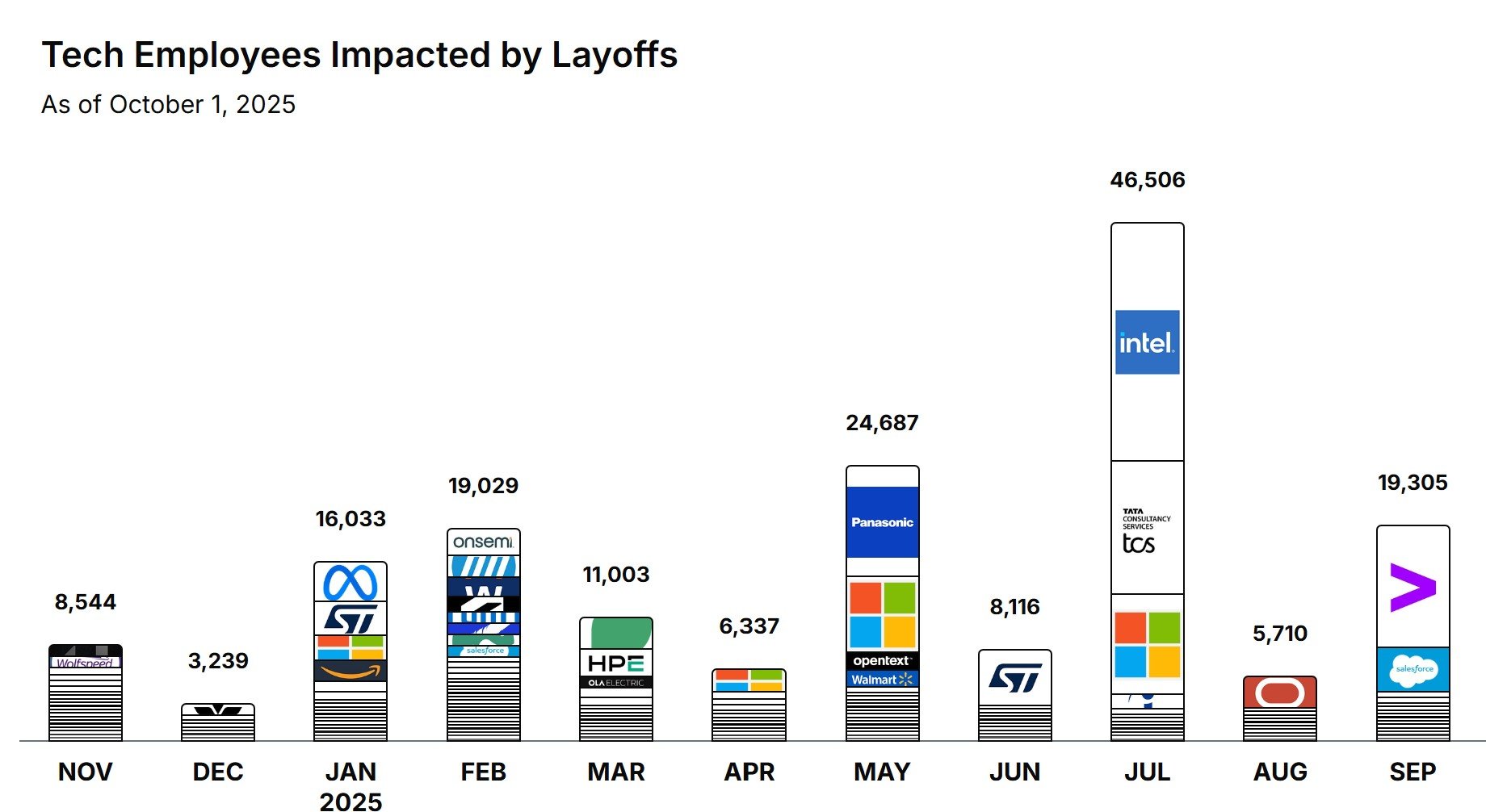
47% of top AI researchers now in China Shawn Kim, Morgan Stanley’s head of tech research in Asia, said China is “methodically executing a long-term strategy to establish its domestic AI capabilities.” A trade war may slow progress, but it’s unlikely to derail China’s AI ambitions entirely. | | | | ⚠️ AI: Excuse or executioner? | | | | Unemployment is creeping up, hiring is slowing, and layoffs are back in the headlines. And increasingly, companies are pointing the finger at AI. But is it really the culprit, or just a convenient scapegoat? 🧐 Experts aren’t buying it Pick any industry and “AI restructuring” has become shorthand for cutting jobs while dodging blame. A few recent examples: -
Accenture told staff they must reskill on AI to keep their jobs -
Lufthansa plans to cut 4,000 roles citing AI automation -
Salesforce’s new AI agent handles roughly half of its customer support -
Duolingo is leaning into AI as it phases out contractors.
Even Klarna CEO Sebastian Siemiatkowski partially blamed AI for the company’s 40% payroll cut But many researchers think the AI angle is overblown. “Companies can use AI to make good excuses to appear innovative while hiding other reasons, like over-hiring during the pandemic," said Fabian Stephany of the Oxford Internet Institute Meanwhile, strategist Jasmine Escalara warns this scapegoating “feeds the fear of AI,” which is only making things worse. 📊 The data tells a different story Hard numbers show AI-driven layoffs are still rare. A Yale Budget Lab report found “little disruption” in US employment since ChatGPT launched. And a New York Fed survey shows the share of firms citing AI as the reason for cuts fell from 10% last year to just 1% this year. Even if AI isn’t the main factor, uncertainty itself is dangerous. Without clarity on why the labor market is cooling, policymakers can’t act, and workers stay anxious. “Employees are scared because companies aren’t transparent,” Escalara said. “Now firms openly saying ‘AI caused it’ just adds fuel to the frenzy.” The shutdown and delayed federal data doesn't help either. | | | | Rate today's newsletter... | | | Your feedback matters! Take a sec and tell us how we did! | | | | | | | | | | | | InvestorsObserver | | You received this email because you signed up on our website or made a purchase from us. | | | | |