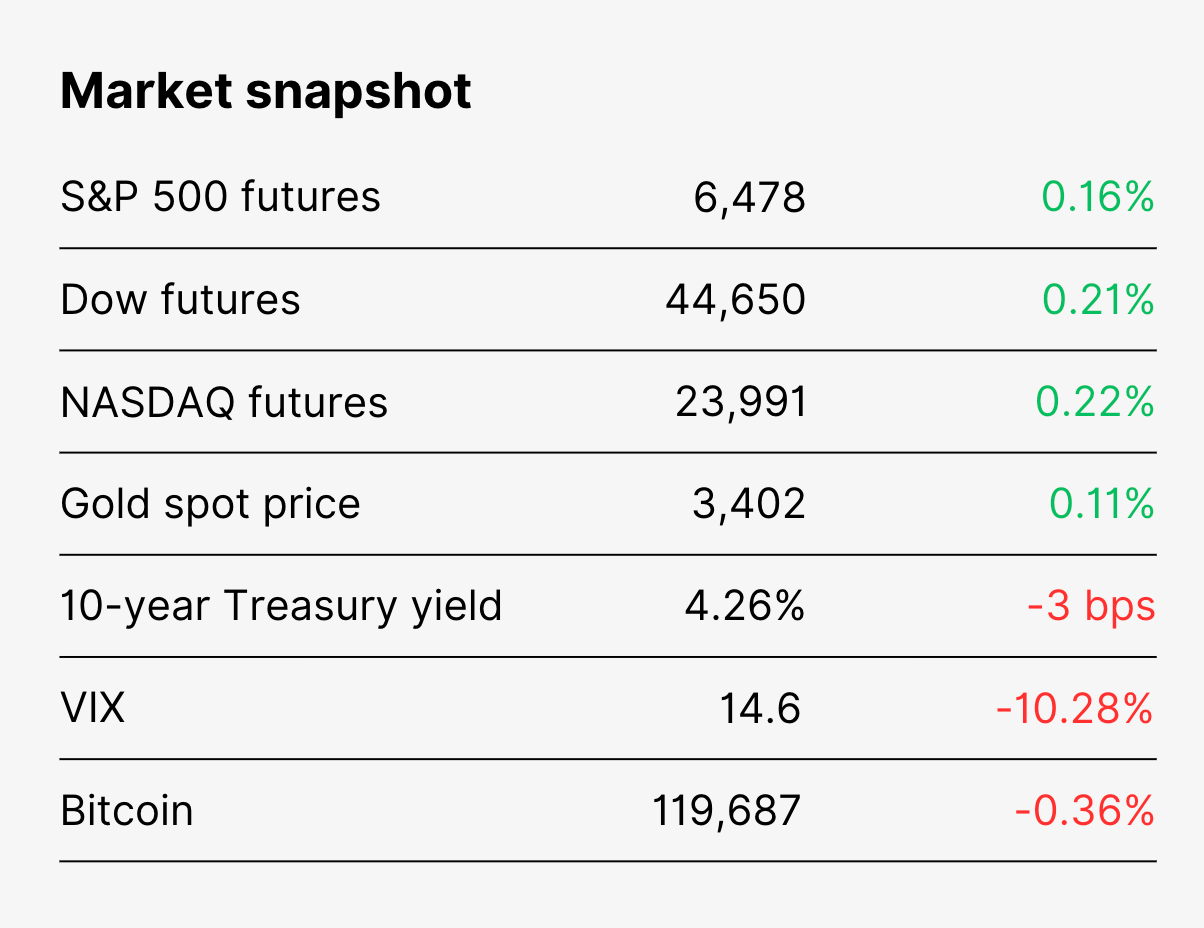
| | Good morning, It’s happening so often lately it’s barely breaking news, but stocks notched yet another record yesterday after a cooler-than-feared CPI print. The S&P 500, Dow, and Nasdaq all climbed more than 1%, while Bitcoin blasted past $120K. But not everything is risk-on. Back in the early 2010s, billionaire Marc Andreessen coined the phrase “software eats the world,” alluding to an economy where code replaces entire industries. Now it’s software's turn. As the latest casualty of Wall Street's new bearish mantra — call it "AI eats software" — Monday.com plunged 30% yesterday. Meanwhile, gold held near all-time highs after Trump exempted it from new tariffs, pot stocks lit up on White House reclassification chatter, and Elon Musk vowed to drag Apple into court over App Store favoritism. And of course, what's a trading day without the Trump-Powell feud? This time the president took aim at Jerome Powell over the Fed’s construction budget. Let’s dig in.
| | | | | Hang tight, Dan Runkevicius, Chief Editor | |  | | | | | “Amid all the talk of tariffs and higher goods prices to come, we’ve seen people stock up on iPhones and cut back on services, such as air travel and lodging. If we see this kind of demand destruction more broadly, the inflationary impact of tariffs would be less than many anticipate.” — Richmond Fed President Tom Barkin | | | | | Six things to know before opening bell | | |
📈 CPI pop lifts stocks to record highs Stocks notched another record Tuesday after a cooler-than-feared July CPI print. The Nasdaq jumped 1.4%, the S&P 500 rose 1.1%, and the Dow closed within striking distance of last year’s record. We’ll break down the CPI report later, but for now, Wall Street's takeaway was simple: no surprises is good news. 🤖 “AI eats software” hits Monday.com A 30% collapse in Monday.com shares put the software sector on alert. Analysts say the drop was as much about AI’s long-term threat to legacy tech as it was about earnings that missed lofty expectations. The selloff rekindled fears that generative AI could gut the very businesses that once “ate the world.” 🪙 Gold holds its shine after tariff carve-out Gold futures flirted with all-time highs after Trump confirmed imports would be exempt from new tariffs, easing fears his Switzerland duties could roil the market. Switzerland refines about 70% of global gold, and bullion has historically dodged import taxes. The yellow metal is up more than 27% year-to-date. 📱 Musk threatens to sue Apple Elon Musk says his AI startup xAI will take “immediate legal action” against Apple, accusing the iPhone maker of burying its apps in favor of OpenAI. “An unequivocal antitrust violation,” Musk posted on X. AAPL barely flinched, adding a fraction of a percent to extend the Nasdaq rally. 🌿 Pot stocks light up on reclassification talk Cannabis plays surged after the White House floated a possible downgrade of marijuana from Schedule I to Schedule III. The move would put it in the same federal category as ketamine and testosterone. Even after cooling from Monday’s spike, the AdvisorShares Pure US Cannabis ETF closed Tuesday more than 57% higher than a month ago. 🏛 Trump takes another stab at Powell The Trump–Powell beef is back. The president threatened a “major lawsuit” over what he called a “horrible” and “grossly incompetent” renovation of the Fed’s HQ, while again blasting Powell for not cutting rates. Remarks from the Chicago and Atlanta Fed chiefs are due today. | | | | 📊 Rotten to the “core”? Breaking down mixed CPI data
| | | | At first glance, the latest inflation print wasn’t as bad as many on Wall Street feared. But that headline number doesn’t tell the whole story. 📊 Digging into the details The Bureau of Labor Statistics pegged July’s CPI inflation rate at 2.7% year-over-year, unchanged from June and a hair below the 2.8% economists had forecast. “Core” inflation, which strips out food and energy, told a different tale. It ticked up from 2.9% to 3.1%, matching or beating most projections, and marking its highest level since February. Wall Street took the news in stride, with stocks generally gaining on the day. But analysts warn that tariffs might to take a bigger bite out of consumers’ wallets in the coming months. The catch is that many companies have been front-loading shipments to dodge duties, but those stopgap moves won’t hold forever. 🚗✈️ What’s driving inflation? Price hikes haven’t hit every corner of the economy equally. Trade tensions and supply-chain kinks are still squeezing some sectors harder than others. “There are clear signs a range of goods prices are moving higher, pushing core goods inflation to a more than two-year high, but some major tariffed items, including autos and major appliances, have yet to show much impact,” said Michael Pearce, chief U.S. economist at Oxford Economics. Here’s what stood out in the July report: -
Gasoline prices fell 2.2%, and energy prices overall dropped 1.1%, helping moderate the headline number. -
Airline tickets rebounded 4% after three straight months of declines. -
Medical care and transportation services both climbed 0.8%, while used cars rose 0.5%.
📌 The bottom line
It’s tempting to celebrate the cooler-than-expected headline CPI, but JPMorgan Asset Management chief global strategist David Kelly isn’t buying the victory lap. “We’re just getting started,” Kelly warned. “This thing will feed through, it’s just a number of months. Inflation is going up very steadily, and it will be above, we think, about 3.5% in CPI by the end of the year.” | | | | 🇨🇳 Where DC-Beijing feud stands | | | | DC–Beijing relations are still as frosty as they've ever been, but the tone has lately warmed, at least from the Trump side. The White House is signaling it’s ready for extended talks with Chinese trade reps to slash sky-high import duties and roll back some of the current restrictions. 📦 Where things stand Yesterday was supposed to mark the start of a new 145% tariff on most Chinese goods headed to the U.S. But a last-minute reprieve from Trump pushed that deadline out by another 90 days. Both sides have taken steps to dial down tensions, including lowering certain duties and resuming trade in once-restricted goods like rare earth minerals and microprocessors. It’s the latest move toward détente after last month’s talks in Sweden ended without a deal. Back then, US Treasury Secretary Scott Bessent said he saw “the makings of a deal." Chinese exports to the US dropped more than 10% between January and July, and have fallen year-over-year for each of the past four months. 🚧 The sticking points The US wants China to stop flooding global markets with cheap exports and is raising concerns over Beijing’s continued purchases of Russian oil. Meanwhile, China wants access to US computer chips to fuel its AI ambitions. That 90-day window now opens a high-stakes negotiation period with potential curve balls that could ripple through any sector. Trump’s announcement was a stabilizing development “for American consumers, for importers of goods who sell those goods in the US, and for manufacturers in China,” said David Meale, former deputy chief of mission for the US Embassy in Beijing. Meale added he’s optimistic this truce will pay off. “I think it is very likely the US and China will come to some kind of trade arrangement, and the next steps are likely to be driven by the prospect of a leaders’ meeting between President Trump and President Xi later this fall.” Nicholas Lardy, nonresident fellow at the Peterson Institute for International Economics, said the talks could restore US–China trade relations. He's not ruling out eased tech-trade rules or even a Chinese investment in US manufacturing while keeping expectations in check “Bilateral trade would shrink considerably, beyond what we have already seen,” even if a deal gets done, he said.
| | | | 🤖 AI is software's 'fast fashion" moment | | | | Fears that AI could gut the world’s biggest software businesses are sparking a sector-wide selloff. The most recent notable casualty is Monday.com, which crashed 30% yesterday. Analysts say the drop isn’t so much about earnings as it is about mounting anxiety over AI. The European tech rout didn’t stop there. SAP SE — Europe’s largest company by market value — sank as much as 7.1% in Frankfurt, wiping out nearly €22 billion ($26 billion) at the day’s low. Smaller peers like Sage Group and Dassault Systèmes slid in sympathy, following Monday’s hit to US names like Salesforce and Workday. “Software valuations remain under pressure from the ‘death of software due to AI’ narrative, which likely drives continued volatility in the short term,” RBC Capital Markets analysts led by Matthew Hedberg wrote Tuesday. 📉 The widening gap A basket of software stocks is now trading near the lowest levels since January versus semiconductor peers. This reversal underscores just how far investor money has shifted into the chip trade. Salesforce is down more than 30% this year, Adobe by roughly 25%. The fear is that AI tools could let applications be built faster and cheaper, eroding the moat around established players. Earlier this month, OpenAI CEO Sam Altman warned the industry could enter a “fast fashion era very soon,” where software is pumped out rapidly at a fraction of the cost. The anxiety is also spilling over to adjacent players. Research and consulting firm Gartner cut its full-year outlook last week, citing tariffs and government budget cuts. But analysts said the weak print is as much about AI competition in the insights business. 🛒 Bargain hunting Not everyone is running for the exits yet. Morgan Stanley’s Josh Baer upgraded Monday.com to overweight Tuesday, arguing the selloff “more than incorporates” the AI threat to search advertising and performance marketing. “Investors are fearing that AI is going to eat software and multiples are going to fall apart,” Jefferies’ Brent Thill told CNBC. “I think the fear is overblown, but nevertheless we are living through a period right now where investors just really don’t care about the group.” | | | | Rate this newsletter | | | Your feedback matters! Before you go, please rate this newsletter and share your thoughts. | | | | | | | | | | | | InvestorsObserver | | You received this email because you signed up on our website or made a purchase from us. | | | | |