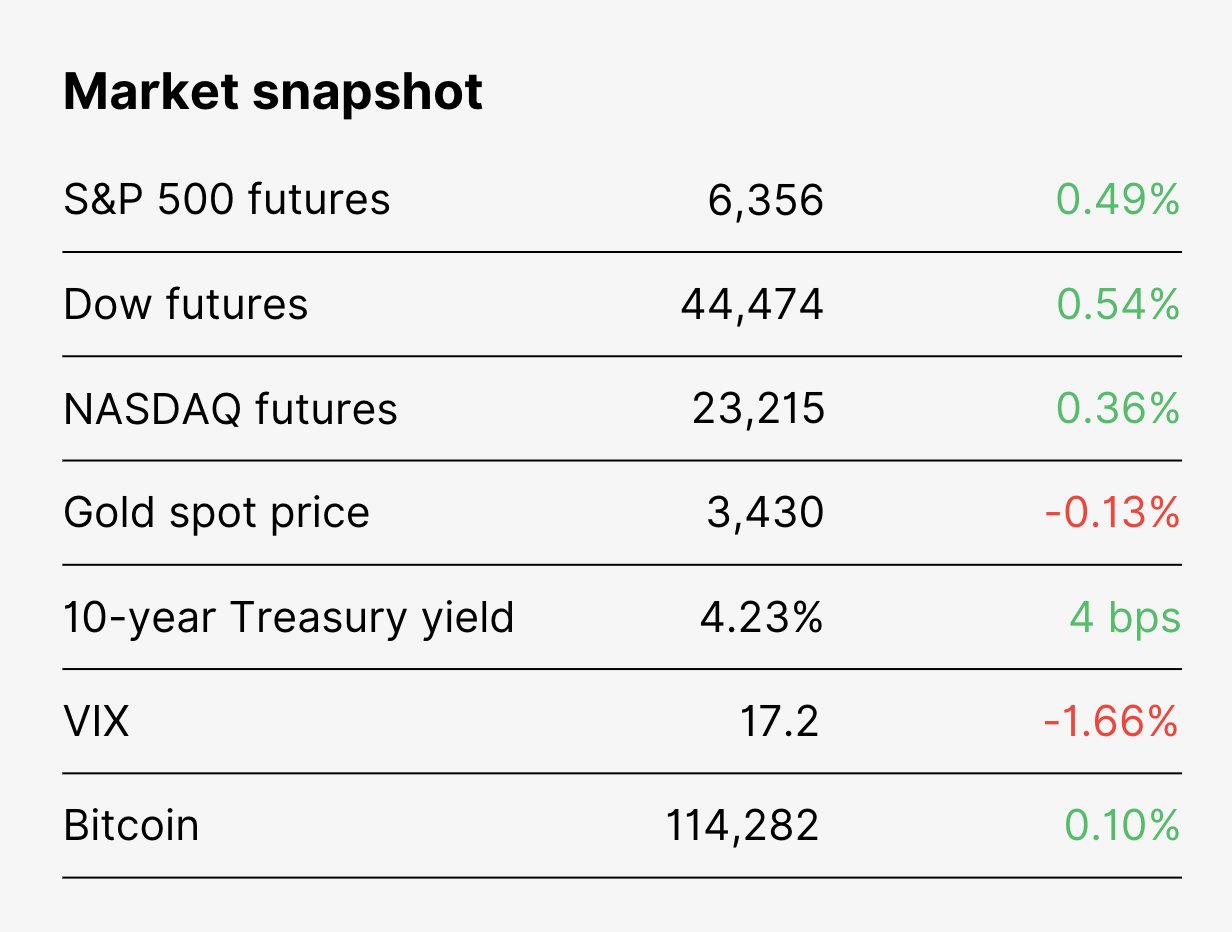
| | Presented by | |  | | | | | | | | | | | Good morning, Trump threatens pharma with a tariff blitz — “small at first” but eventually ramping to 250% — in a bid to bring drug manufacturing back home. Next in line are chips. Meanwhile, JPMorgan just raised the recession flag again, saying the latest jobs slump is a “precursor to entrenchment.” The call comes as debt delinquencies climb and new household credit data from the New York Fed shows more than one in ten student borrowers is already 90 days late. On the flip side, safe havens are making a comeback. Gold ticked higher and silver popped 1.4% Tuesday as a weaker PMI report revived stagflation worries. And with Powell under fire, Trump says Treasury Secretary Scott Bessent won’t be replacing him next year, but “the two Kevins” are still in play. It’s shaping up to be another big day for markets. Let’s dig in. | | | | | Hang tight, Dan Runkevicius, Chief Editor | |  | | | | Five things to know before opening bell
| | | 🧠 OpenAI’s $500B share sale OpenAI is reportedly lining up a secondary share sale that could value the AI juggernaut at a mind-bending $500 billion. Existing investors, including Thrive Capital, are said to be sniffing around for employee-held shares. The deal would mark another massive paper gain for the ChatGPT maker as Wall Street’s AI fever shows no sign of breaking. 💊 Trump’s pharma tariff blitz Trump says imported drugs are next on his tariff hit list, starting “small” but climbing to 150%, then 250% over the next 18 months. The president says the goal is simple: “We want pharmaceuticals made in our country.” He also hinted chips could be next. 🥇 Gold jumps on stagflation fears Safe havens are back in demand. Gold prices nudged higher Tuesday and silver jumped 1.4%. The rally came after fresh PMI data flashed the ugly combo of slowing growth and rising prices, a historical recipe for stagflation. 🏦 Bessent out as Powell replacement Trump says Treasury Secretary Scott Bessent is out of the running to replace Fed Chair Jerome Powell when his term ends next year. But “the two Kevins” — ex-Fed Gov. Kevin Warsh and NEC chief Kevin Hassett — are reportedly still on the shortlist. 🗓️ Jobs data leads today’s calendar Wall Street is nervously waiting for the latest jobless claims after Friday’s ugly unemployment report. Other numbers to watch: Q2 productivity, June wholesale inventories, and consumer credit. Eli Lilly, Constellation Energy, and Monster Beverage headline today’s earnings slate. | | | | 🎁 Here’s your $200 head start in crypto
| | | | If you’ve been reading IO (or not living under a rock), you know crypto isn't fringe anymore. With Wall Street funneling billions into digital currencies and blockchain infrastructure, it's cemented itself as a must-have asset in every modern portfolio. 🤔 Consider this: The first crypto spot ETF — BlackRock’s iShares Bitcoin Trust — became the fastest ETF ever to hit $50 billion in assets, outpacing gold’s historic debut. BlackRock analysts now say crypto is evolving into a “new portfolio diversifier” alongside gold, stocks, and bonds. Even conservative money is piling in. Pension funds from Michigan to Wisconsin are allocating millions into Bitcoin, and sovereign wealth funds from Abu Dhabi to Norway are following suit.
Big money managers can’t ignore it anymore. And if you’re ready to take the plunge, there’s probably no real alternative to Coinbase. 💡 Think of Coinbase as the Fidelity of crypto. It’s the "too big to fail” broker of digital assets, with security and regulatory oversight smaller players simply can’t match and afford. That’s why over 100 million investors and Wall Street giants like JPMorgan and Morgan Stanley trust Coinbase to trade and store their crypto. 🎁 The best part is InvestorsObserver readers can now get up to $200 in free crypto when you sign up for a Coinbase account through us. Here’s how: ✅ Open a Coinbase account ✅ Fund your wallet and buy crypto ✅ Claim up to $200 in crypto as a welcome bonus*
👉Sign up now and claim your $200 in crypto
*Just so you know, we’re sharing this because we genuinely think it’s worth your time. That said, we may earn a commission if you sign up through our link. Valid for new users who make a cryptocurrency purchase on Coinbase. Limited while supplies last or Coinbase revokes this incentive at its sole discretion. Coinbase reserves the right to change the terms, eligibility criteria, and payouts for all incentives at any time, for any reason. Void where prohibited or if Coinbase determines that the customer is not eligible for the offer. Terms apply. | | | | 📉 Deficit drops just in time for another tariff gut punch | | | | We’re on the eve of yet another deadline, with U.S. partners bracing for the next round of tariff hikes on goods bound for American ports. As we wait for the showdown, let's look at the latest data to see how those tariffs are reshaping trade so far. 📉 Digging into the numbers The U.S. trade deficit dropped for a third straight month in June, falling 16% from May, according to new Census Bureau data. That puts the deficit at its lowest level in nearly two years. Both imports and exports were down. That's a pullback from the Q1 import surge when American companies rushed shipments ahead of Trump’s expected tariffs. One standout was that U.S.-China disputes resulted in a historic drop in Chinese imports. While the data hints at a return to something resembling normalcy after months of chaos, tomorrow’s deadline could quickly flip the script again. 📊 What the experts say Oren Klachkin, Chief U.S. Economist at Nationwide Financial Markets, said exporters are in for a challenge but not a dead end. “Exports are not poised to record strong growth going forward, but stronger foreign currencies and an opening up of foreign markets may bolster U.S. exports, though admittedly this will take time to play out,” Klachkin said. Wells Fargo economists Shannon Grein and Tim Quinlan said the Q2 import pullback lines up with front-loaded demand in the first quarter. “Businesses pulled forward demand in Q1, resulting in a massive import surge,” they wrote. “With a surplus of product and inventory on hand, imports fell in all three months of the second quarter,” Grein and Quinlan wrote in a note. On the steep drop in Chinese imports, Matthew Martin, Senior Economist at Oxford Economics, said it’s not a major concern as other countries are filling the gap. “Other trading partners in Asia have mostly filled the void, increasing their share by roughly the same amount,” he said. | | | | | Inflation keeps chewing through household budgets, and fresh data from the New York Fed signals the pinch is real. 🎓 Student loans take the hit It wasn’t a surprise that delinquencies would spike after the long moratorium on student loan repayments ended earlier this year. But the New York Fed’s latest Quarterly Report on Household Debt and Credit shows just how bad it’s getting: more than 1 in 10 Americans with student debt is at least 90 days late. Total student loan balances hit $1.64 trillion in Q2 2025, with Fed researchers noting delinquencies rose “sharply” during the three-month stretch. 📊 Other red flags Here are a few highlights from the report: - Americans tacked on $185 billion in debt in Q2
- Credit card and auto loan debt also accelerated
- Overall delinquency rates ticked up to 4.4% from Q1
Mortgage delinquencies are also on the rise but not a red flag for the housing market yet. “Despite the recent uptick in mortgage delinquency, overall mortgage performance remains strong by historical standards,” said Joelle Scally, Economic Policy Adviser at the New York Fed. The Fed also highlighted FHA mortgages as a growing pain point, noting that transitions into 30 days past due exceeded 4% this quarter, the steepest rise among loan categories. | | | | 💥 PMI brings back stagflation talk | | | | Businesses can only suck up higher costs for so long before passing them to shoppers, and the latest data says that handoff is already underway. 🔍 What the numbers show The Institute for Supply Management’s July report painted a mixed picture: -
The Services Price Index jumped more than two points, the biggest rise since November 2022. -
The overall ISM services index unexpectedly slowed from June to July. -
The employment index missed expectations, falling to a four-month low. “July’s PMI continues to reflect slow growth,” said Steve Miller, chair of ISM’s Services Business Survey Committee. “Nevertheless, it’s worrisome to see prices and unemployment rise in tandem.” 💼 Market fallout Wall Street hated it. All three major indexes closed lower Tuesday as investors weighed the one-two punch of slowing growth and higher prices, a classic recipe for stagflation. Ryan Sweet, chief U.S. economist at Oxford Economics, chalked up part of the input cost increase to tariffs. “The increase in the price-paid index is likely partially attributed to tariffs,” he said. He warned the report highlights “the risks toward further slowing in the economy and higher inflation.”
| | | | Rate this newsletter | | | Your feedback matters! Before you go, please rate this newsletter and share your thoughts. | | | | | | | | | | | | InvestorsObserver | | You received this email because you signed up on our website or made a purchase from us. | | | | |