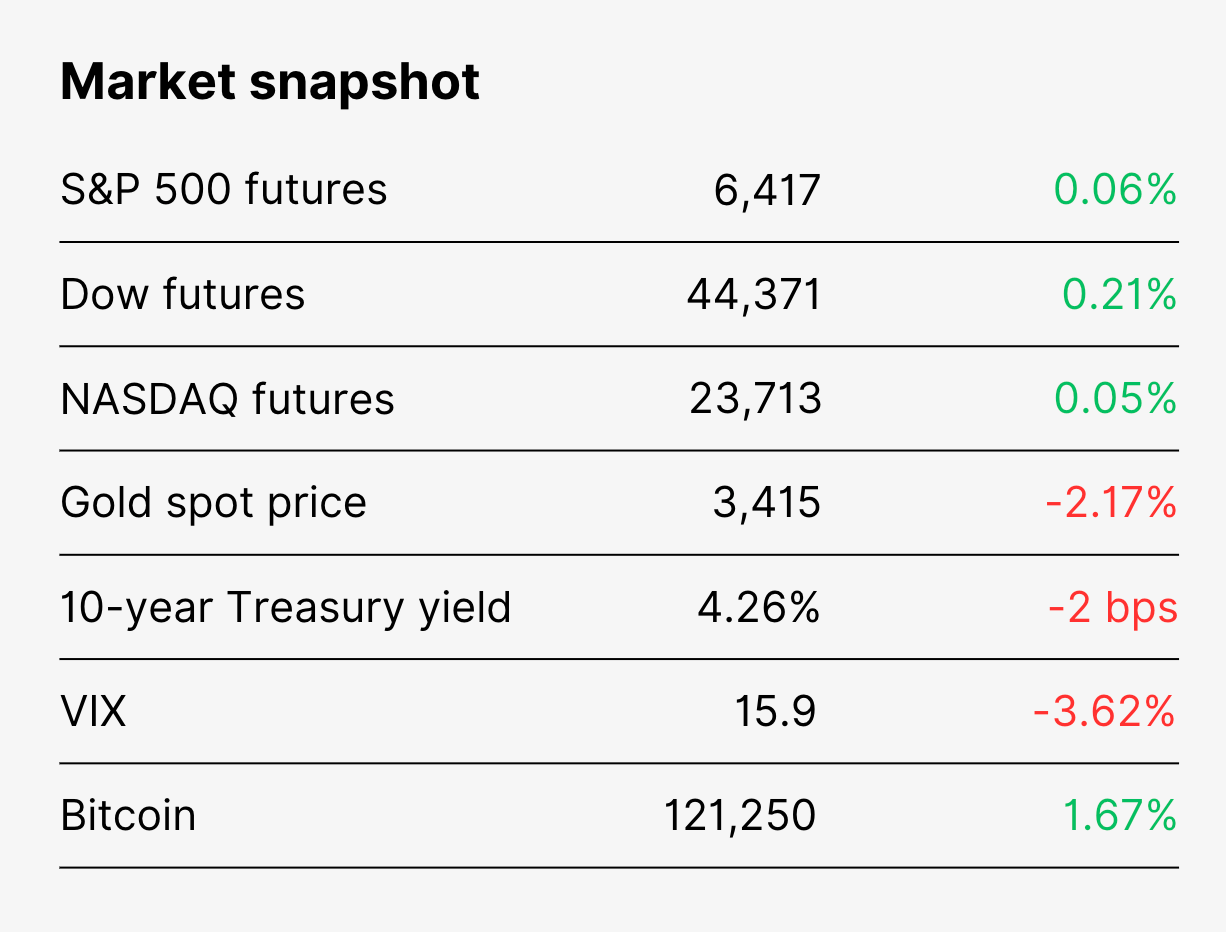
| | Good morning, Wall Street is learning the new rules of Trumponomics, starting with a stunner: Nvidia and AMD will fork over 15% of their China AI chip revenue to Washington in exchange for export licenses. It’s a de facto tariff-era toll, and a reminder that in this White House, compliance can be monetized. On the macro side, the Fed’s rate-cut chorus is growing louder ahead of fresh inflation data. Tomorrow’s CPI is expected to tick higher, with more tariff-driven price hikes in the pipeline. Currency desks are bracing for “Act Two” of the dollar’s slide, with Morgan Stanley calling its mid-year rebound just an intermission before another leg lower. Meanwhile, tokenization is quietly turning into Wall Street’s next big thing, with Coinbase, Kraken, and Robinhood all racing to move stocks onto blockchain rails. A fad or the new normal, we’ll soon find out. Let’s dig in.
| | | | | Hang tight, Dan Runkevicius, Chief Editor | |  | | | | | “I think that at least 6,600 is a minimum because if we’re making 6,600 in the next few weeks, then I think that probably 7,000 is a level we can touch by the end of the year. … Three things are happening. One is that the economy has survived tariff Armageddon...The second is that we are getting closer to the Fed making a dovish pivot. They’ve been on hold for a long time. … That, I think, leads to a re-rate of multiples. And the third is that I think sentiment is still quite bearish. Many of our clients think that we’re going to have a recession because of the tariffs that started on August 1st. But I think businesses are ready to get through that, and that sentiment collapsing helps [price to earnings].” - Fundstrat managing partner Tom Lee | | | | | Six things to know before opening bell | | |
💻 Nvidia and AMD made a deal with Trump Nvidia and AMD just agreed to hand over 15% of their China AI chip revenue to Washington in exchange for export licenses. That's a de fact tariff-era toll that’s already raising eyebrows in both Silicon Valley and Beijing. “This seeming quid pro quo is unprecedented from an export control perspective,” said Jacob Feldgoise at the Center for Security and Emerging Technology. 🚜 Deere drops $20B on U.S. manufacturing It’s not Apple’s $100B splash from last week, but John Deere’s $20B commitment to domestic manufacturing is still turning heads. The spend will target product development, advanced manufacturing, and “cutting-edge” tech, according to exec Cory Reed. Shares opened the week up 0.75% after Friday’s pop. Q2 earnings drop Thursday. 🥇 Gold’s tariff whiplash Gold futures hit all-time highs Friday on reports Swiss gold bars would get swept up in Trump’s latest 39% import levy, then slid after word a “near-future” executive order would exempt them. Miners still ended the week higher, but bullion’s price gains were mostly erased by Friday’s close. 📈 All eyes on CPI this week A quieter earnings calendar leaves room for the week’s main event: tomorrow’s CPI. Economists see July inflation ticking to 2.8% from 2.7%, with core up to 3%. UBS’s Alan Detmeister thinks tariff-driven price hikes could push CPI to 3.5% by year-end. Also ahead are PPI Thursday and consumer sentiment plus retail sales Friday. 🍔 Restaurants feel the squeeze Rising food costs (+21% YoY in June) and a still-tight labor market are squeezing margins at every price point. “The middle-income consumer is also under pressure,” said Moody’s Michael Zuccaro. With typical margins of just 3–5%, National Restaurant Association economist Chad Moutray says “the math has to work” and right now, it’s not. 🏦 The Fed’s dovish chorus grows louder Weak jobs data, tariff-linked inflation, and political pressure are making the Fed’s September meeting look like a coin flip for a rate cut. “Once the labor market stumbles, it tends to fall quickly and hard,” warned SF Fed’s Mary Daly. JPMorgan’s Michael Feroli says Powell’s “path of least resistance” is to pull forward the next 25bps cut. | | | | 💵 Dollar’s decline may be just getting started
| | | | The greenback has already taken a pounding this year, thanks to trade tensions and ballooning U.S. debt. But the worst may be not over yet 📉 Act One: The steepest drop in 50 years During the first half of 2025, the dollar sank a staggering 11% against major currencies, the steepest drop in half a century and the official end of a bull run that lasted 15 years. July brought a 3.2% bounce on better economic data, but Morgan Stanley warns it may have been nothing more than a pause. David Adams, head of FX strategy at Morgan Stanley, pointed to “ongoing tariff impacts, rising unemployment, decreased GDP growth, and a global U.S. asset selloff” as signs we’ve only seen Act One of the dollar’s slide. “We’re likely at the intermission rather than the finale,” Adams said. “... The second act for the dollar’s weakening should come over the next 12 months, as U.S. interest rates and growth converge with those of the rest of the world.” 🔄 What a second leg lower could mean If the second act plays out, the knock-on effects could be big. A prolonged decline would push more investors into hedges like Bitcoin, foreign currencies, and multinational stocks, further eroding the dollar’s reserve currency dominance. The downside is weaker buying power, pricier imports, and more inflation. That’s why analysts are increasingly advising clients to park at least part of their portfolios in assets built to withstand a weaker dollar. And with U.S. companies dumping euro-denominated bonds at a faster clip, Harvard economist Kenneth Rogoff thinks the market sends a clear message. The dollar “is about to get knocked down a couple pegs,” Rogoff warned. ⚖️ Possible lifeline or just a pause? There is a possible upside scenario. James Lord, chief global FX strategist at Morgan Stanley, said “it’s possible the dollar will receive more support” if tariff-linked inflation sticks around. But for now, he says, political pressure outweighs tailwinds. “Recent evidence of labor market weakness combined with policy uncertainty in the U.S., such as tariff negotiations and the recent debate about an early change in the Fed’s leadership, remains a source of downward pressure on the dollar.” | | | | ₿ Crypto firms push to tokenize stocks | | | | Digital assets are spilling into just about every corner of investing, and now exchanges are eyeing a slice of the equities business. The latest push is turning shares into blockchain-based tokens that can be traded like crypto. 📜 From theory to reality Traders have heard the term “equity tokenization” for a while, with BlackRock’s Larry Fink floating the idea early last year, but it’s only recently gone mainstream. - Coinbase announced a tokenization initiative during its latest earnings call.
- Kraken teamed up with Backed to launch an xStocks platform.
- Robinhood says the response to its own token plans has been “very positive.”
So what are tokenized stocks, exactly? They’re digital versions of public company shares stored on a blockchain and held in crypto wallets.
Brian Armstrong, CEO of Coinbase, has been touting stock tokens for a while, arguing that even a 3% share of the equities market would double the crypto market. “We’ve always said we’re updating the system and building the bridge to bring equities on to crypto rails is the next phase of our strategy,” Armstrong said. Vlad Tenev, CEO of Robinhood, is targeting tokens for OpenAI and SpaceX shares and says the demand is obvious. “It’s clear customers want this,” Tenev said. “They not only want it in Europe, but they want it in the U.S. as well.” ⏳ When does it hit the U.S.? Tokenization supporters say the model will make trading faster, cheaper, and more secure. But even with a crypto-friendly White House, there’s a regulatory gauntlet ahead before U.S. investors can start collecting stock tokens. Critics point to hacking risks, compromised accounts, and the same pitfalls that have plagued crypto for years. Meanwhile, Europe is already a step ahead, which, given its typically stricter regulatory stance, makes it even more surprising. Tokenized equities have been trading there for months. There’s no clear timeline for the U.S., but with U.S. and global regulators warming up to the idea, the next few months could bring a lot more noise... ... and maybe the first real chance for American investors to add stock tokens to their portfolios. | | | | 🚢 Freight data shows tariffs biting hard | | | | The first full week after Trump’s delayed tariffs kicked in already took a tool on U.S. import demand, and freight is feeling it more than most sectors. In fact, two fresh reports point to a major slowdown that’s hard to miss. 📉 Containers and truckloads tank Imports usually follow seasonal patterns, but this year’s numbers are breaking the mold. U.S. container imports and truckload volume are both down double digits from a year ago, underscoring just how dependent the freight industry is on Chinese goods. With D.C.–Beijing negotiations still unresolved, the impact of Trump’s earlier 145% tariff on China is still reverberating, slashing that country’s U.S.-bound freight bookings by 42%. On the bright side, intermodal rail demand looks healthier, but analysts say it’s likely a mirage. Volumes spiked earlier this year as shippers rushed to beat the tariff clock, making the current numbers look better than they are. 🔮 What’s next for freight Unless trade flare-ups ease, most forecasts suggest the slowdown is only getting worse. But there are a couple of silver linings: -
The latest Logistics Manager’s Index shows a logjam of inventories, as shippers hedge against higher long-term costs. -
Several big trucking firms are adding September surcharges, hinting at full-capacity runs in the weeks ahead. Those positives may be short-lived. If the freight slump spreads, it could ripple into prices and supply chains in true tariff-era fashion. | | | | Rate this newsletter | | | Your feedback matters! Before you go, please rate this newsletter and share your thoughts. | | | | | | | | | | | | InvestorsObserver | | You received this email because you signed up on our website or made a purchase from us. | | | | |