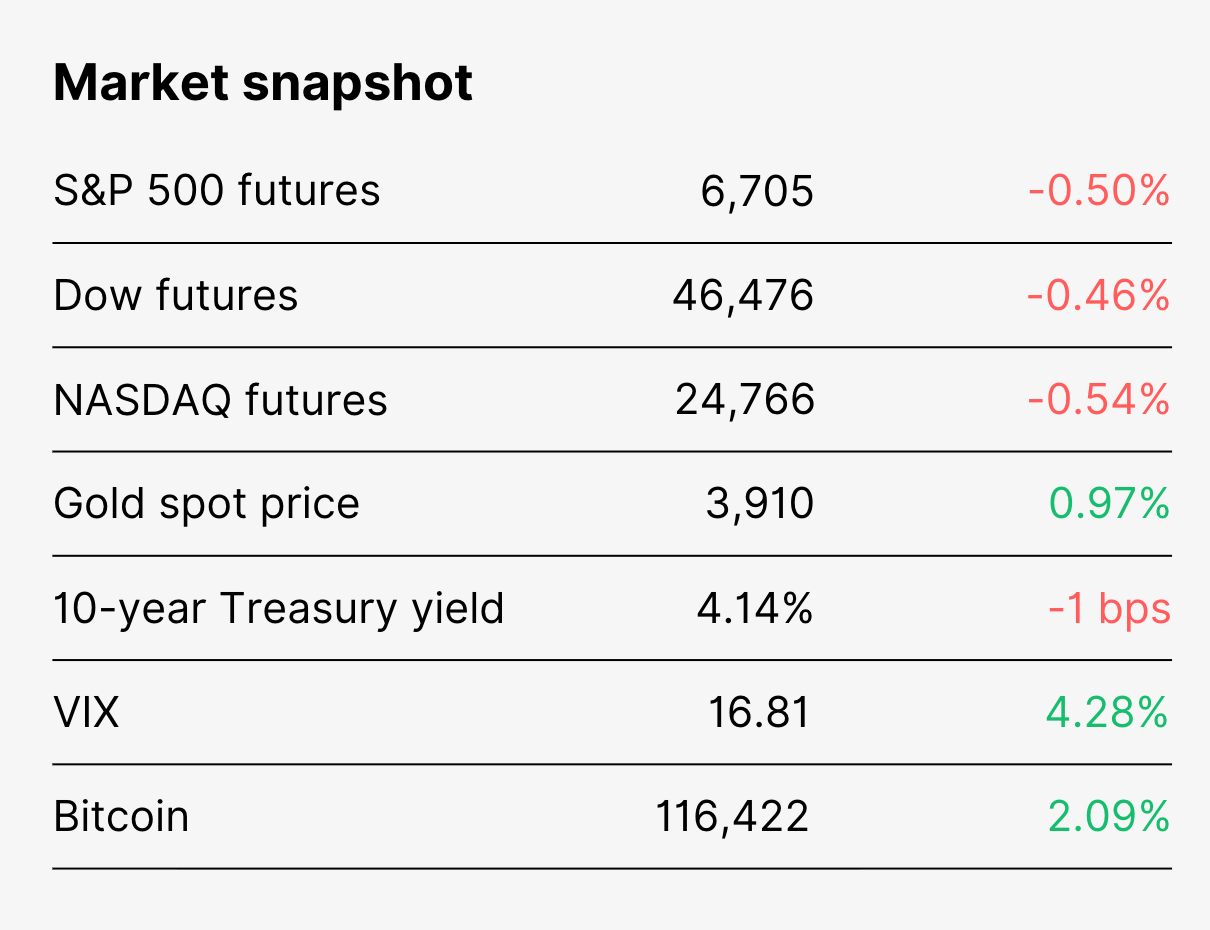
| | Good morning, Since ChatGPT’s launch, AI stocks drove 75% of S&P 500 returns, 80% of earnings growth, and 90% of capex growth, Morgan Stanley told me yesterday. There’s a lot of talk about AI as a bubble. But at this point, AI is no longer just a market story. The multi-trillion-dollar investments around it (emphasis on investment) have become an anchor of economic growth. In fact, AI expenditures now account for 1% of US GDP and two-thirds of annualized growth over the first half of 2025, according to the Bureau of Economic Analysis. AI spending is so immense that it’s now contributing more to GDP growth than consumer spending. Let it sink in. Investment in software and computers (AI expenditure proxies) accounts for just 6% of economic output… yet produces more growth than the backbone of the US economy. The catch is that this boom is pure capex with a long and unclear ROI driven by FOMO in the increasingly monopolistic, winner-takes-it-all tech sector. Even big tech execs admit as much. As Google CEO Sundar Pichai said during Alphabet’s earnings call last August… “When you go through a curve like this, the risk of underinvesting is dramatically greater than the risk of overinvesting.” “There’s definitely a possibility … based on past large infrastructure build-outs and how they led to bubbles, that something like that could happen here,” Meta CEO Mark Zuckerberg said on the Access podcast this month. The risk isn’t just in overspending but also in the concentration of spending. By Morgan Stanley estimates, the top 10 AI spenders now account for roughly 33% of spending among the 2,000 largest U.S. publicly listed companies. That’s well ahead of the 25% share from the biggest telecom-infrastructure builders during the dot-com bust. “While this narrative may have longer to run, analogies to the 1999–2000 ‘Cisco moment,’ when a few companies slowed investment on fears of overheating, are increasing,” said Morgan Stanley CIO Lisa Shalett. The bottom line is economic growth is hanging by a thin thread of capex spending from a handful of companies. And if AI is a bubble, the economy could very well pop with it.
| | | | | Hang tight, Dan Runkevicius, Chief Editor | |  | | | | | “Funding the government is an essential responsibility of Congress. A government shutdown would create uncertainty, disrupt critical services and harm American businesses, workers and families.” — The Business Roundtable, represented by CEOs from top companies including Apple, GM, Walmart, and JPMorgan Chase | | | | | Five things to know before opening bell | |
💸 More Fed officials support rate cuts Some Fed officials are now openly weighing more rate cuts to prop up growth and the labor market. “It may be appropriate to ease the policy rate a bit further this year, but the data will have to show that,” said Boston Fed chair Susan Collins. Meanwhile, Fed vice chair Philip Jefferson warned the labor market “could experience stress” if rates stay the course. 📉 Consumer confidence slides again September consumer confidence fell more than expected, dropping 3.6 points to 94.2, missing a Reuters forecast of 96. Senior economist Stephanie Guichard noted that sentiment on business conditions “was much less positive than in recent months,” while perceptions of job availability fell for the ninth straight month, hitting a multi-year low. 🎵 Spotify sinks on CEO exit Spotify shares fell about 4% yesterday after CEO and founder Daniel Ek announced he would step down at the start of next year. He framed the move as a “natural evolution” into his new role as executive chairman, and Wall Street sees potential upside in the long term. JPMorgan’s Doug Anmuth compared the new co-CEO setup to Netflix under Ted Sarandos and Greg Peters and highlighted that Sarandos sitting on Spotify’s board could provide valuable guidance through the transition. 📈 Stocks end September on high note September ended on a positive note for stock. The S&P 500 rose 0.4%, marking its fifth consecutive month-over-month gain, while the Nasdaq’s streak extended to six. The S&P 500 has gone 108 consecutive trading sessions without a single-day drop of 2% or more, the longest such streak since July 2024 🗂️ Shutdown won’t stop all the data The government shutdown could delay some reports, including Friday’s unemployment figures, but there’s still plenty of economic data hitting midweek. ADP releases its September jobs report today, while August construction spending and September manufacturing PMI numbers are also due.
| | | | 💼 Latest jobs data sends mixed messages
| | | | The shutdown might delay Friday’s official labor report, but the data coming out yesterday offered a nuanced snapshot of the US jobs market. At first glance, the Job Openings and Labor Turnover Survey (JOLTS) from the Bureau of Labor Statistics looked encouraging, but the details tell a more mixed story. 📊 What the JOLTS report found -
Job openings ticked up slightly to 7.227 million in August, a modest rise of 19,000 from July. Economists surveyed by Reuters had expected a decline to 7.185 million -
Average monthly nonfarm payroll gains from June to August were 29,000, down from 82,000 during the same period last year -
Hiring fell off a cliff, dropping by 114,000 to 5.126 million in August -
Meanwhile, layoffs declined by 62,000, settling at 1.725 million In other words, the labor market is still slowing but not collapsing. Powell called it a “curious balance” where both labor supply and demand are falling at the same time. Part of the explanation is that tariff uncertainty is keeping hiring managers cautious, while stricter immigration enforcement is shrinking the available workforce. 🛢️ The Exxon exodus ExxonMobil confirmed its restructuring would slash roughly 2,000 jobs, or 4% of its workforce, as the company consolidates operations into larger regional offices. “We’ve seen the value of bringing people together in the same location … we are aligning our global footprint with our operating model and bringing our teams together,” the compnay stated. The news comes on the heels of Starbucks' announcements about 900 worker and plans to shutter underperforming stores. Analysts often cite “no-hire, no-fire” trends as signs of a still-healthy labor market. Even with August’s dip in layoffs, the level remains 13% higher than last year, showing that the labor market is moderating rather than rebounding. | | | | ✈️ K-shaped recovery hits budget sectors | | | | Discount retail has been a rare bright spot in earnings season, as cash-strapped shoppers (and even well-off Americans) increasingly turn to dollar stores. But the insulation from a cooling economy won’t last forever, and budget hotels and airlines are already feeling the squeeze... 📉 A sign of the times Discretionary spending is usually the first to take a hit in a downturn, and travel numbers are proving the rule. “We are increasingly concerned about the backdrop for lower-end and select service hotels,” said Bank of America analysts Shaun Kelley and Dany Asad. Budget airlines are struggling too, trying to balance price-sensitive travelers with profitability in a slowing economy. High-income consumers are temporarily propping up niche segments, while many who would normally take budget trips are cutting back entirely. Kelley and Asad note that hotel revenues aren’t keeping pace with corporate profits like they did pre-Covid. Lodging and airline spending has dropped an average of 2% since 2023, even as overall consumer spending grew 1% in the same period. “Low income is particularly weak. Breaking down the data by income, the lower income cohort are meaningfully underperforming the broader category and the higher income cohort,” they said. 🔮 What happens next? Economists are concerned about a “K-shaped” consumer economy, with spending power concentrated among wealthier households. “We’re also likely to see continued depressed consumer sentiment readings, even as spending, driven by a narrow slice of households, remains strong," said Oxford Economics deputy chief US economist Michael Pearce. GlobalData managing director Neil Saunders says even affluent shoppers are gravitating toward value brands. “They don’t like the fact that more and more of their money is absorbed by essentials and the basics of life," he said. So what has happened is they have sought out better value for money, and they’ve especially done that in grocery and household essentials.” Notably, Saunders excludes hotels and air travel from this trend... for now. | | | | 🏢 Are data center REITS next big thing in AI? | | | | AI investment has been by far the biggest driver of equity gains this year. But one surging subsector could help keep the party going: AI-focused data centers. 🏢 The REIT conundrum Fermi America grabbed headlines this week after filing to go public... as a real estate investment trust (REIT), not a traditional stock. Following in the footsteps of REITs like Equinix and Digital Realty, it aims to capitalize on the booming AI data center space. REITs don’t usually deliver the rapid gains Wall Street sees in AI stocks. They’re bound by long-term contracts and legal requirements to distribute 90% of taxable income as dividends, which obviously tempers upside. Strategists aren’t expecting Fermi America, or any REIT, to rival Nvidia’s returns, though. But these data centers are the backbone of the AI sector, and their success would ripple directly into related equities. 🚀 Analysts still see upside Data centers are just one piece of a rapidly evolving, market-moving AI ecosystem — which, some worry, is tied to a handful of big names. HostingAdvice senior data center analyst Bill Kleyman isn’t sweating it, though. “Overall AI demand is so strong across many sectors that a shortfall from one large customer would likely be offset by others ramping up their investments.” Meanwhile, investment outlooks are picking up steam. Citi analyst Atif Malik predicts AI capex will reach $2.8 trillion between 2025 and 2029, setting the stage for the next leg of the AI rally. The catch is those are plans, not commitments. If AI spending or investment slows, all of these plans could fall like dominos. | | | | Rate today's newsletter... | | | Your feedback matters! Take a sec and tell us how we did! | | | | | | | | | | | | InvestorsObserver | | You received this email because you signed up on our website or made a purchase from us. | | | | |