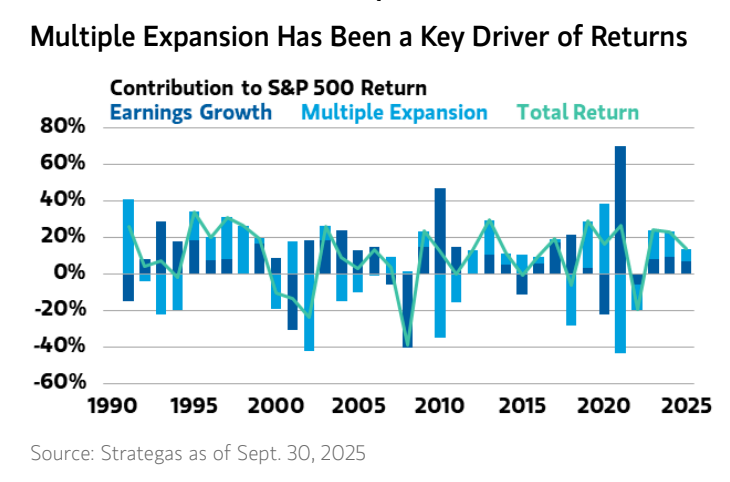
| | Good morning, This time I’m skipping the usual news rundown and going straight for something actionable. Every day, I scour hundreds of pages of sell-side research and speak to analysts on Wall Street to find the best explanation of what’s happening in the markets. Here’s an interesting take from my inbox today... Morgan Stanley CIO Lisa Shallet makes a great point that we should be conscious of the assumptions driving today’s forward earnings and multiples. While the rally is driven by AI capex and positive earnings revisions, the macro assumptions behind those expectations already have a lot priced in. Besides, it's not earnings growth but multiple expansion that has been the biggest driver of returns since 2020. | | | | | What this all means is that much of this rally is built on an aggressive earnings growth outlook and the macro assumptions that reaffirm it. While Morgan Stanley remains cautiously bullish, they recommend watching ISM indicators as a gauge of whether the goldilocks scenario is playing out... ...and loading up on real assets, including REITs and gold, as a hedge, just in case. | | | | | Hang tight, Dan Runkevicius, Chief Editor | |  | | | | | “If the Democrats refuse to keep the government open, then perhaps the efforts we’ve been making to make government more efficient will even accelerate.” — Trump economic adviser Kevin Hassett, on the possibility of federal employee layoffs | | | | | Five things to know before opening bell | | |
🚗 Tesla teases something big
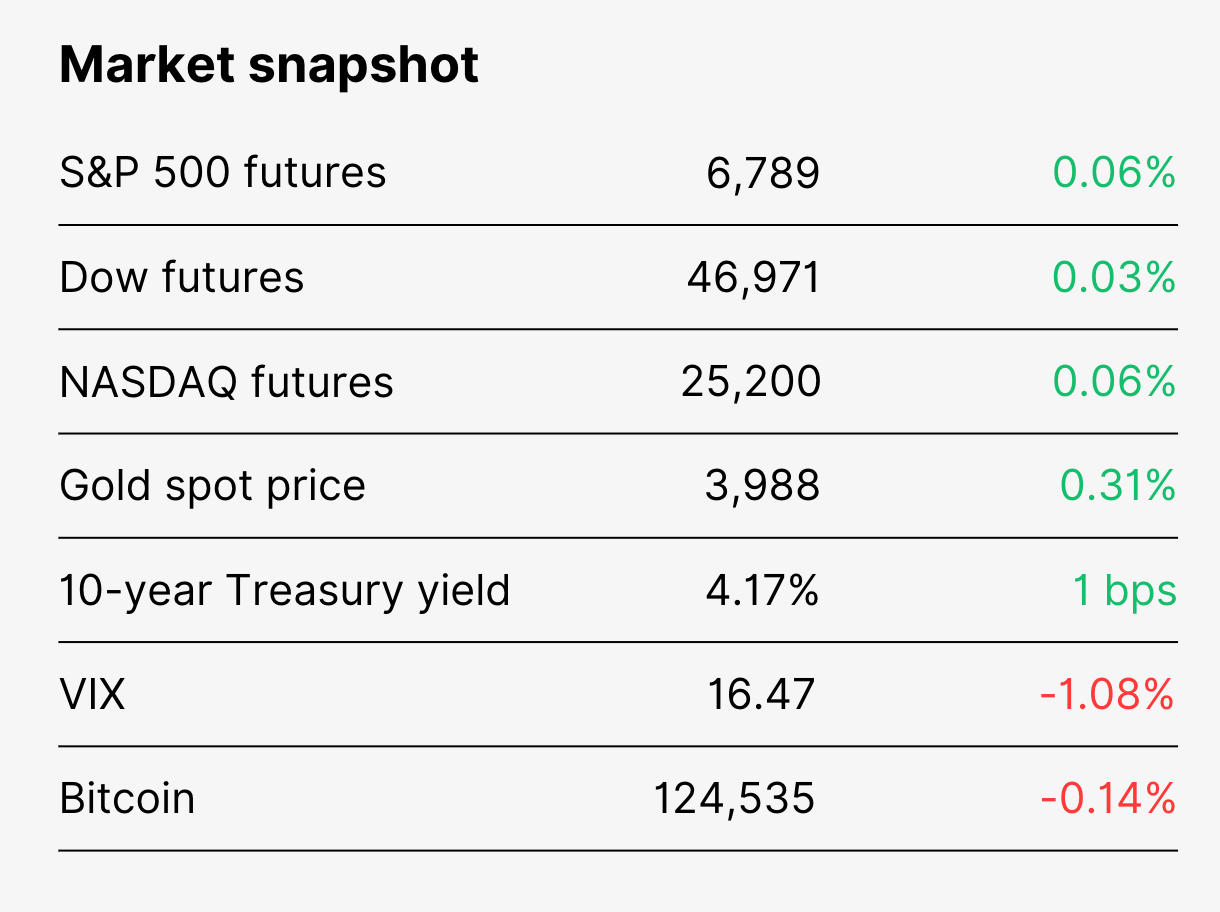
Tesla is keeping the suspense alive. The EV giant teased an announcement today with vague social posts showing wheels and headlights. Could this be the “more affordable models” promised in summer earnings? TSLA shares are loving the hype, up 5.45% Monday after strong Q3 EV delivery numbers. Expect buzz, not clarity… for now. 🚀 Bitcoin hits a new all-time high BTC topped $125K this week, flirting with a $2.5T market cap, nearly on par with S&P megacaps. Crypto as a whole now tops $4.2T. Bitcoin’s rally has made it a go-to safe haven, and JPMorgan warns of a “debasement trade” as global unrest and debt mount. 💰 CMA surges on $10.9B deal Comerica Bank jumped 13.7% after Fifth Third announced a nearly $11B takeover, creating a top-20 bank with $288B in assets. Fifth Third dipped slightly, but CEO Tim Spence hailed it as a “pivotal moment” to grow in high-demand markets. Regional banks keep getting gobbled up, and this deal is the biggest of the year. 📉 AppLovin tumbles on SEC probe AppLovin shares cratered 14% after the SEC opened an investigation into possible data-collection and ad-targeting violations. Whistleblowers allege unauthorized user tracking; the company denies wrongdoing and is cooperating. It’s the steepest single-day drop for AppLovin in six months. 🚚 Trump threatens new tariffs Trump announced a 25% tariff on imported medium- and heavy-duty trucks starting next month. Logistics stocks shivered, given the industry moves ¾ of US freight. Trade talks are coming this week, and the Supreme Court will weigh in on the constitutionality of Trump’s wider “reciprocal” tariffs. | | | | 🤖 OpenAI’s clout keeps growing
| | | | The AI trade has powered the market’s wildest rally in years … and one company at the center isn’t even on the NYSE. OpenAI, now valued around $500 billion, continues to move everything from chipmakers to ecommerce names with every announcement and rumor. 💥 Both an outsider and a market mover Even as a private company, OpenAI’s influence is undeniable. Shopify and Etsy shares jumped last week after a new ChatGPT feature allowed direct purchases. Meanwhile, OpenAI’s reveal of an in-house tool to rival existing software sent stocks like Atlassian and HubSpot sliding. This week’s DevDay conference only reinforced its clout. New ChatGPT capabilities now let users perform tasks inside other apps. Bulls see this as a step toward profitability after H1 2025 losses hit $2.5B despite $4.3B in revenue.
And the icing on the cake is OpenAI’s GPU deal with AMD that gave OpenAI a 10% equity stake and a clear path to future revenue.
🔮 What’s next? UBS analyst Karl Keirstead expects OpenAI to “diversify more aggressively beyond ChatGPT subscriptions,” possibly into web browsers or travel services. Ingalls & Snyder strategist Tim Ghriskey notes the company’s role as a market mover is cemented: “Even though we can’t play OpenAI directly, any info about its plans or products helps investors assess the landscape," he said. "Maybe companies we thought were at risk aren’t, or maybe we spot the next big AI play.” There's a growing debate about whether investors are getting ahead of themselves. Even CEO Sam Altman has warned of a bubble. But for now, OpenAI’s influence is stronger than ever, leaving investors somewhere between excitement and anxiety. | | | | 📈 Small caps hit record highs. Here's why that matters... | | | | The Russell 2000 is stealing the spotlight, crossing 2,500 for the first time ever and extending last month’s record into October. And the small-cap rally might just be getting started... 🏟️ Small caps step into the big league
For years, the Russell 2000 was the quiet sibling to the S&P 500 and Nasdaq, especially as AI-fueled mega-cap tech soared. But this fall, small caps are getting their moment. Analysts point to rate cuts, easing inflation fears, and strong credit conditions as tailwinds for smaller, debt-sensitive companies. By the numbers since August: -
S&P 500: ~7% gains -
Nasdaq: ~10% gains -
Russell 2000: +13.5% “We think we are in for a run in small-cap equities. They’ve started to pick up a little bit – and they are interest-rate sensitive,” Voya’s Eric Stein says 🔑 Small-cap bulls have a point
One of the biggest bullish cases for small caps is a massive valuation gap, with small caps currently trading at a 24% discount versus large caps. The Russell 2000 Value ETF’s forward P/E of ~18 makes it a rare bargain while bigger indexes keep breaking records. Caution is warranted because a spike in bond yields or consumer prices could send small caps defensive. But history suggests upside for all equities. In fact, the last time the Russell 2000 broke out, the S&P 500 added 15% over the next year. 📌 Bottom line: If investors are looking past AI megacaps, it could signal broader Wall Street optimism, not just a rally built on AI capex. | | | | 💳 Klarna’s IPO buzz shows how far BNPL has come... | | | | Even weeks after hitting the NYSE, Klarna is still stealing headlines. The stock debuted around $40 and have remained a favorite with analysts, who say the BNPL giant’s dominant spot in a booming sector leaves plenty of upside. 📌 How big is it? Here are some stats: - Klarna boasts a sector-leading 111 million consumers
- Nearly a million merchants have partnered with the platform
- By comparison, Affirm’s BNPL program has 23 million users
Wedbush strategists are bullish on its global expansion and new product plans, calling the setup “attractive for a leading global commerce network.”
Meanwhile, Deutsche Bank made a more interesting bullish case in its note this week: Klarna’s marketing division. With direct access to a digital ad market worth nearly half a trillion dollars, the bank says this “allows Klarna to monetize its platform through impression-based, cost-per-click, and cost-per action models.”
Price targets are bullish across the board. $50 from Wedbush, $48 from Deutsche, and Bank of America tops at $51. ⚖️ BNPL isn’t just Klarna Even if you’re not planning to invest in Klarna, it’s worth understanding the potential appeal and risks of BNPL. What was once a niche “loan” option has become a mainstream payment option, with nearly half of Americans have used BNPL at least once. That puts BNPL in direct competition with traditional credit cards. Supporters tout its interest-free access to credit, while critics warn of hidden fees and financial overextension. LexisNexis VP Kevin King calls BNPL a “giant black hole in the credit profile,” noting that it reduces card usage and other key revenue drivers. But Affirm COO Michael Linford begs to differ: “Credit isn’t new. Credit cards aren’t new. But they’ve had a hard time adapting to consumer needs.” BNPL, he says, is here to stay. | | | | Rate today's newsletter... | | | Your feedback matters! Take a sec and tell us how we did! | | | | | | | | | | | | InvestorsObserver | | You received this email because you signed up on our website or made a purchase from us. | | | | |