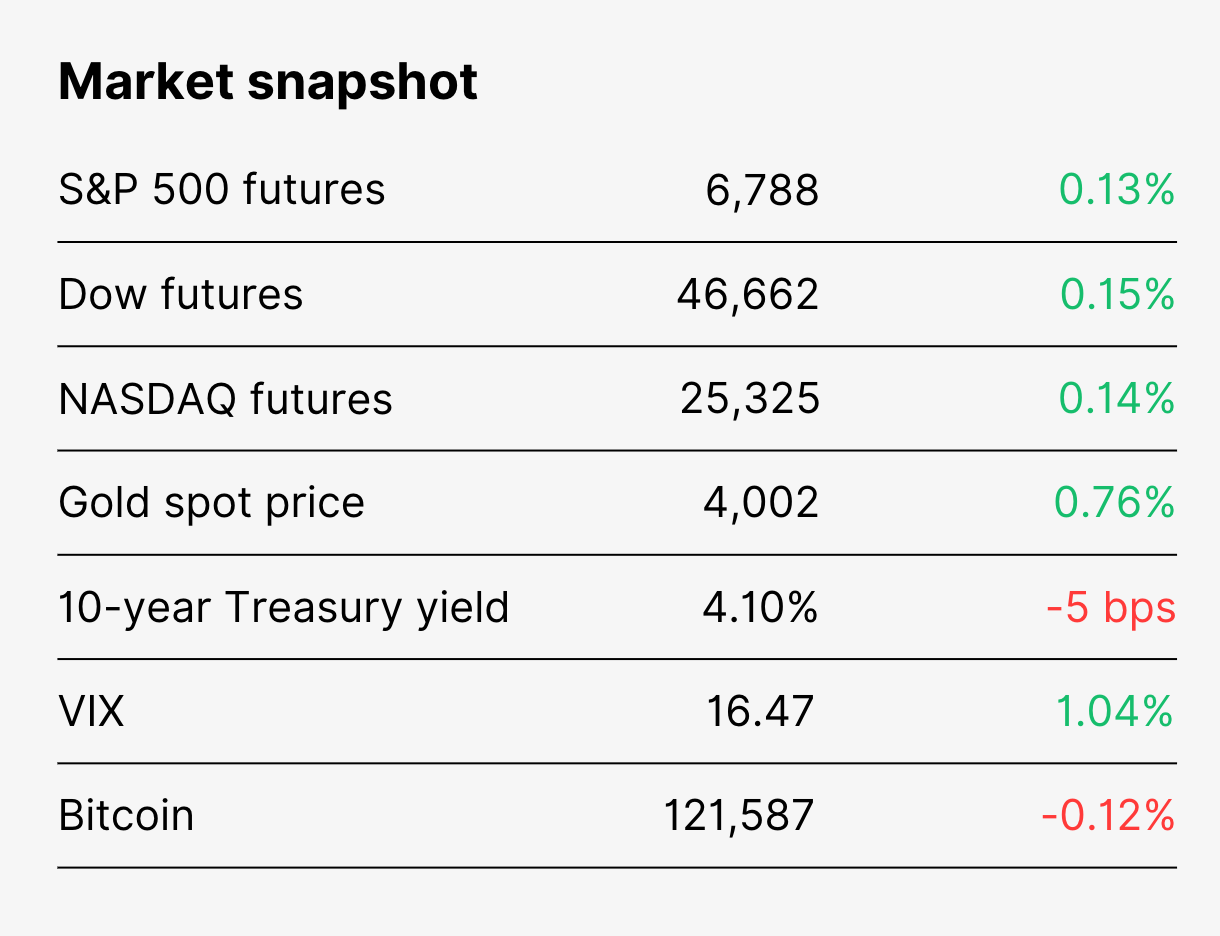
| | Good morning, Before we get into today’s news, a few optimistic thoughts (which we’ve apparently been short on lately) from my conversations over the past few days... I was on the phone the other day with Merrill’s strategists, who are easily some of the biggest bulls on Wall Street. What they’re saying is that although there’s always something to worry about, the numbers, which keep coming in better than expected, don't justify that anxiety. Here’s a short excerpt from their recent note to clients (emphasis mine): “U.S. economic growth and U.S. earnings have held up much better than expected. The economy expanded by a much-stronger-than-anticipated rate of 3.8% in Q2, while the Atlanta Fed tracker for real growth in Q3 is presently hovering around 3.8% as well. Q2 earnings, meanwhile, surprised to the upside (12% year-over-year growth), with margin expansion and upward earnings revisions. Similar dynamics are expected to unfold in Q3.” And they wrap it up with this line... “That’s another way of saying that the great market comeback of 2025 isn’t over, not with a confluence of [the above] factors.” For much of the year, US stocks lagged their global peers, but Merrill says that's about to change... or as they put it, “Don’t bet against the comeback kid.” There’s a saying among investors that nothing is more expensive than missing a bull market. The good news is, you never have to as long as you keep dollar-cost averaging. | | | | | Hang tight, Dan Runkevicius, Chief Editor | |  | | | | | “With inflation still too high, monetary policy should lean against demand growth to allow the space for supply to grow and relieve price pressures in the economy.” - Kansas City Fed president Jeff Schmid | | | | | Five things to know before opening bell | | |
🥤 Pepsi rallies on earnings beat, new CFO
PepsiCo stock ticked higher after the soda-and-snack giant beat Q3 forecasts. Strong international sales helped offset lagging North America, and the company is leaning into its “Make America Healthy Again” push, swapping seed oils and cutting additives across several product lines. Pepsi also confirmed Walmart U.S. finance chief Steve Schmitt will replace its retiring CFO next month. 💰 IRS adjusts tax brackets for inflation The IRS is getting ahead of rising prices, releasing inflation-adjusted tax brackets for next year. The top 37% rate now kicks in at $640,600 for single filers and $768,700 for joint filers. Standard deductions rise to $16,100 and $32,200, respectively. Long-term capital gains thresholds, estate tax exemptions, and several credits are also moving up. 🌬️ Orsted cuts 1 in 4 jobs amid U.S. policy chill Danish wind giant Ørsted will cut roughly 25% of its global workforce (about 2,000 jobs) by 2027 as it scales back U.S. projects in response to President Trump’s pause on offshore wind leases. The pivot underscores how the “Sell America” trade and shifting U.S. energy policy are nudging global firms to focus on steadier European markets. 💻 Intel’s new AI chip Intel unveiled its long-awaited Core Ultra Series 3 “Panther Lake” processor. the first chip built with its new 18A process and the first to roll out of its Arizona Fab 52 plant. The launch could help the company claw back relevance in the AI race against Nvidia and AMD. 📊 All eyes on consumer sentiment data today With federal economic data still offline, all eyes are on today’s University of Michigan consumer sentiment report. The survey due at 10 a.m. ET will shed light on how Americans are feeling about inflation, jobs, and their wallets. September’s reading showed a 5% drop, with 44% of respondents saying higher prices were dragging on their finances. Long-term inflation expectations rose to 3.7%, marking a second straight monthly increase. | | | | 🐂 Historic bull run or paper illusion?
| | | | For generations of investors, the common wisdom was that gold and stock moved in opposite directions, i.e., one rises as the other falls. But recently, they’ve been moving in tandem, reaching all-time highs together and retreating in tandem yesterday (although metals did receive a late-in-the-day boost). Analysts say that’s a problem because it suggests investors aren’t buying risk-on assets like stocks because they feel safe … it’s because everything else looks too dangerous. ❓ Opportunity, warning, or both? Gold’s record-breaking run past $4,000 an ounce is a tell-tale signal that the “debasement trade” we outlined in yesterday’s newsletter is picking up steam. For a quick recap, a falling dollar, political turmoil at home and abroad, and soaring federal deficits are driving the flight to real, scarce assets. Surprisingly, that now includes Bitcoin, with the crypto mirroring gold’s behavior and acting as a negatively correlated asset to a weaker dollar. But yesterday’s pullback in metals suggests the bull run in safe havens may be running a little ahead of itself. And that wouldn't be the first time. In fact, gold corrections have historically often preceded broader market recalibrations, particularly when risk assets and safe havens move in unison. 🔮 Paper illusion With the greenback on pace for its worst year in more than half a century, analysts say the rally in gold, stocks, and crypto isn’t about optimism but about fading confidence in the dollar. The Kobeissi Letter’ Adam Kobeissi thinks rate cuts that are likely to be announced over the next few months could make things even worse. “What’s really happening here is assets are pricing in a new era of monetary policy. When safe haven assets, risky assets, real estate, and inflation are all rising together, it’s a macro-based shift. The Fed has zero control of long-term yields.” Independent analyst Shanaka Anslem Perera calls it the “illusion of prosperity,” arguing that the market is experiencing “monetary panic in slow motion,” not a historic bull run. “This is not a boom,” he concluded. “It’s the endgame of a system priced in paper and powered by illusion.” | | | | 🇨🇳 Here's why rare earths on fire. Hint: China | | | | While U.S. markets slid yesterday on shutdown fears and rate-cut uncertainty, rare-earth bucked the trend thanks to a bombshell from China. 🐉 China’s role in the surge Beijing says foreign entities now need licenses to import any goods with 0.1% or more of their value tied to rare earths. The timing is key — coming ahead of a likely Trump-Xi meeting — and it means companies relying on Chinese refineries, magnet recycling tech, or exports now need government approval. One Trump administration official called it a “power play designed to control global tech supply chains.” With Beijing wielding its rare-earth dominance, which are critical for everything from tech to EVs and defense, supply crunch fears sent stocks climbing. ⚡ How the industry responded U.S. miners led the charge: The rally follows recent boosts from the Trump administration’s equity stakes in several miners as part of a push to secure a domestic supply chain and reduce reliance on China. “This action reinforces the need for forward-leaning U.S. industrial policy. Building resilient supply chains is a matter of economic and national security,” said MP Materials. 🌎 The bigger picture Evercore ISI analysts call it nothing more than a “game of chicken” between the world’s two largest economies. For investors, the takeaway is that, in today’s markets, politics and posturing can move stocks as much as earnings or interest rates. | | | | 🦢 Should you worry about “white swan”? | | | | Stocks are flying on AI optimism, with the Nasdaq up nearly 30% YTD and Nvidia cementing itself as the world’s most valuable company. Even Thursday’s near-flat close didn’t faze tech bulls. Nvidia CEO Jensen Huang says demand for computing power has “grown substantially” and insists the AI boom is “still in its early stages.” 📈 Where things go from here A wave of cross-investments between chipmakers, cloud providers, and AI startups draws comparisons to the creative financing that fueled the dot-com bubble 25 years ago. But banks like Goldman and BofA note most AI investment is profit-backed, not borrowed. BofA’s Vivek Arya estimates circular funding accounts for just a single-digit percentage of the $5T expected to flow into AI by 2030. Goldman strategists add that even concentrated growth isn’t the same as a bubble. ⚠️ "White Swan" warning Nassim Taleb, who coined “black swan,” sees a different threat: a “white swan,” a drawn-out economic ordeal that could drag down stocks far beyond 2025 gains. The culprit is out-of-control global debt, not AI. Bridgewater’s Ray Dalio seconds the warning, noting that Uncle Sam may soon need to borrow just to pay interest, risking runaway inflation and eroding confidence in the dollar. Meanwhile, former Google exec Sridhar Ramaswamy — now CEO of AI data firm Snowflake — says companies should focus on value creation over market noise. “We have to earn dollars, every single dollar at a time… the stock market will settle itself.” | | | | What are your investment goals? | | | It’s anonymous, just a few quick questions to help us tailor our analysis to you. | | | | | | | | | | | | | | | InvestorsObserver | | You received this email because you signed up on our website or made a purchase from us. | | | | |