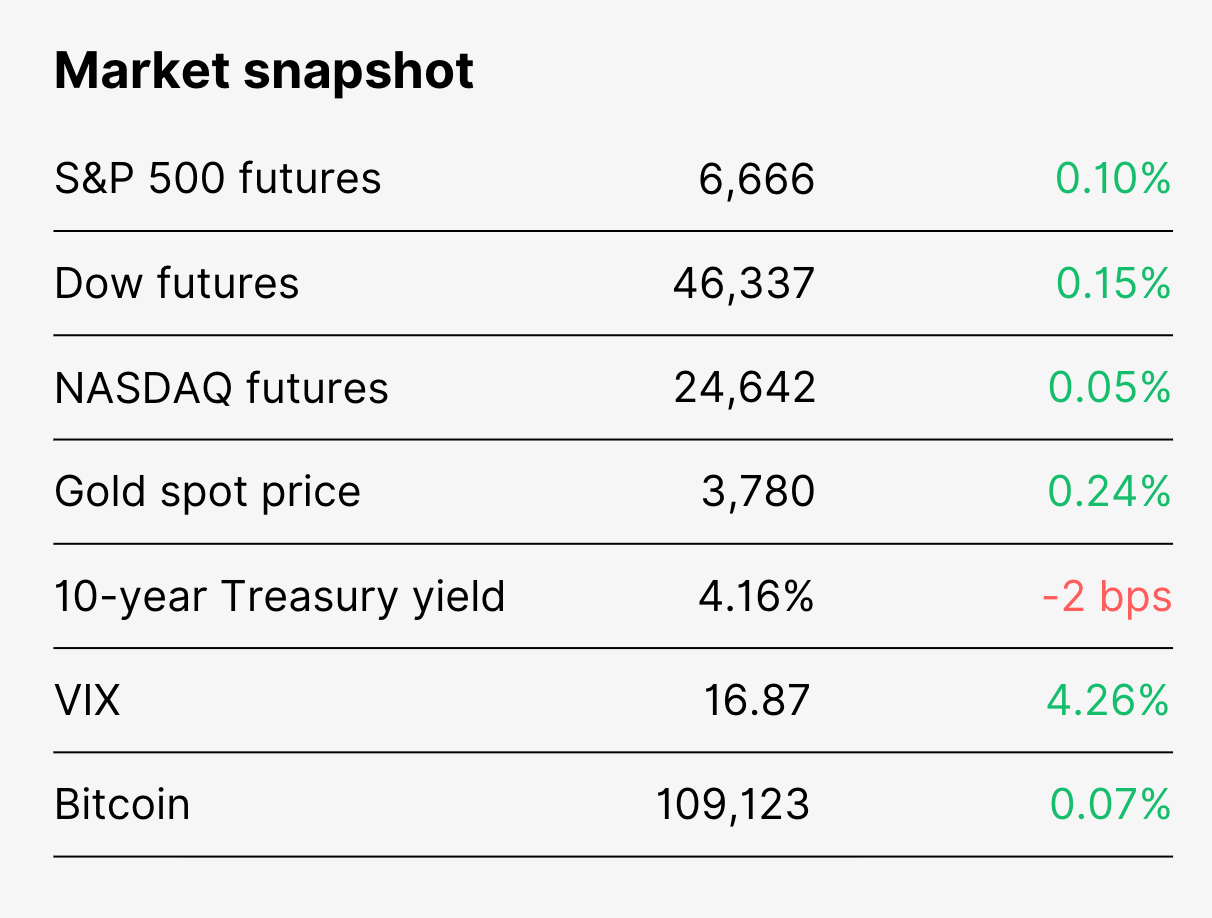
| | Good morning — Wall Street is juggling a lot this morning. Futures are mixed. Trump introduced 100% tariffs on patented drugs, and Amazon just got slammed with a $2.5 billion FTC settlement over Prime subscription snafus. Meanwhile, gold is flexing its safe-haven muscles near record highs as Bitcoin wobbles, proving once again who’s the store-of-value king. All eyes are on today’s PCE inflation and Michigan consumer sentiment readings, which could shake rate-cut expectations. The Fed is split on what to make of it all. Some urge caution, others push for faster cuts, leaving markets guessing which path Powell will take next. Over at Main Street, optimism is clashing with reality. Q2 GDP came in hotter than expected at 3.8%, but Starbucks layoffs remind us that labor-market risks haven’t vanished. And looming over it all is the government shutdown clock. There’s a lot to digest before the weekend, but one thing is clear: whether it’s gold, Fed policy, or the latest earnings shock, volatility is the name of the game in H2 2025. | | | | | Hang tight, Dan Runkevicius, Chief Editor | |  | | | | | "The hard part about timing the market is you've got to be right twice. You've got to get out at the right time, and then you've got to be able to get back in at the right time, and that's very hard to do." — Charles Schwab CEO Rick Wurster | | | | | Five things to know before opening bell | | |
💸 AMZN takes a $2.5B hit Amazon finally put an end to an FTC probe, but it cost them $2.5 billion. The settlement covers alleged deceptive practices around Prime subscriptions from mid-2019. About 35 million affected members will get $51 each, while Amazon denies any wrongdoing. A “clear and conspicuous” cancellation button is now required. 📊 Inflation and sentiment in the spotlight Today’s PCE inflation and Michigan consumer sentiment reports could move markets. Consensus expects mild PCE numbers — 2.7% annual, 0.3% monthly — with core prices slightly higher. Michigan sentiment preliminaries dipped to 55.4 from 58.2 in August. Lower- and middle-income consumers are feeling the pinch hardest, survey director Joanne Hsu said. 🏛️ Fed independence on the line Trump’s push to oust Fed governor Lisa Cook has drawn fire. If successful, it would be the first forced removal of a sitting governor and critics warn it could weaken the Fed’s independence. A Supreme Court brief signed by every living former Fed chair called the move a direct threat to economic stability and the Fed’s credibility. ⏳ Shutdown risk rising The federal government’s Oct. 1 budget deadline is looming, and shutdown odds are climbing. Analysts warn layoffs, service disruptions, and market volatility are all on the table. Rating agencies could even put the U.S. on credit watch. Citi’s Andrew Hollenhorst flagged potential delays in key economic data, including the September jobs report. 📉 Q2 GDP surprises, markets shrug Q2 GDP growth was revised up to 3.8%, a strong rebound from Q1’s 0.6% contraction. Consumer spending drove the lift, especially in services. Investors weren’t impressed, with all three major indexes closing lower and | | | | 💼 Where is the labor market at?
| | | | The Fed’s rate cut — and hopes for more to come — have boosted optimism about the jobs market. But yesterday’s data sowed confusion: solid jobless numbers paired with a high-profile corporate shakeup. 📈 Breaking down the numbers The Labor Department’s weekly jobless claims report showed a notable slowdown, supporting hawkish Fed arguments that unemployment isn’t an immediate threat: -
Seasonally adjusted new claims fell to 218,000, down from 232,000 the previous week. -
Analysts had expected a slight rise, with a consensus of ~235,000. -
Continuing claims dipped modestly, falling 2,000 to 1.926 million. ☕ Starbucks shakeup The good news didn’t last. In a public letter, Starbucks CEO Brian Niccol, who took the helm just over a year ago, announced hundreds of store closures and nearly 1,000 job cuts as part of a $1 billion restructuring plan. “We will continue to carefully manage costs and stay focused on the key areas that drive long-term growth,” Niccol wrote. Even with claims at low levels, uncertainty can weigh on sentiment — especially with high-profile layoffs like Starbucks’. “Recent employment reports show a clear trend: the labor market is losing momentum. That spells trouble for the economy and the stock market. The slowdown in job creation, coupled with weaker corporate earnings, is setting the stage for increased market volatility,” said RIA Advisors’ chief strategist Lance Roberts. | | | | 👑 Gold holds safe-haven crown | | | | For much of 2025, Bitcoin's steady climb in the face of global turmoil drew comparisons to gold as an alternative store of value.
While the crypto is still trading well above its January levels, gold has surged 40% this year, which is more than double bitcoin’s return. The crypto demand is growing too, thanks to new ETF flows and corporate adoption. But gold remains the main hedge against everything from U.S. fiscal worries to wars in Europe and the Middle East. “Investors don’t see enough fiscal stability on the U.S. side and overall if you think about the trade war, about tensions with Russia and the Middle East, it’s easy to understand why gold is surging,” said Swissquote analyst Carlo Alberto De Casa. 🏦 Morgan Stanley’s portfolio update Morgan Stanley CIO Mike Wilson underscored the shift, unveiling a new “60/20/20” inflation-shielding portfolio that places 40% in Treasuries and gold, with the rest in equities. His verdict is that gold now beats Bitcoin as the hedge to own. “Gold is now the anti-fragile asset to own, rather than Treasuries. High-quality equities and gold are the best hedges.” Quantitative Commodity Research’s Peter Fertig added that today’s PCE inflation report could hand gold another tailwind. “If the economic data comes in as the market has expected, that at least indicates that the market is on the right track toward the Fed easing [rates] providing support for gold,” he said.
Gold closed mostly flat yesterday, holding near record highs around $3,770 an ounce. BTC, meanwhile, is down more than 5% over the past five sessions, dipping below $109,000 before clawing back some ground. | | | | 🦅🕊️ Fed hawks and doves square off | | | | In his post-rate-cut remarks earlier this week, Fed Chair Jerome Powell admitted there is “no risk-free path” going forward. As central bankers weigh the lesser evil, they’ve been unusually transparent about their reasoning over the past few days... 📢 Voices from both sides Yesterday’s calendar was packed with Fed speeches hinting at, if not outright stating, what officials think the next move should be. Chicago Fed Governor Austan Goolsbee, speaking in Michigan, voiced concern about cutting rates too deeply or too quickly. “If we are in this environment where inflation’s been above the 2% target for almost five years in a row now, and it’s going the wrong way, just counting on the inflation to be transitory makes me uneasy,” he said, cautioning against front-loading too many cuts. Kansas City Fed President Jeff Schmid acknowledged that the labor market may be cooling more “substantially or abruptly” than expected, but shared Goolsbee’s caution. “I view the current stance of policy as only slightly restrictive, which I think is the right place to be,” he added. Meanwhile, Fed Governor Stephen Miran — the central bank’s newest member — continues to advocate for more aggressive cuts, warning that current rates could stunt growth. “That’s why it’s so important to start adjusting more quickly, rather than less quickly,” he said. “When monetary policy is in that restrictive a stance, the economy becomes more vulnerable to downside shocks. In my mind, there’s not really a need to be running that type of risk.” Fed Governor Michelle Bowman, also a Trump appointee, seconded Miran, suggesting the Fed could implement three rate cuts by year-end, as she originally projected in December 2024. 🔄 The calculus keeps changing With each new market report, Fed officials fine-tune their guidance. Today’s PCE inflation release will be one of the most influential signals ahead of the FOMC’s late-October meeting. Vanguard senior analyst Josh Hirt expects stubborn inflation will limit Fed action to just one more cut this year. “The Fed needs to continue to add that element of caution around the inflation mandate,” he said, noting that price pressures are shaping up to be “more worrisome” than current market trends suggest. | | | | Rate today's newsletter... | | | Your feedback matters! Take a sec and tell us how we did! | | | | | | | | | | | | InvestorsObserver | | You received this email because you signed up on our website or made a purchase from us. | | | | |