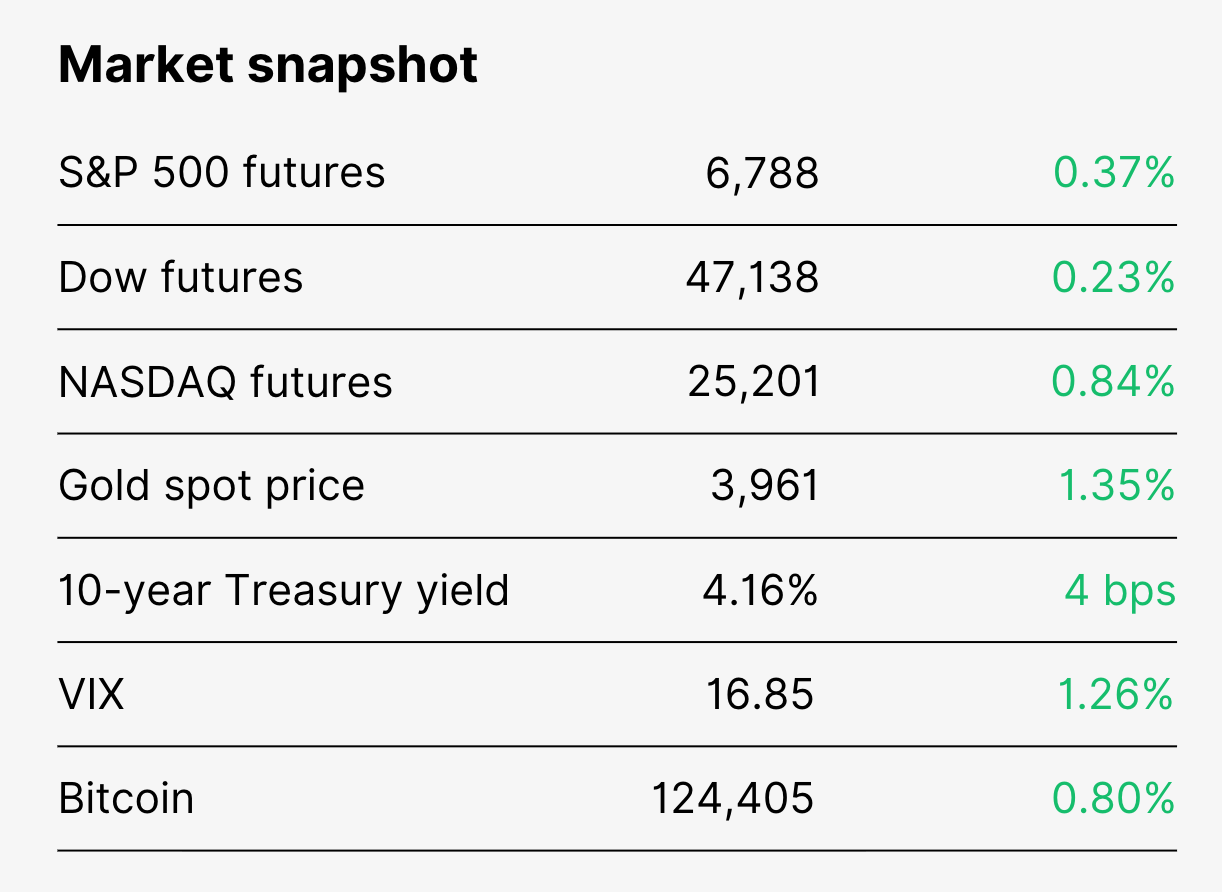
| | Good morning, Washington’s shutdown has turned into a market sideshow and Bitcoin is the surprise headliner. The world’s biggest crypto just logged a 17% weekly jump, hitting an all-time high over the weekend as investors bet on digital assets as a hedge against DC dysfunction. Standard Chartered now sees $135K as the next stop and $200K by year-end if ETF inflows keep up. Meanwhile, business groups are fuming over Trump’s $100K H-1B visa fee, futures are edging higher despite the government freeze, and gold’s rally has gone full supernova, up nearly 50% this year. On the corporate side, Reddit is still licking its AI wounds after ChatGPT stopped using its data, though shares bounced as it courts Google for a new deal. Speaking of courts, the Supreme Court is about to wade into Trump’s trade powers and a Fed firing case that could redefine central bank independence.
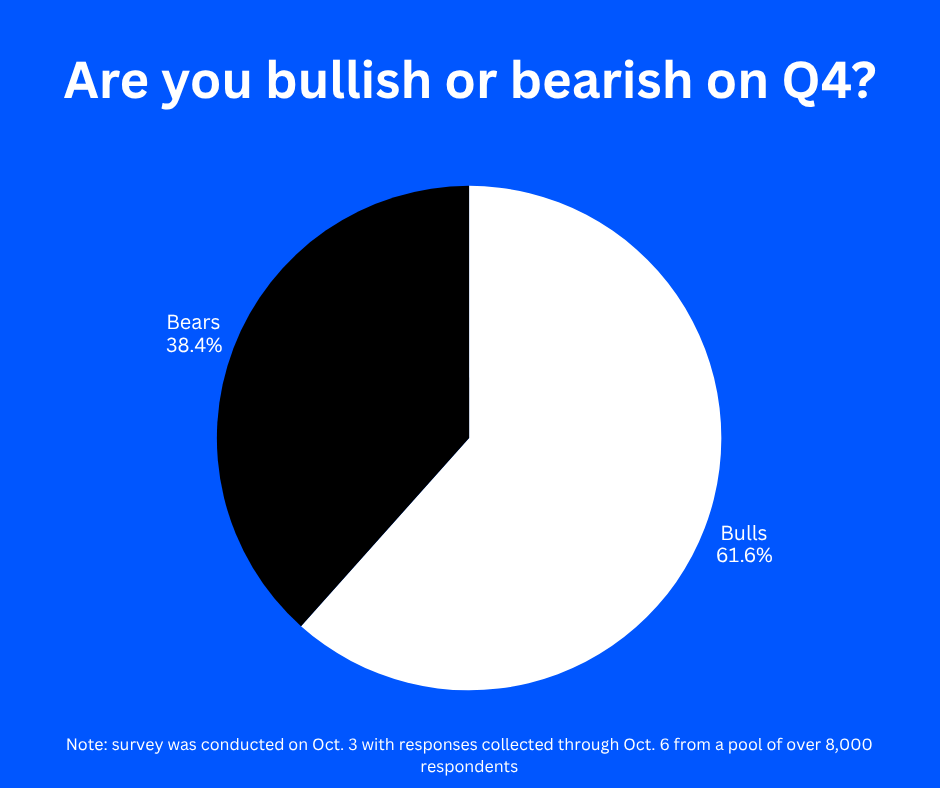
Let’s dig in. P.S. I was impressed with your engagement in the survey. I’ve shared Friday’s results based on responses from over 8,000 participants at the end of the newsletter!
| | | | | Hang tight, Dan Runkevicius, Chief Editor | |  | | | | | "Gold is now the anti-fragile asset to own, rather than Treasuries. High-quality equities and gold are the best hedges" - Morgan Stanley CIO Mike Wilson | | | | | Five things to know before opening bell | | |
📈 Bitcoin surges to new record highs
October is off to a roaring start for Bitcoin, which gained 17% last week and hit a record high over the weekend. Standard Chartered’s Geoff Kendrick noted that this shutdown matters more than the 2018–2019 version because Bitcoin now trades with “US government risks.” He sees $135K short-term and keeps his $200K year-end forecast, expecting “at least another $20 billion” in BTC ETF inflows. 🤖 Reddit regroups after AI flop Reddit’s AI experiment hit a bump after ChatGPT stopped using its data, tanking RDDT shares more than 15% for the week. But Friday saw a bounce as Reddit continues talks with Google on a potential partnership to drive direct engagement. Critics say the platform is trading its community for short-term gain, but some analysts believe the bold pivot could pay off over time. 💼 Business groups chide Trump A dozen industry groups are pushing back on Trump’s $100K fee for each new H-1B visa. In a letter delivered last week, they warned the move would shrink the pool of skilled workers US companies rely on. The groups asked the White House to collaborate with industry “without increasing the significant challenges US employers face recruiting, training, and retaining top talent.” 📈 Futures point to strong week start Stocks futures are flashing green this morning, with all three major indexes adding a fraction of a percent. For now, investors seem largely unfazed by DC gridlock, turning their attention to Fed speeches, third-quarter earnings, and Amazon’s Big Deal Days to gauge the economy's health. 🇯🇵 Japan’s markets roar on pro-stimulus pick Japanese equities surged after the ruling party chose pro-stimulus lawmaker Sanae Takaichi as its next leader. The Nikkei 225 jumped more than 4%, while the yen slipped past 150 per dollar and hit a record low versus the euro. The country is now bracing for a shift to the right and the potential economic policies that come with it. | | | | 🏛️ SCOTUS front and center this month
| | | | Trump’s tweets and DC budget battles have already rattled markets. Now the Supreme Court is about to take center stage... and its decisions could move economic forecasts, if not Trump’s legacy. 🏛️ Two cases to watch - Learning Resources Inc. v. Trump: Set for review in less than a month, this case will decide if the president can unilaterally impose import tariffs. Businesses hit by his tariffs argue he isn’t empowered by the International Emergency Economic Powers Act, as the White House claims. Most of Trump’s “reciprocal” tariffs targeting specific countries hang in the balance.
- Cook v. Trump: This escalated to the Supreme Court after Trump tried to fire Fed governor Lisa Cook over alleged mortgage fraud. Cook refuses to step down, and a lower court says she can stay. SCOTUS will decide if Trump had proper cause — a ruling that could reshape how independent the Fed really is.
💼 Why you should care These aren’t just political headlines. If Learning Resources goes Trump’s way, presidents could reshape global trade policy without Congress, adding more uncertainty. A loss for the White House could force repayment of tariffs and unravel a key part of his trade strategy. Cook v. Trump will either reinforce or erode confidence in the Fed’s independence... and by extension, how much influence the president can exert on monetary policy. 🖼️ The bigger picture “The President, White House, and Congress get most of the attention, but the high court is equally vital, if under-reported, in its economic influence,” Better Markets CEO Dennis Kelleher and legal director Stephen Hall. “Too often the Court’s role as a protector of the economy and America’s Main Street families is overlooked because the public — and to a greater extent the media — tend to focus on the Court’s cases dealing with more high-profile and controversial social issues like abortion rights, gun control, and more recently, issues surrounding immigration.” The upcoming term could change how markets and Main Street feel the Court’s impact, even if most people don’t notice. | | | | | Wall Street has been fretting for months about AI. Is it fueling a real stock rally or just inflating the next bubble? New research suggests the panic is fading long before any actual burst... 🌐 Web searchers have spoken Or, more accurately, they’ve gone quiet. Deutsche Bank analysts found global Google searches for “AI bubble” have dropped 85% since their August peak. That high-water mark came when MIT warned of a dip in AI returns and OpenAI’s latest release failed to excite. Searches for “AI boom” are also down. Deutsche’s own “bubble worry” index, tracking news headlines, fell sharply from 7.3 to 5.1 since August. But Google searches are just one measure. There's a massive void between trillion-dollar investments in AI and revene, and risk is still real. 🔄 Will bubble history repeat itself? Many warn AI could follow the hype-and-collapse pattern of the 1999 dot-com bubble. But Deutsche strategists Adrian Cox and Stefan Abrudan aren’t convinced. They think integrating AI into “well-governed enterprise systems” takes time, and a modest market correction may actually signal maturity. “Evidence is still emerging of where the dollars and cents of value will come,” they wrote. Catalyst Hedged Equity Funds manager Joe Tigay sees at least one more big bum coming. “It absolutely feels dangerous to buy tech stocks right now. Their valuations are high, and they could correct at any moment. But my core thesis is that we are likely not at the bubble’s end yet," he said. He adds that the “liquidity phase that preceded the final, astronomical surge of 1999-2000” is still ahead. “Missing the final rally would be a catastrophic mistake,” he said. Goldman Sachs CEO David Solomon is bracing for a drawdown as early as next year, warning a “lot of capital will be deployed that will not deliver returns.” Meanwhile, MacroStrategy Partnership estimates the AI bubble is now 17x bigger than the dot-com peak and 4x bigger than the 2008 subprime crisis. Even Jeff Bezos called AI an “industrial bubble” last week. But that doesn’t rule out a comeback like Amazon’s post-dot-com revival.
At the end of the day, it’s anyone’s guess. You can spot the speculative signs, but we won’t know we’re at the peak until it pops. | | | | 📉 Alternative jobs data coming in | | | | Even during a partial data blackout, economists say they have enough clues to sketch out a forecast... and the Chicago Fed is showing how it’s done. Instead of waiting for delayed government reports, the Chicago Fed released its own monthly labor metric just days before Washington went dark. That report showed unemployment just under 4.4%, matching highs not seen in four years. With official data now offline, Chicago Fed president Austan Goolsbee says it’s time to get creative. “We fight with the army we have at moments like this,” he said, adding that it’s “critically important” to track any signs of transition in the economy. For now, he says, those signals “point to a pretty stable labor market.” 🧠 Reading between the numbers Other non-BLS indicators are a mixed bag. We’ve already seen the ADP report showing 32,000 job losses in August, hinting at a softer hiring environment. A few more pieces complete the puzzle: -
Goldman Sachs estimates 224,000 national jobless claims last month, typical, though slightly elevated by 2025 standards -
Dow Jones consensus calls for 51,000 new nonfarm payrolls in September and a repeat of August’s 4.3% unemployment rate -
BofA economist Shruti Mishra noted a steady 2.2% annual rise in card spending last month, saying “spending growth remains solid despite soft labor data." Indeed data shows job postings down nearly 9% year over year, led by weakness in tech. Healthcare remains the standout exception Indeed’s Cory Stahle added that younger and long-term unemployed workers are finding it harder to get back into the job market. “Regardless of what the unemployment rate is, people taking longer to find jobs is a sign of economic distress for some households,” he said. 📌 Bottom line: In the absence of government data, analysts are sketching out a fairly consistent view — the jobs market isn’t great, but it’s not terrible either. | | | | InvestorsObserver | | You received this email because you signed up on our website or made a purchase from us. | | | | |