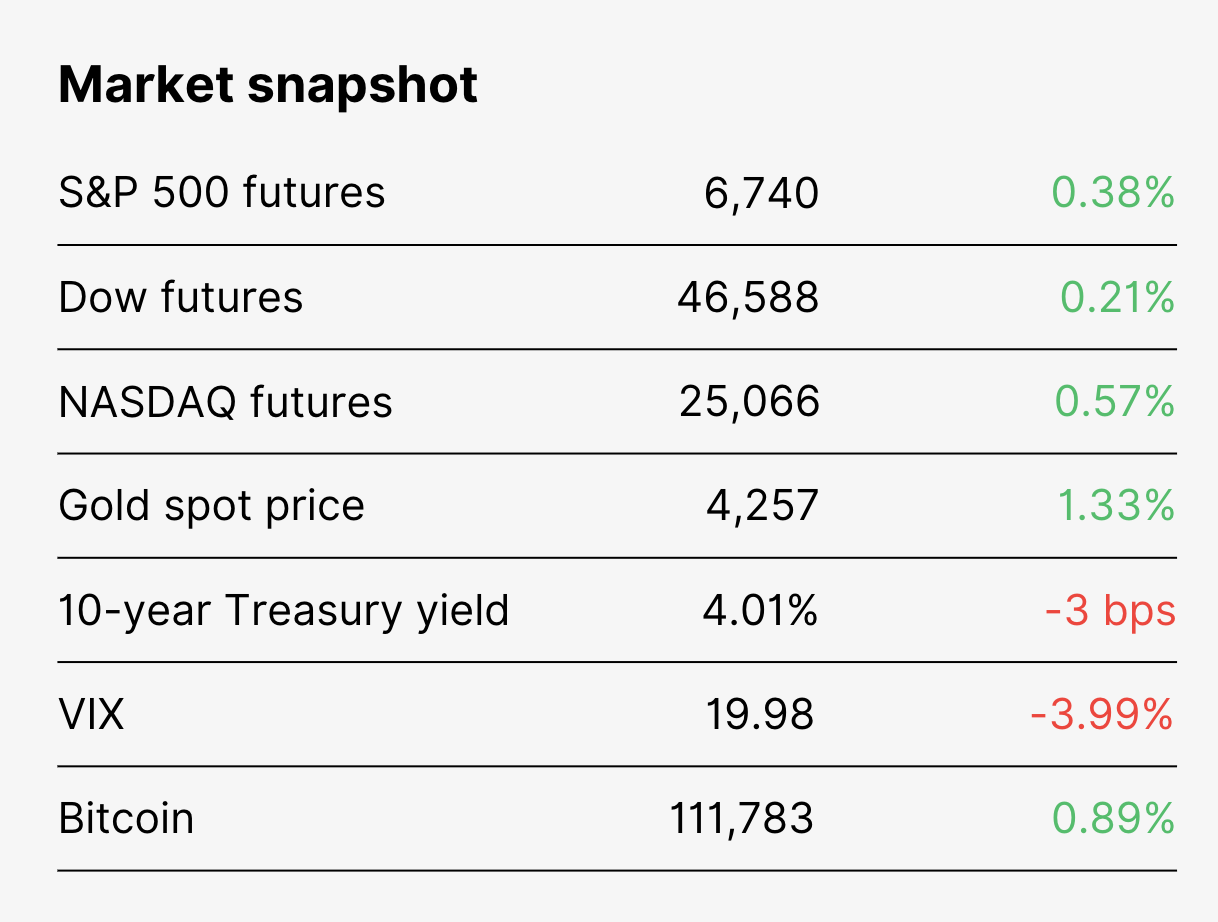
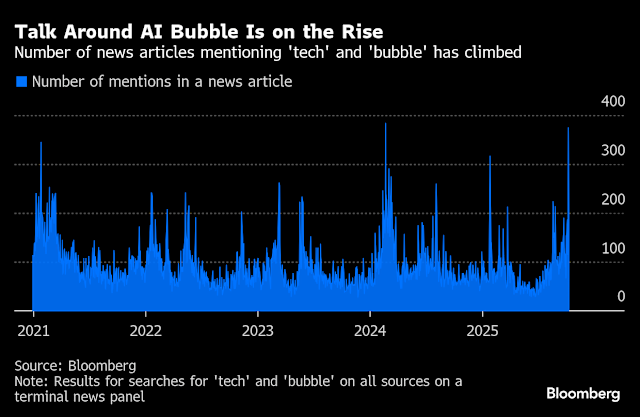
| | Good morning, Wall Street is starting to have second thoughts about its seemingly unconditional fixation on AI. Analysts are now openly debating whether the AI boom is entering its “priced-to-perfection” phase or teetering on the edge of a bubble... ... with JPMorgan, Goldman Sachs, and State Street offering strikingly different takes on where the trade goes next. Meanwhile, Treasury yields are slipping toward the 4% mark as traders bet on more Fed rate cuts and brace for another Trump tariff shock. The Fed’s latest Beige Book confirmed what many already feel: prices are still rising, and tariff-driven costs are gradually creeping into final goods. In Washington, the government shutdown is turning into a slow-motion layoff wave. The White House now expects over 10,000 federal job cuts as agencies run out of funding. Finally, a new threat is emerging on the digital horizon. Quantum computing could eventually crack Bitcoin’s encryption. For now, Bitcoin sits just above $111,000 after a volatile week, but even the bulls admit a quantum reckoning may only be a few years away. While nearly every asset class wrestles with inflation, tariffs, and record valuations, one trade remains bulletproof: gold. The metal hit another record above $4,257 an ounce, with some analysts now calling for $6,000 by next year and $10,000 by 2030. Let’s dig in! | | | | | Hang tight, Dan Runkevicius, Chief Editor | |  | | | | |
“Prices rose further during the reporting period. Tariff-induced input cost increases were reported across many Districts, but the extent of those higher costs passing through to final prices varied.”
— The Federal Reserve’s latest Beige Book report
| | | | | Five things to know before opening bell | | |
🏛️ Shutdown layoffs set to top 10K
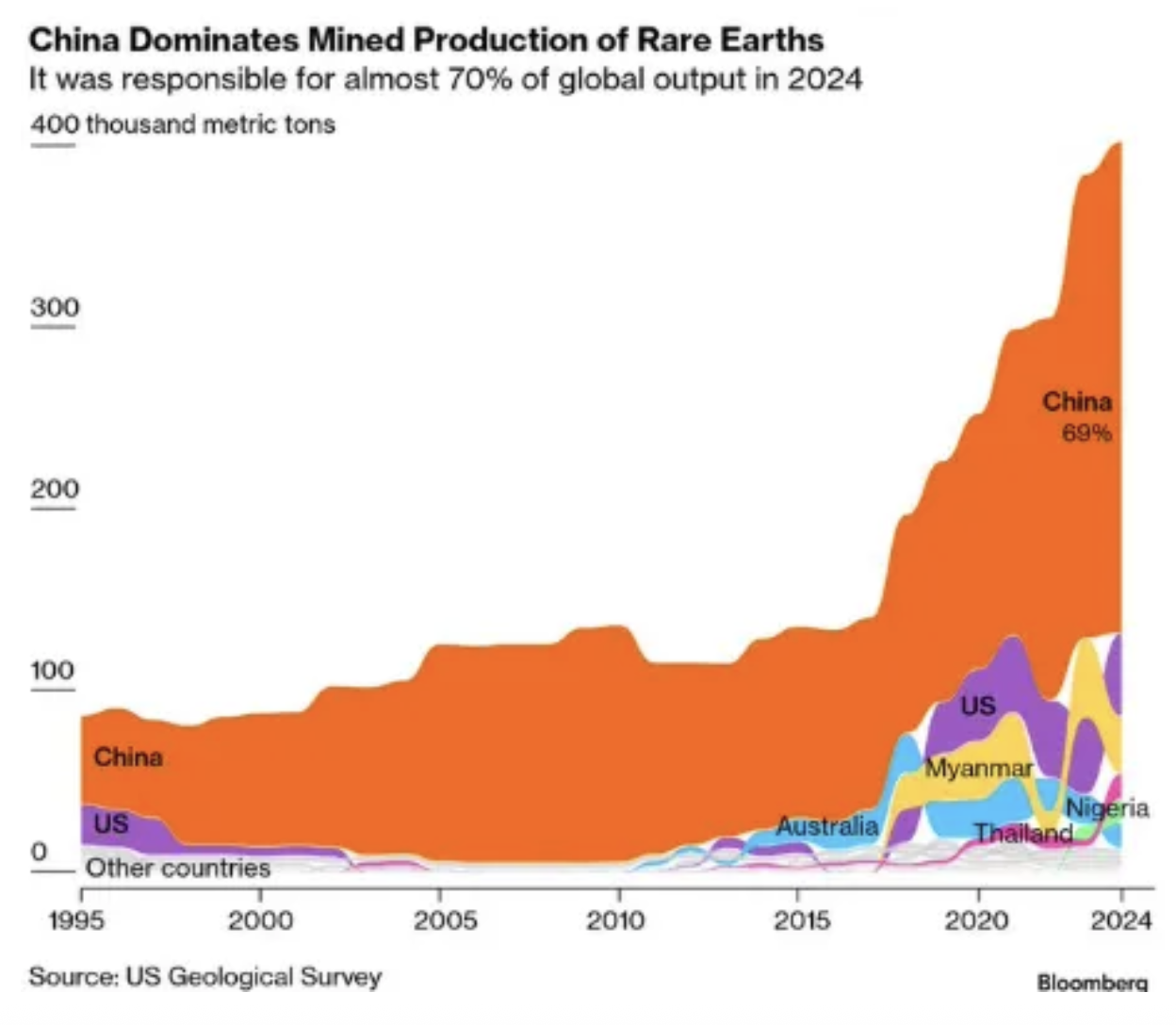
White House budget director Russell Vought said yesterday that the Trump administration expects to eliminate more than 10,000 federal jobs as the government shutdown drags on. Framing the cuts as part of Trump’s broader effort to “shutter the bureaucracy,” the announcement follows roughly 4,200 layoff notices already issued. Unions have filed lawsuits, and a federal judge has temporarily blocked the layoffs. 🇨🇳 Tariff truce talks Treasury Secretary Scott Bessent said the US could extend its pause on import duties for Chinese goods beyond three months... but only if Beijing backs off its plan to tighten export controls on rare-earth elements. That comment marks a rare diplomatic overture as both sides look for ways to calm things down without losing leverage ahead of the next round of talks. 💵 Bond yields nears key threshold Treasury yields slipped again Wednesday as investors priced in more Fed rate cuts and tariffs. The 10-year yield is now hovering just above 4%, while the two-year has dropped to 3.47% near a three-year low. Pepperstone’s Michael Brown said markets now expect rates to fall to around 3% by mid-2026. Another wave of tariffs, he added, could push yields even lower. 🏦 Bank earnings lift Wall Street spirits Bank of America and Morgan Stanley both topped Q3 forecasts, posting profit jumps of 23% and 45% driven by a rebound in dealmaking, IPOs, and trading activity. The strong results mark a major turnaround from early 2025’s volatility and suggest corporate confidence is back. 🪙 Metals show no sign of slowing Spot gold set a new record above $4,220 an ounce yesterday, while silver broke $53 as investors rush into hard assets. JPMorgan says even a modest rotation from foreign assets into gold could send it toward $6,000, while BofA projects $5,000 gold and $65 silver by next year. Yardeni Research’s Ed Yardeni went further, calling gold “physical bitcoin” and predicting it could top $10,000 by 2030. | | | | 🫧 AI: Not if, but when...
| | | | Big Tech’s all-in bet on AI has powered much of Wall Street’s three-year rally, lifting valuations to levels not seen since the dot-com era. But a growing chorus of analysts now say it’s not a question of if the AI bubble pops... it’s when. 📈 Bulls and bears As I wrote yesterday, JPMorgan CEO Jamie Dimon called “elevated asset prices” a “category of concern” on the bank’s earnings call. He’s not alone. JonesTrading chief strategist Michael O’Rourke said this week he “absolutely” believes we’re in an AI bubble, if for no other reason than the massive gap between Big Tech’s AI spending and its still-modest revenues. “That’s where investors should recognize there’s a disconnect,” he said, adding that upcoming Big Tech earnings could expose more of that divide. Bank of America’s latest Global Fund Manager Survey named the “AI equity bubble” the top global shock risk for the first time ever. Meanwhile, State Street’s Risk Appetite Index shows institutions piling into riskier assets for five straight months. And while deals like Walmart’s new partnership with OpenAI appear to validate the long-term potential, some analysts say they’re actually just adding more hype. Not everyone sees a bubble, though. eToro’s Lale Akoner argues the AI rally has simply shifted from the “discovery” phase into “pricing to perfection,” noting that both demand and balance sheets across the industry remain strong. Goldman Sachs takes a similar view, reminding investors that the Magnificent Seven’s median forward P/E sits around 27x, roughly half the late-’90s dot-com level. That, they argue, keeps it out of true bubble territory, at least for now. 👀 What analysts are watching Without clear consensus, strategists are watching two key factors: -
whether AI investments start showing diminishing returns, and -
whether physical constraints begin to bite. “If it becomes questionable that all this investment will really pay off… that’s when the trade becomes very vulnerable,” said Madison Investments’ Patrick Ryan. Barclays’ Venu Krishna points to another pressure point entirely: power. “The power issue is probably one of the most important gating factors you should be looking out for,” he said, reminding investors that even trillion-dollar ideas still need electricity to scale. | | | | 📋 Breaking down Trump’s new China plan | | | | After a tense few days, the Trump administration is working to calm things down with China. Treasury Secretary Scott Bessent weighed in yesterday, reassuring markets that Trumps is pursuing “competition, not decoupling” with Beijing. ⚡ What’s new
Bessent’s media op helped soother markets. He laid out a series of steps the administration is preparing to shield American companies from what he calls “nonmarket manipulation” by the Chinese government: -
Price floors across key sectors to prevent China from undercutting US competitors -
A national mineral reserve to ensure access for defense, energy, and other critical industries -
Partial government ownership in key corporations, including the Pentagon-MP Materials deal Reduce reliance on China’s rare earths with other trade partners Bessent is convinced the plan puts Washington in a position of strength ahead of the next round of trade talks. 📌 Where things stand Despite all the name-calling, Bessent stressed bilateral talks are ongoing and Trump will meet Chinese President Xi Jinping at the APEC summit in South Korea later this month.
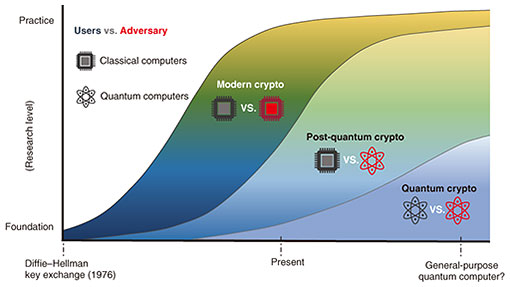
He also hinted that the current 90-day tariff pause could still be extended, on condition that Beijing refrains from implementing new export restrictions. That was enough to lift the S&P 500 and Nasdaq, helping both close the day fractionally higher after a volatile midweek session. | | | | 🧭 The risk of Bitcoin's "Q-Day" | | | | Digital assets have come a long way this year. Bitcoin is in the six figures, crypto ETFs have pulled in record inflows, and institutions are increasingly (sometimes reluctantly) embracing crypto as a new asset class. But just as quickly as blockchain disrupted Wall Street, quantum computing could turn the industry on its head... 🧨 An existential threat in the making Quantum technology is poised to revolutionize entire sectors by performing calculations once thought impossible. It’s not a question of when, but if. Some analysts worry that this quantum disruption could also sweep up crypto. At a conference this week, Capriole Investments founder Charles Edwards warned that Bitcoin’s underlying encryption could be broken by quantum computers “within two to eight years.” McKinsey analysts predict “Q-Day,” a point when quantum tech breaks RSA encryption keys, could arrive within a decade, implying BTC’s firewalls might crumble even sooner. The amount of quantum processing required, roughly 2,300 qubits, according to Microsoft and Meta researchers, is now expected to be feasible by the end of the decade. Edwards argues Bitcoin developers must act now, adopting new quantum-resistant protocols. Failure to do so could invite “mass theft and erosion of trust in the $2 trillion asset.” ⏱️ What about the short term? The quantum threat remains largely theoretical, but after last week’s rout, investors are focused on crypto’s near-term future. Bitwise CIO Matt Hougan called the $20 billion liquidation following Trump’s surprise threat to impose 100% tariffs on China “a leverage event, not a fundamental one.” BTC prices plunged as much as 15% before rebounding to start the week, then tumbled again midweek, finishing more than 2% lower, just below $111,000 as of late yesterday.
Even if Hougan is right that fundamentals haven’t changed, quantum computing could represent a much bigger long-term systemic risk. That doesn’t mean crypto is doomed. Researchers argue the cryptocurrency’s open-source framework could allow it to upgrade to quantum-resistant encryption. | | | | Rate today's newsletter... | | | Your feedback matters! Take a sec and tell us how we did! | | | | | | | | | | | | InvestorsObserver | | You received this email because you signed up on our website or made a purchase from us. | | | | |