| | Good morning,
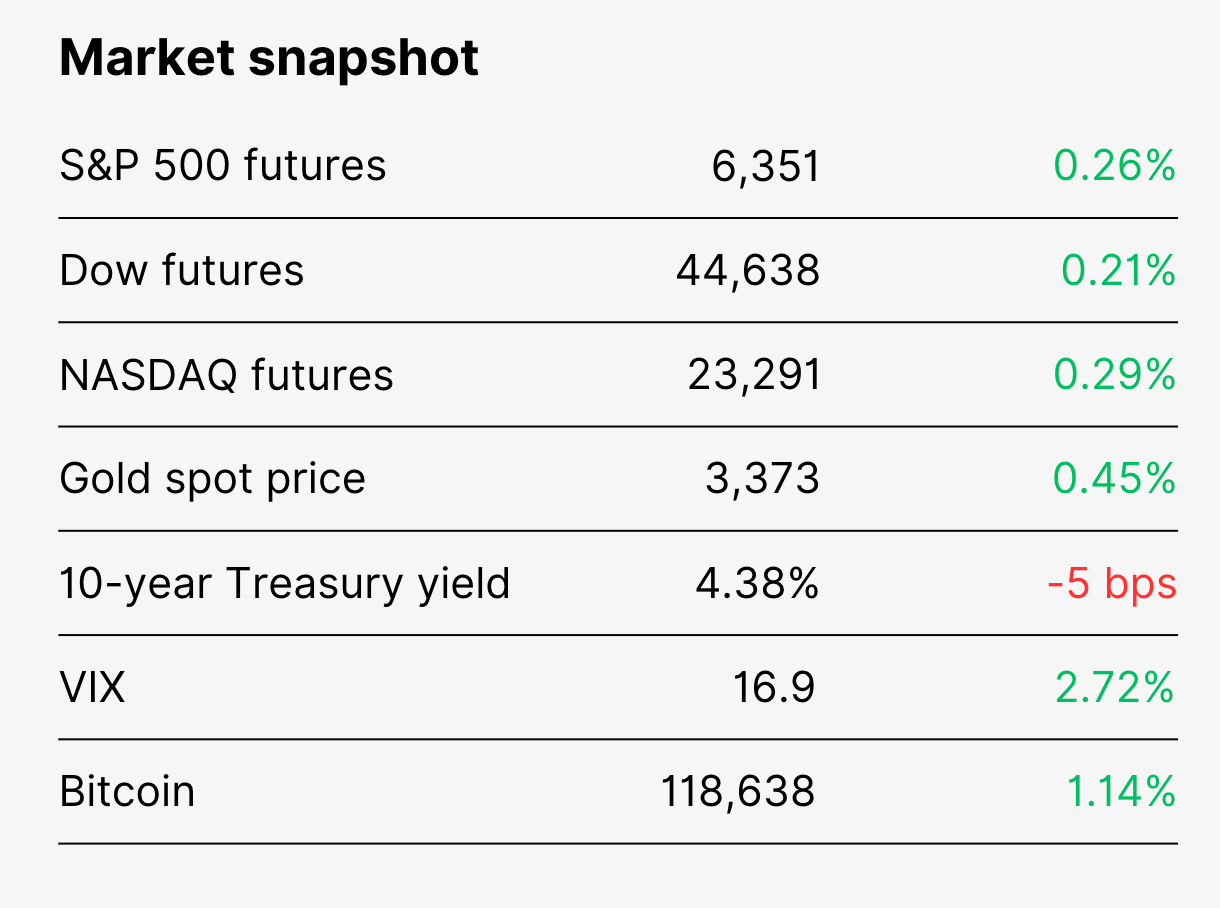
Stocks aren't breaking a sweat even after last week’s sprint and the Nasdaq’s record close on Friday, with all major indexes up this morning. We’ve got Powell and Bowman on the mic this week, earnings rolling in from Tesla to Domino’s, and some early-morning tremors from the breakfast aisle. Meanwhile, crypto is celebrating a legislative win (with some raised eyebrows), and consumer data shows Americans are spending... ...just not the way they used to. Let’s dive in. | | | | | Hang tight, Dan Runkevicius, Chief Editor | |  | | | | | “While the labor market looks fine on the surface, once we account for expected data revisions, private-sector payroll growth is near stall speed, and other data suggest that the downside risks to the labor market have increased. With inflation near target and the upside risks to inflation limited, we should not wait until the labor market deteriorates before we cut the policy rate.” — Fed Gov. Christopher Waller. | | | | | Five things to know before opening bell | | |
🇪🇺 EU preps for no-deal Trump tariffs European Union leaders will meet this week to hash out a response to a possible no-deal trade scenario with Donald Trump. The urgency comes from Trump's changing negotiating stance, which appears to be hardening ahead of an August 1 deadline. If Europe is not ready, a no-deal scenario could hit like a freight train. 🔩 China floods U.S. with rare earth magnets Despite recent wins for U.S. rare earth production, America’s supply chain still runs through China. New trade data shows rare earth magnet imports from China surged 660% in June, hitting 353 metric tons. That spike comes just a month after shipments dipped due to tariff fears, underscoring how dependent the U.S. remains on Beijing for critical tech, EV, and defense components. 📉 Leading indicators out today The Conference Board’s latest Leading Economic Index is out today, offering another read on the economy. Last month’s dip was just 0.1%, but over the past six months, the index has dropped 2.7%, nearly double the pace of the previous half-year decline. The group is sticking with its call for “a significant slowdown in economic growth” through 2025. 🏛️ Powell, Bowman speak, but don’t expect many clues Fed Chair Jerome Powell and Governor Michelle Bowman are set to speak at a central banking conference tomorrow, but don’t hold your breath for a policy preview. The Fed is in its pre-meeting blackout period, so rate talk will be minimal at best. One speaker to watch is OpenAI CEO Sam Altman, who’s likely to draw as much attention as the central bankers themselves. 📊 Earnings roll in and Tesla is under miscroscope Another barrage of Q2 earnings starts today, with Domino’s Pizza, Verizon, NXP Semiconductors, and Roper Technologies on deck. But all eyes are on Tesla later this week, after UBS analysts slammed the stock as “fundamentally overvalued,” citing slumping sales, an underwhelming robotaxi rollout, and Musk’s political distractions.
| | | | 🇺🇸 Trump Signed the GENIUS Act. So what?
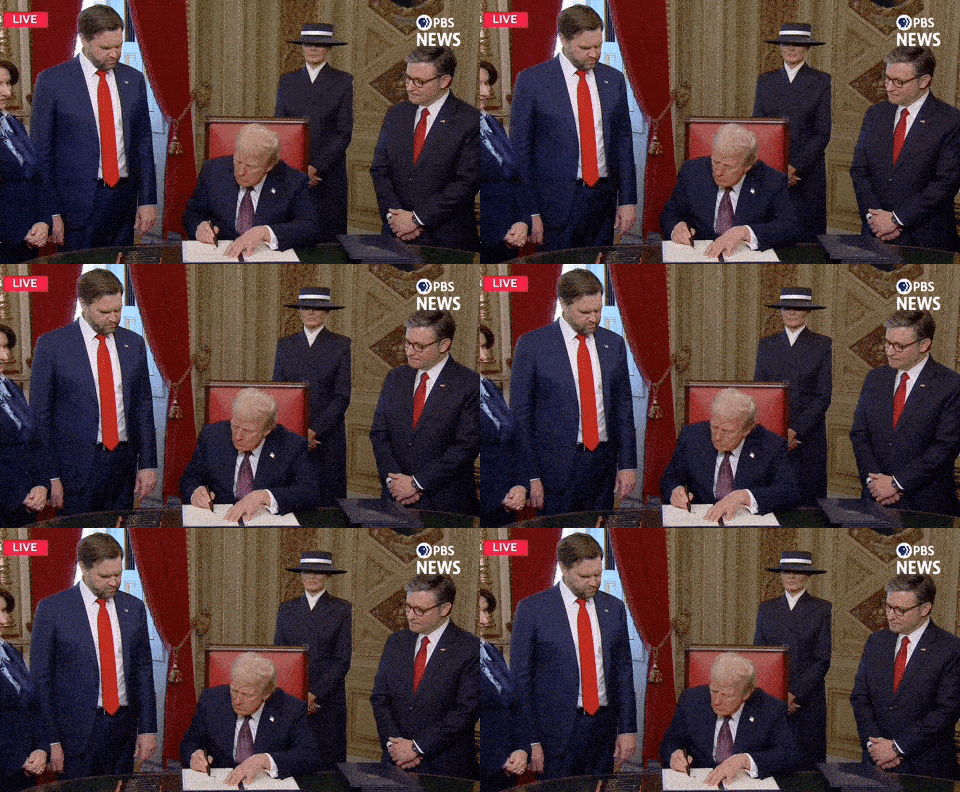
| | | | The White House, a majority of lawmakers, and much of the crypto world closed out so-called “Crypto Week” on Friday with a win... ... President Trump officially signed the GENIUS Act into law. The bill's passage marks a historic moment: For the first time, digital assets have been officially recognized on Capitol Hill. While crypto bulls cheered the news, not everyone is buying the hype. 🪙 What the law actually does Let’s start with what the GENIUS Act is and what it isn’t. First of all, the law focuses squarely on stablecoins, digital assets pegged 1:1 to the U.S. dollar or another established currency. It lays out a regulatory framework for how these tokens can be issued, held, and transacted. It's a major development for one of the most used (and most misunderstood) parts of the crypto market. Other bills that aim to regulate broader areas of the industry — like token registration and custody rules — are still working their way through the Senate. So while GENIUS is progress, its scope is still relatively narrow.
📣 Cautiously optimistic That didn’t stop Trump and others from taking a victory lap. Coinbase CEO Brian Armstrong was among the first to weigh in. “Now that we have clear legislation, we’re going to see the Fortune 500 really start to adopt stablecoins,” he said. He pointed to Coinbase’s new Shopify integration, as well as recent moves by Walmart and Amazon, as early signs of momentum. Others were more measured. Citizens Financial CEO Bruce Van Saun said stablecoins are “here to stay,” but admitted the current optimism might be “a little overhyped.” Solv Protocol CEO Ryan Chow praised the law’s contribution to “legal clarity and structural legitimacy.” But like others, he stopped short of declaring victory. 🚀 A starting point, not a finish line There’s no question the GENIUS Act marks a step forward. But there’s also broad agreement that crypto still has a long way to go before hitting true mass adoption. As Symbiosis Finance co-founder Will K said, “The industry needs to stop building for crypto natives and start building for everyone else.” 📌 Bottom line: Crypto (or at least its most boring, least speculative corner) is taking a big step forward. But that doesn’t mean digital assets have gone mainstream just yet. | | | | ☕ American breakfast may get a little less caffeinated | | | | International trade talks are still in flux as the White House preps a new wave of tariffs set to hit global partners as early as next month. But tariff effects are already hitting home... starting at the breakfast table. 🍊 The cup is half empty Egg prices have ruled headlines lately, but now it’s orange juice and coffee in the crosshairs. Following President Trump’s announcement of a 50% tariff on Brazilian exports, reportedly in response to political tensions over the country’s recent leadership trial, markets moved fast.
Within a week, orange juice futures jumped 10%, and coffee climbed 6%. That's because Brazil supplies over half of America’s orange juice and around 30% of its coffee beans. And if you take your coffee sweet? Brazil is also the largest supplier of sugar to the U.S., and sugar futures are up 6% in recent weeks as well. 🛍️ It’s bigger than breakfast Economists and shoppers are bracing for broader price hikes as trade tensions build. And with less than 22 weeks until Christmas, retailers are already feeling the strain. Balsam Brands, a major seller of holiday décor and artificial trees, is scaling back inventory ahead of the season. “The uncertainty has led us to spend all our time trying to rejigger what we’re ordering, where we’re bringing it in, when it’s going to get here. We don’t know which items we’re going to have to put in the catalog or not,” said CEO Mac Harman. 📌 Bottom line: Tariffs may be aimed abroad, but for now, the ripple effects are already hitting Americans.
| | | | 🛍️ Pick your guilty pleasure | | | | The University of Michigan’s latest consumer sentiment survey ticked up in July, marking a third straight month of improvement. But while consumers are still spending, alternative data suggests that spending is becoming increasingly selective. 📊 What the survey shows The sentiment index rose 1.8% to 61.8 in July, up from 60.7 in June. Other key takeaways: -
Inflation expectations dipped from 5.0% to 4.4% -
The current conditions index rose 3.1% to 66.8 -
Consumer expectations nudged up just under 1% for the month Zooming out, sentiment is still 16% below where it stood at the end of last year, even after three months of gains. And that 4.4% inflation expectation is still way above the latest year-over-year CPI reading of 2.7%. 🍽️ Spending shifts
Thanks in large part to the strong labor market, Americans are still swiping, but they’re spending more selectively. That’s the takeaway from American Express, which chimed in with recent Bank of America commentary on “consumer selectivity.” In Friday’s earnings call, AmEx said spending is shifting. Dining out is up, but travel is down, signaling a move toward smaller splurges and more local indulgences. “We live in uncertain times, but I think people are continuing to live their lives. What we’re seeing right now is very consistent spending," said AmEx CEO Stephen Squeri. 📌 Bottom line: Consumers haven’t pulled back. They’re just getting pickier about their guilty pleasures.
| | | | Rate this newsletter | | | Your feedback matters! Before you go, please rate this newsletter and share your thoughts. | | | | | | | | | | | | InvestorsObserver | | You received this email because you signed up on our website or made a purchase from us. | | | | |