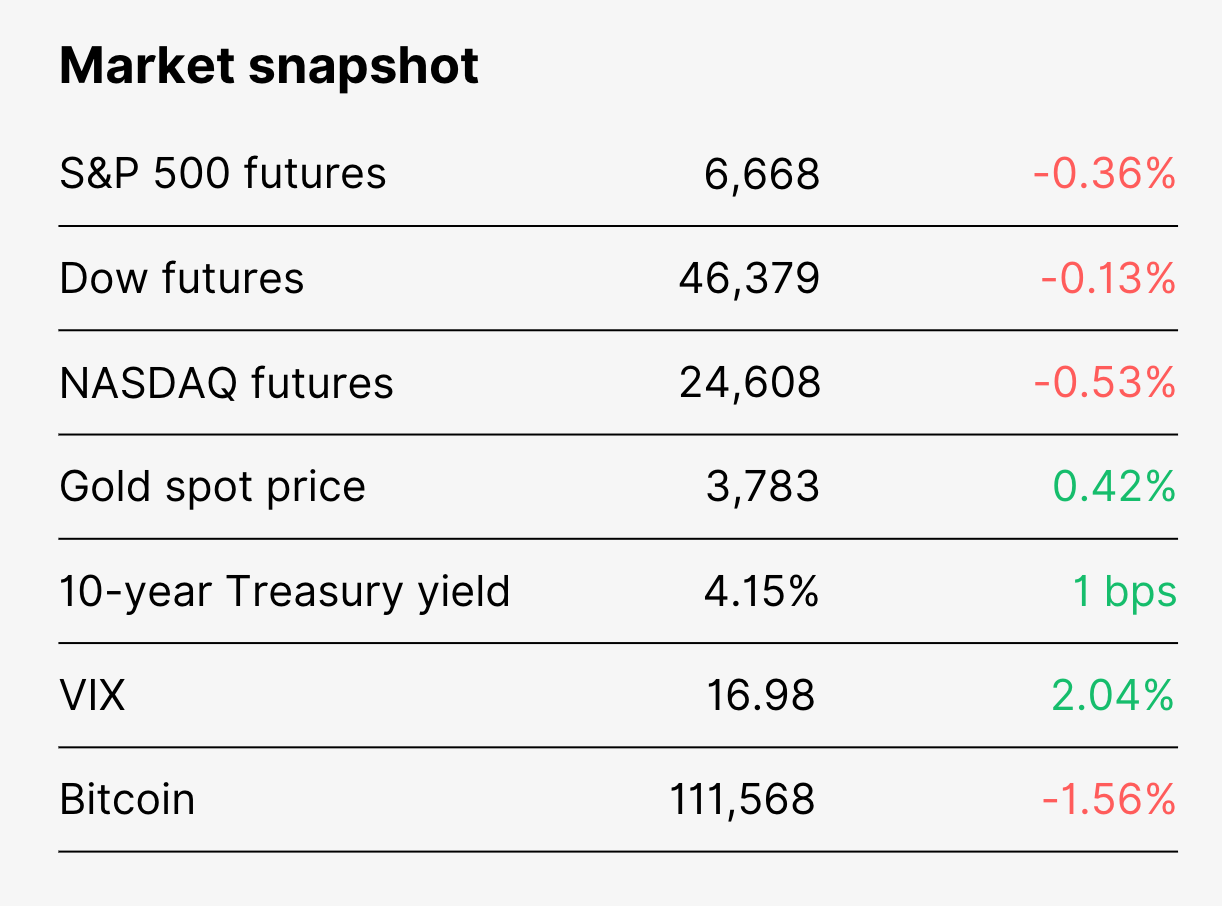
| | Good morning, Wall Street’s obsession with rate cuts is starting to look like a gamble. Future markets are pricing in back-to-back-to-back cuts, but Fed insiders — from Powell to Mary Daly — keep reminding everyone that the Fed is walking a tightrope. Meanwhile, Trump’s tariffs are disrupting the auto game. US carmakers are losing buyers in Europe to China, even as GM just scored a fresh boost on the back of lithium fever. Lithium Americas — which has a joint venture with GM — nearly doubled in a day after whispers of a government stake in its Nevada mine. On the tech side, Alibaba’s $53 billion AI push sent its stock flying, Bitwise brushed off crypto’s correction with a bullish ETF call... Zooming out, housing data gave mixed signals that left economists shrugging, and a cardboard box recession indicator just flashed red. While stocks still hover near record highs, optimism is giving way to caution... with strategists debating whether this feels like 1999 all over again or just another technical correction in the making. Let’s dig in. | | | | | Hang tight, Dan Runkevicius, Chief Editor | |  | | | | | “Managing change isn’t a one-time thing. You must keep at it. Moving forward, it is likely that further policy adjustments will be needed as we work to restore price stability while providing needed support to the labor market. This comes through in our most recent projections, released last week. But these are projections, not promises, and making good decisions will require us to anchor on our objectives, assess the tradeoffs, and decide, again and again.” — San Francisco Fed president Mary Daly | | | | | Five things to know before opening bell | | |
🚗 US automakers take a hit in Europe
Trump’s tariff talk gave the Big Three a home-field advantage in the US. But in Europe, they’re losing ground fast to Chinese rivals. A new Escalent survey shows 47% of European buyers would consider a Chinese import, now three points higher than those open to an American brand. Just a year ago, 51% were willing to buy US, while only 31% would have picked Chinese. KC Boyce, Escalent’s VP of powertrain innovation, said the survey (conducted May–July) didn’t probe the cause, but he suspects geopolitics is souring sentiment toward American autos. 💸 Bessent joins in on heckling Powell We’re used to President Trump’s digs at Jerome “Too Late” Powell. But now Treasury Secretary Scott Bessent is piling on, arguing rates are “too restrictive” and “need to come down.” In an interview yesterday, he said the Fed should already be talking about cutting 100–150 basis points by year-end. That’s a far cry from where policymakers are, still debating whether to trim just another 25 bps next month. His comments came a day after Powell said the Fed faces a “challenging situation” balancing jobs and inflation. 🤖 AI investment surge boosts BABA Alibaba was one of tech’s big winners yesterday, soaring more than 8% after CEO Eddie Wu pledged to spend $53 billion over three years on AI. The company wants to be a “full-stack” player — supplying both models and infrastructure — as Wu admitted industry demand has blown past expectations. He also forecast global AI investment could hit $4 trillion over the next decade, giving fresh ammunition to Big Tech bulls betting the rally still has legs. 🏡 Home sales beat forecasts last month New US home sales in August hit their highest level in three and a half years. But analysts warn the pop isn’t a turning point. Homebuilder sentiment is weak, jobs worries are rising, and the August spike may have “no obvious driver,” according to Santander’s Stephen Stanley. With mortgage rates dipping, Nationwide’s Ben Ayers said sales could get a seasonal lift this fall, but builders are already cutting back on projects and permits for the next six months. ₿ Crypto correction doesn’t bother Bitwise Bitcoin stumbled earlier this week, but Bitwise CIO Matt Hougan is staying bullish. He expects the number of corporations holding Bitcoin on their balance sheets to double to 360 within a year, and sees ETFs driving stronger flows in Q4. “I take this pullback as an opportunity, not a setback,” he said. | | | | ⚡️ Lithium Americas doubles on Uncle Sam deal rumors
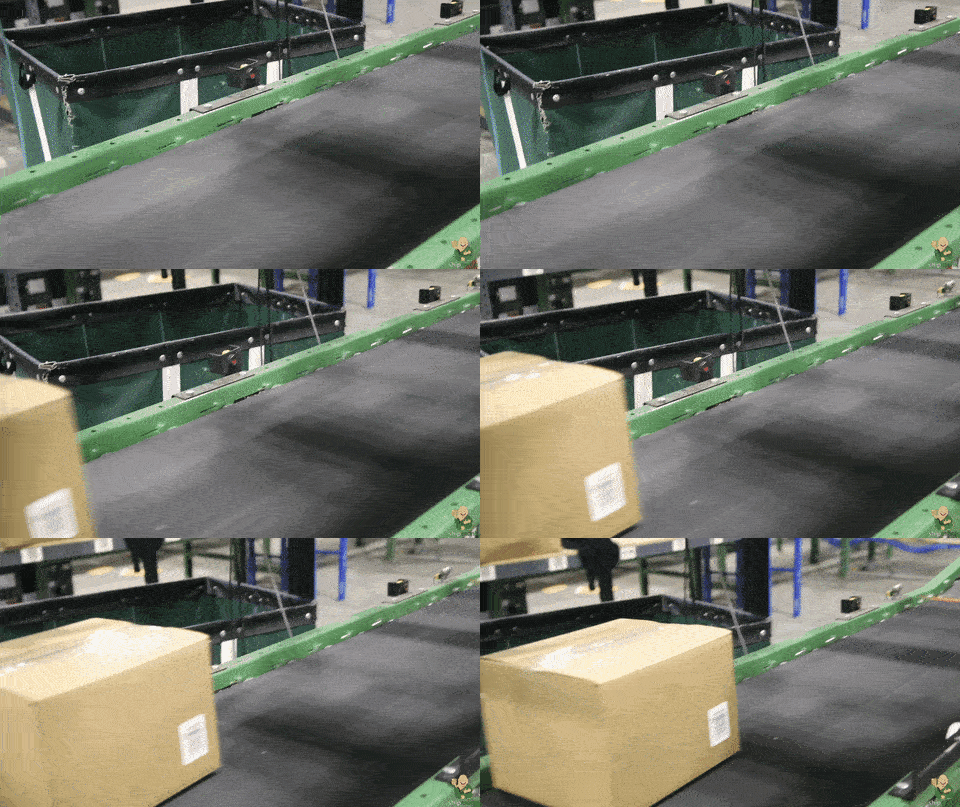
| | | | First Intel, now lithium. After last month’s announcement that Washington had taken a 10% stake in Intel, Wall Street has been speculating which industries could be next in line for public–private partnerships. Yesterday, that speculation lit a fire under Lithium Americas. Shares of the Canada-based miner rocketed 96% after reports surfaced late Tuesday that the Trump administration is eyeing a 10% stake in the company. The deal would be tied to a $2.26 billion Department of Energy loan for its Thacker Pass mine in Nevada, with Lithium Americas prepared to hand over no-cost warrants. The White House is also reportedly seeking guarantees from General Motors, a key backer of the project. 🪨 Why Thacker Pass matters Thacker Pass would be the largest lithium mine in the Western Hemisphere, dwarfing Albemarle’s Silver Peak, the only US operation currently running. With government backing, Wall Street sees plenty of upside. LAC shares nearly doubled on the day, while GM, which has already invested $625 million for a 38% stake, climbed 2.29% to just under $60. GM’s rally also got an extra lift from UBS, which upgraded the stock to buy and boosted its price target to $81. 🇺🇸 The cornerstone of Trump’s agenda The administration has long pitched lithium production as a way to strengthen US dominance in EV batteries and cut reliance on China. China currently controls nearly two-thirds of global supply. By contrast, the US produces less than 3%. Phase one of Thacker Pass is slated to begin in 2028, producing about 40,000 metric tons annually, which is enough to power 800,000 EVs. | | | | 🎲 Is Wall Street betting too much on cuts? | | | | The Fed delivered its first rate cut of the year last week, with more likely on the way, but experts remain divided on whether it can truly move the needle. Oxford Economics’ John Canavan is relatively upbeat on growth and inflation, expecting a “slow but steady” economy and prices cooling to around 3% by mid-2026. What worries him is how aggressively markets are pricing in cuts. About 9 in 10 expect a second consecutive move at next month’s FOMC meeting, and roughly 8 in 10 think a third will follow in December. “That’s too aggressive,” Canavan argues, noting that even with cooling inflation, “it’s not enough to justify the pace markets are betting on.” He added that jobs are “steadier than some Fed projections and recent market sentiment suggest,” without the “large layoffs” that some Fed doves have feared. 🎉 Party like it’s 1999? Dot-com comparisons have been all over the place lately. Goldman Sachs head of hedge fund coverage Tony Pasquariello, however, says this year’s environment is giving him dot-com flashbacks. “I was at Communicopia last week,” he said. “I was also at Communicopia back in 1999. It had a similar feel. The markets have a similar feel too: valuations extended, concentration high. How do you square the circle with history?” Pasquariello also offered a counterpoint to the idea that tech is doing all the heavy lifting. “One could say this has been a very narrow rally,” he said. “I don’t totally agree. There are 11 headline sectors in the S&P 500, and all 11 are positive on the year" "Mega-cap tech may be the fastest horse, but it’s far from the only pocket of strength.” Oxford's Canavan pushed back on the dot-com repeat narrative. “We don’t think this is 1999 all over again,” though he acknowledged that “valuations are stretched, and we may be ripe for a near-term technical correction.” If a pullback does occur, he expects tech to lead the market through 2026. 💊 A treatment, not a cure There’s a reason Wall Street is so fixated on rate cuts. Merrill chief investment officer Chris Hyzy noted that last week’s adjustment — and expectations for more — will have a real impact on stocks. “Investors may want to consider making some portfolio adjustments,” he advised. Hyzy expects rates could drop again at each of the remaining two 2025 FOMC meetings, with additional cuts possible in 2026. Barring a major downturn, rate cuts should have a fairly predictavle output. “In the absence of recession, markets tend to go up. When the Fed is adding stimulus on top of that, the wind’s blowing in a favorable direction for the bulls,” said Pasquariello. | | | | 📦 Economists hunt for recession clues | | | | Calling a recession is tricky because by the time we know we’re in one, it’s often already underway. That’s why strategists are scouring any signal they can find, from quirky consumer habits to industrial staples. 📦 It all starts with the boxes Remember the “lipstick index”? The idea that small indulgences rise when other luxuries fall? Morningstar senior equity analyst Davis Swartz isn’t buying it. “My opinion would be that when there’s a recession, people cut back on everything, and that probably includes lipstick,” he said. A more grounded gauge comes from former Fed chair Alan Greenspan’s favorite: cardboard boxes. Ubiquitous in commerce, shifts in production can hint at broader economic trends. Virginia Tech economist Jadrian Wooten calls it a “potential recession indicator because it’s so common, a lot of people take it for granted.” If the cardboard box signal is correct, the economy could be headed for a rocky patch. According to data from Fibre Box Association, US box shipments — the volume of empty packaging materials sold to retailers — fell to their lowest second-quarter level since 2015. “This is actually the peak time for holiday season ramp-ups. Companies are not ordering boxes to ship products to Target or Walmart,” Wooten said. These quirky indicators are not perfect, but in 2025, every hint counts. | | | | Rate today's newsletter... | | | Your feedback matters! Take a sec and tell us how we did! | | | | | | | | | | | | InvestorsObserver | | You received this email because you signed up on our website or made a purchase from us. | | | | |