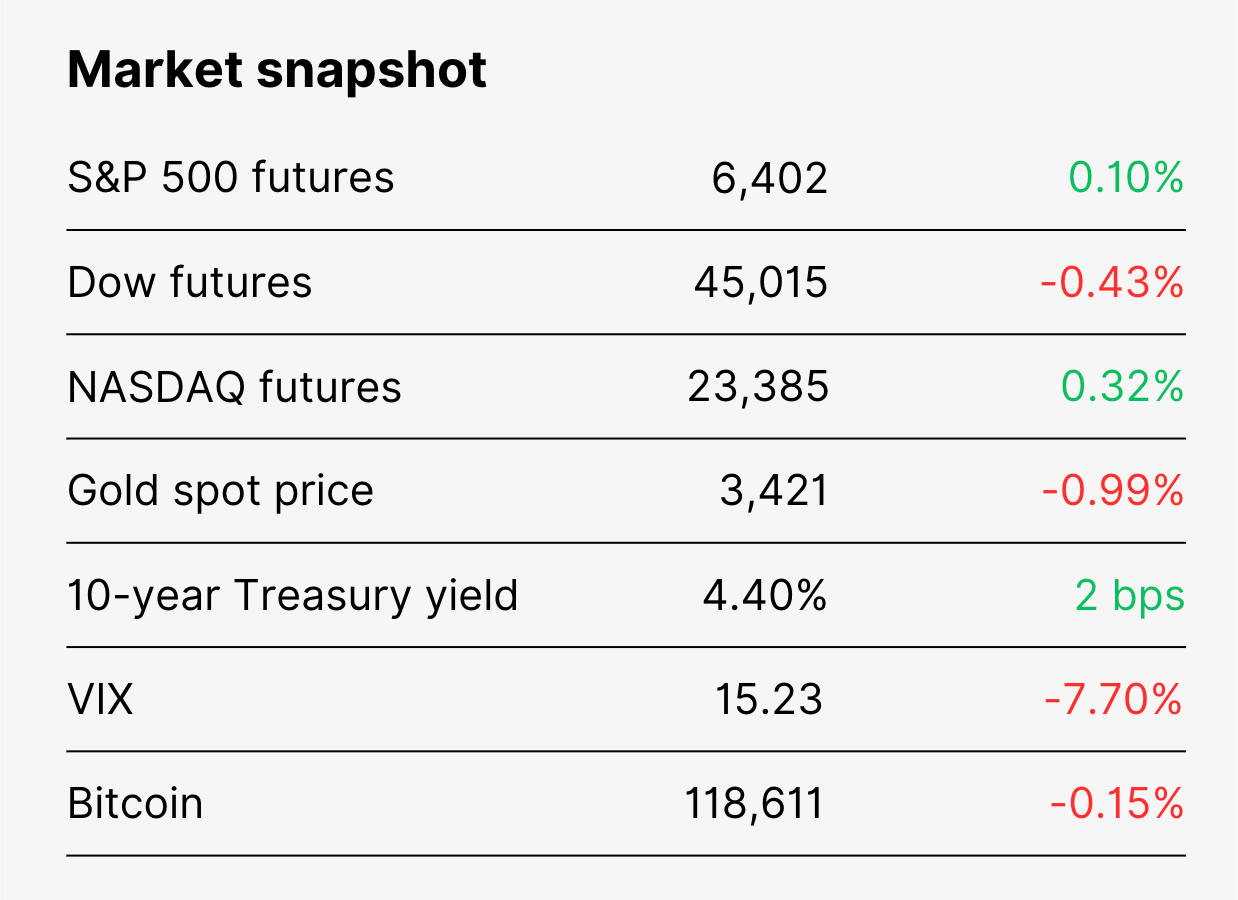
| | Good morning, GoPro nearly doubled and Krispy Kreme popped 40% this week as part of meme mania 2.0… and somehow Tesla is the boring one. But the real action is in Washington, where Trump’s fresh trade deals and his new “AI action plan” are moving markets faster than Wall Street can digest. This morning we’re breaking down that plan, the backlash from U.S. automakers over the Japan deal, and Trump’s 15% tariff ultimatum just days before the deadline. Let's get to it. | | | | | Hang tight, Dan Runkevicius, Chief Editor | |  | | | | | “I think people are realizing that this is just purely a social media-based ramp and that it’s not based on anything fundamental. … Now, it’s just, quite frankly, a vehicle for pumping and dumping.” — Interactive Brokers chief strategist Steve Sosnick, on the ‘meme stock’ resurgence | | | | | Five things to know before opening bell | |
🇪🇺 EU considers accepting Trump's 15% deal The U.S. and EU are inching closer to a deal that would slap a 15% tariff on most imports, including cars. Commerce Secretary Howard Lutnick floated Tokyo’s $550 billion investment as a model said it's unlikely with Europe: “Europe is not going to give us $1 trillion to invest.” Officials are pressing to finalize something before August 1. 🧁 Meme stocks are getting tasty The latest entries in the meme-stock frenzy: GoPro and Krispy Kreme. Shares of both companies surged this week with GoPro nearly doubling and Krispy Kreme briefly up 70% before cooling off. In classic meme stock fashion, both rallies defy logic and have no clear explanation. 🛢️ Oil steadies after Cushing build WTI crude bounced around break-even on Wednesday after the fourth straight day of declines, supported by a surprise inventory build at Cushing, Oklahoma. “Cushing is perhaps the most important takeaway,” said Kpler’s Matt Smith, noting more stockpile builds are likely. While overall supplies remain tight, the news helped stabilize the market. ⚡ Tesla whiffs on Q2 Tesla’s Q2 report disappointed across the board. Sales are down, earnings and revenue missed expectations, and management blamed tariffs as well as general policy confusion. But hey, there's a new EV model coming out later this year! That wasn’t enough for investors who sent the stock lower after hours, though. 🏠 Housing hit by high rates Existing home sales dropped 2.7% in June vs. the 0.7% economists expected. That brings the seasonally adjusted annual rate to just 3.93 million units, the lowest in months. NAR’s Lawrence Yun blamed mortgage rates stuck around 6.77%, adding that a dip to 6% could unlock 160,000 new first-time buyers. 🏗️ "Big, beautiful winners" Analysts are mapping out who will cash in on Trump’s “One Big, Beautiful Bill,” and manufacturing is at the top of the list. Capital Group equity portfolio manager Matt Hochstetler also points to industrial machinery, HVAC, semis, and pharma could due to generous tax credits and deductions tied to AI, R&D, and factory construction. Brownstone’s Nick Rokke said the bill “should encourage the onshoring of supply chains and create more jobs for Americans.” | | | | 🤖 What’s in Trump’s new “AI action plan”?
| | | | Just days after wrapping up “Crypto Week” with the signing of the Genius Act, President Trump turned his focus to another tech frontier: artificial intelligence. On Wednesday, the White House unveiled its AI action plan, offering a fresh look at Washington's plan to win the AI global race. 📌 Highlights: -
Loosening Biden-era restrictions on U.S. microchip exports -
Cracking down on AI platforms built with “ideological biases” -
Promoting domestic AI data centers and U.S.-made AI exports “There is a global competition now to lead in artificial intelligence, and we want the United States to win that race,” said David Sacks, chair of the White House Council of Advisers on Science and Technology. Trump issued his first AI-focused executive order just days into his term, promising to remove “unnecessary barriers” to innovation. The new action plan is being positioned as the next major step in that agenda. 🎯 Will it target “woke AI”? Some early reports suggest the plan could target so-called "woke" models that lean left politically, raising alarms about free speech and fairness in federal contracts. One White House official tried to clarify, saying the goal is to ensure the government only partners with LLM developers whose systems are “objective and free from top-down ideological bias.” Legal experts see potential pitfalls. “If you sanction software that is liberal, but not software that is conservative, the challenge will be that the executive order is content-based discrimination,” said law professor Rory Little. 💼 Big Tech wants in While the full impact of the plan is still TBD, major AI players are already lining up to partner with Washington. “We are increasingly working with the government to roll out our services to lots of government employees,” said OpenAI CEO Sam Altman ahead of the announcement. Amazon, Google, and Microsoft are also reportedly in the mix for future federal AI contracts. | | | | 📦 Trump sets 15% as new tariff floor | | | | Trump says 15% is the new baseline for his global tariff push, raising the floor ahead of the Aug. 1 deadline. “We’ll have a straight, simple tariff of anywhere between 15% and 50%,” he said Wednesday at an AI summit in Washington. “We have 50 because we haven’t been getting along with those countries too well.” The new 15% minimum marks a shift from earlier messaging. Back in April, Trump proposed a universal 10% tariff on almost every country. Then earlier this month, he floated letters to over 150 nations outlining tariffs “probably 10 or 15%.” Commerce Secretary Howard Lutnick said smaller nations, including much of Latin America, the Caribbean, and parts of Africa, would likely face 10%. 🇯🇵 Japan buys a discount On Tuesday, Trump said Japan earned a tariff cut from 25% to 15% in exchange for lifting restrictions on some U.S. goods and backing a $550 billion investment fund. South Korea is reportedly exploring a similar fund and working to secure a 15% rate, especially for autos. Meanwhile, the Philippines is aiming to lower its own tariff burden to 15% from the current 19%, according to its U.S. ambassador. Not all nations are so optimistic. A leaked internal estimate from Hanoi suggests Vietnam’s exports to the U.S. could drop by as much as one-third if the new tariffs stick. 🇪🇺 “We can’t negotiate with everyone” While the White House framed the tariff letters as a starting point for negotiations, Trump now appears more comfortable using them as a take-it-or-leave-it deal. “You can’t negotiate deals with everyone,” Trump said Wednesday. “If [the EU] agrees to open up the union to American businesses, then we will let them pay a lower tariff.” Talks with the European Union are reportedly “serious,” but time is short. With just days to go before the Aug. 1 deadline, most of the world is still scrambling for a deal. | | | | 🚘 Detroit Big 3 not happy with 'historic' deals | | | | Just before markets opened yesterday, the White House unveiled new trade agreements with the Philippines and Indonesia. Early reports show blanket 19% tariffs on their exports to the U.S., while American goods will face little to no duties in return. But the real bombshell came when President Trump claimed he had “just signed the largest deal in history with Japan.”
Meanwhile, Treasury Secretary Scott Bessent said more agreements are expected in the days leading up to the August 1 tariff deadline. 🚘 U.S. automakers not happy The U.S. auto industry is especially rattled. While Japanese automakers saw their shares jump on the news, the Detroit Big 3 aren’t celebrating. The American Auto Policy Council — which represents Ford, GM, and Stellantis — warned the deal could hurt U.S. manufacturers. “Any deal that charges a lower tariff for Japanese imports with virtually no U.S. content than the tariff imposed on North American-built vehicles with high U.S. content is a bad deal for U.S. industry and U.S. auto workers,” said Council President Matt Blunt. Both GM and Stellantis said this week that tariffs could weigh further on earnings for the rest of the year. White House adviser Kush Desai pushed back on the criticism, calling the deal a historic win. “A historic win for American automakers by putting an end to Japan’s unfair auto trade barriers for American-made cars,” he said. | | | | Rate this newsletter | | | Your feedback matters! Before you go, please rate this newsletter and share your thoughts. | | | | | | | | | | | | InvestorsObserver | | You received this email because you signed up on our website or made a purchase from us. | | | | |