| | Good morning,
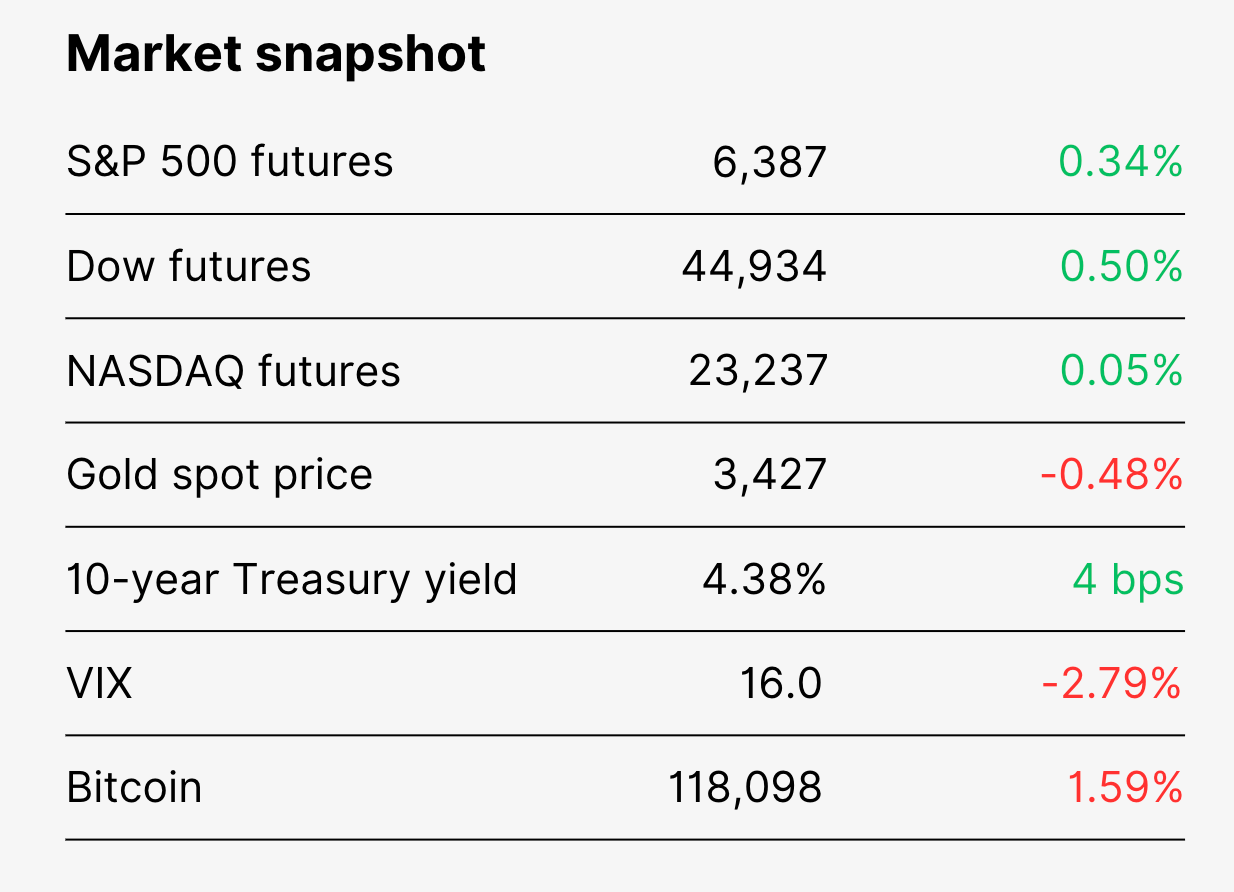
Futures are up this morning after Trump scored a major (historic wouldn't be an overstatement either) win in the trade war. On Tuesday, the administration struck a deal with Japan that will impose 15% tariffs on imports (yes, including cars) while pledging to invest $550 billion in the U.S. In return, Japan will accept American-made cars and trucks built to U.S. motor vehicle safety standards, without requiring additional modifications. Meanwhile, meme-stock fever is back, with Opendoor and Kohl’s leading a nostalgia-fueled rally that has little to do with fundamentals and everything to do with vibes. But it’s not all roses this week. General Motors just poured cold water on Wall Street’s optimism, reporting $1.1 billion in tariff-related losses last quarter alone. It’s the first real evidence that the new trade regime is hitting corporate bottom lines and a potential sign of what’s to come in Q3. If that’s not enough to make you check your stop-losses, Goldman Sachs is flashing a yellow light on the U.S. economy, Circle just caught a downgrade, and “No Buy July” is all the rage. It’s shaping up to be another data-heavy, sentiment-sensitive session. | | | | | Hang tight, Dan Runkevicius, Chief Editor | |  | | | | | “Tech stocks' lofty prices and sky-high valuations will make it critically important they handily beat earnings estimates and deliver positive outlooks for the remainder of the year." — State Street chief investment strategist Michael Arone | | | | | Five things to know before opening bell | |
🇺🇸 Trump lands Japan trade deal President Trump announced a sweeping agreement with Japan that sets 15% tariffs on key imports (yes, including cars) along with a $550 billion investment package. In return, Japan will drop extra safety requirements for American-made vehicles and accept cars built to U.S. standards. 🚗 GM takes a $1.1B hit from tariffs General Motors just gave Wall Street a taste of what’s to come under the new trade regime. The automaker said it lost $1.1 billion in profits last quarter due to tariffs and doesn’t have a near-term plan to recoup that loss. 🎯 Meme stocks are back... but they’re not the ones you remember The retail crowd is back at it. Opendoor and Kohl’s are the new darlings of Reddit’s meme army, replacing the 2021 classics like GameStop and AMC. Kohl’s (KSS) stock more than doubled at one point Tuesday, while Opendoor's (OPEN) rallies more than 400% this month. 🇪🇺 EU threatens $117B retaliation if tariffs go live The European Union is preparing to retaliate if Trump follows through with his threat to hit EU exports with 30% tariffs starting August 1. Officials say they’ll combine two prior lists of U.S. goods, totaling €100 billion ($117 billion), into one countermeasure package. 🥤 Coca-Cola leans into Trump's sugar push Coca-Cola briefly popped higher Tuesday after posting better-than-expected profits, but warned a weaker dollar could drag on EPS through year-end. Meanwhile, the company confirmed plans to launch a new line made with U.S. cane sugar, backing up Trump’s earlier announcement and positioning itself for patriotic product buzz.
| | | | | GameStop might still be the poster child of meme stocks, but a new generation of names is getting the Reddit treatment this week. And as you'd guess, fundamentals aren’t invited to this party. 🏠 The Opendoor rollercoaster It started last week when a wave of Reddit buyers piled into Opendoor Technologies, a penny stock, which was on the brink of delisting. Quick recap: -
Shares jumped 42% on Monday, triggering multiple trading halts -
Tuesday opened strong, but gains flipped to losses by the close -
After spending most of 2025 below $1, the stock briefly touched $5 -
It ended Tuesday at $2.88, down over 10% on the day but still up 81% year-to-date 🛍️ Kohl’s takes a spin Then came Kohl’s. The long-struggling retailer saw a similar spike Tuesday, doubling intraday before settling 37.75% higher for no clear reason. The rally caught analysts off guard. “There’s a lot of irrational exuberance around the stock,” said GlobalData managing director Neil Saunders “It’s very similar to what we saw with Bed Bath & Beyond back in the day. There’s nothing really that Kohl’s has done to fundamentally earn this level of increase.” ⚠️ Analysts throw up red flags These kinds of surges — especially without any material news — are exactly the sort of signals that make institutional investors nervous. “Sharp jumps in shares of Opendoor, Kohl’s, and other meme stocks act like giant red flags for investors,” said Adam Crisafulli, head of Vital Knowledge. “Froth this extreme is never a good sign.” To Ihor Dusaniwsky, head of predictive analytics at S3 Partners, it’s a classic standoff — shorts vs. speculators — and he says it’s only getting wilder. “In this charged atmosphere, even a single dollar of uncommitted capital — dry powder waiting in the wings — can unleash a stampede, tipping the balance in a heartbeat and generating jaw-dropping price swings within a single session,” he wrote. “It’s not just investing. it’s a tactical war zone where sentiment and strategy collide.” 📌 Bottom line: So yes, meme stocks are back. But if the last 72 hours are any indication, they are even riskier this time around.
| | | | 🚫 "No buy July" goes viral | | | | The American consumer has held surprisingly strong in the face of tariff and inflation fears. But under the surface, a quiet shift is taking place. 💳 A spending detox goes viral Call it “No Buy July.” Americans are now embracing what Betterment financial planner Hanna Kaufman calls a “financial detox.” “For one month, you hit pause on all non-essential spending — think takeout, impulse Amazon buys, new clothes — and focus only on what you really need,” Kaufman explained. The trend is gaining traction on social media, especially in a Reddit group with over 70,000 members, where users are sharing goals, tips, and support. Some participants are limiting purchases to essentials for just July. Others are extending the “no buy” mantra for the rest of the year. “Challenges work because they give you structure with a finish line,” Kaufman added. “You’re not saying ‘no’ forever, just ‘not now.’” That may be healthy for personal finances, but if this mindset spreads, it could become a real headwind for U.S. growth. 🧾 Sentiment and spending still strong Retailers aren’t panicking yet. The latest data shows a lot of resilience in both sentiment and spending: -
Consumer sentiment rose 1.8% this month -
Retail sales climbed 0.6% in June, beating the 0.1% forecast -
Credit rejection rates dropped last month, according to the New York Fed Then again, these gains have mostly been a low-base rebound from Liberation Day lows. “Some retailers have noted cautious spending habits emerging in recent earnings announcements, while Walmart, the largest retailer in the world, highlighted price increases are likely in the near term,” said Terry Sandven, chief equity strategist at U.S. Bank Asset Management. 📌 Bottom line: Consumers may still be swiping, but if “no buy July” turns from a TikTok trend into a broader spending, retailers might start feeling the pinch. | | | | | Goldman Sachs says the tariff honeymoon is over, and it’s dialing down its forecast for the second half of 2025. Goldman economists now expect a major slowdown in the second half of 2025, projecting just 1.1% annual GDP growth, a notable step down from their own earlier estimates. According to Goldman chief economist Jan Hatzius, the problem is that “growing real income drag from tariff-related price increases” is set to offset “the boost from easier financial conditions.” Retail data isn’t helping the case either. Even after a surge in consumer spending, Goldman noted that retail sales are on pace to finish the first half . That kind of stagnation, Hatzius warned, “rarely happens outside of recession.” Goldman’s forecast isn’t locked in, though. Much depends on how Trump’s new tariffs shake out when they go into effect globally next week. The bank currently assumes effective tariff rates will land around 15%, reflecting a 14-point jump this year and another 3-point bump in 2026. That, in turn, would push inflation to 3.3% in 2025, before easing to 2.7% in 2026 and 2.4% in 2027. But if the final tariff rates are meaningfully higher (or lower), the impact could be significantly higher. “Even a one-time price increase will eat into real income, at a time when consumer spending trends already look shaky,” Hatzius said. 🌏 Early signs from China Global wage trends are another canary in the coal mine. Following recent reports showing Chinese wage growth at just 3.9% last quarter (the lowest excluding COVID-era data) Goldman flagged knock-on effects for U.S. consumption trends. “Our wage tracker suggests that sluggish wage growth may impose headwinds to consumption growth in the second half of 2025,” the economists wrote. “We anticipate incremental and targeted easing measures in the second half of the year to alleviate labor market pressures.” 📌 Bottom line: between tariff shocks and cooling wage growth globally, Goldman sees a fragile few quarters ahead.
| | | | Rate this newsletter | | | Your feedback matters! Before you go, please rate this newsletter and share your thoughts. | | | | | | | | | | | | InvestorsObserver | | You received this email because you signed up on our website or made a purchase from us. | | | | |