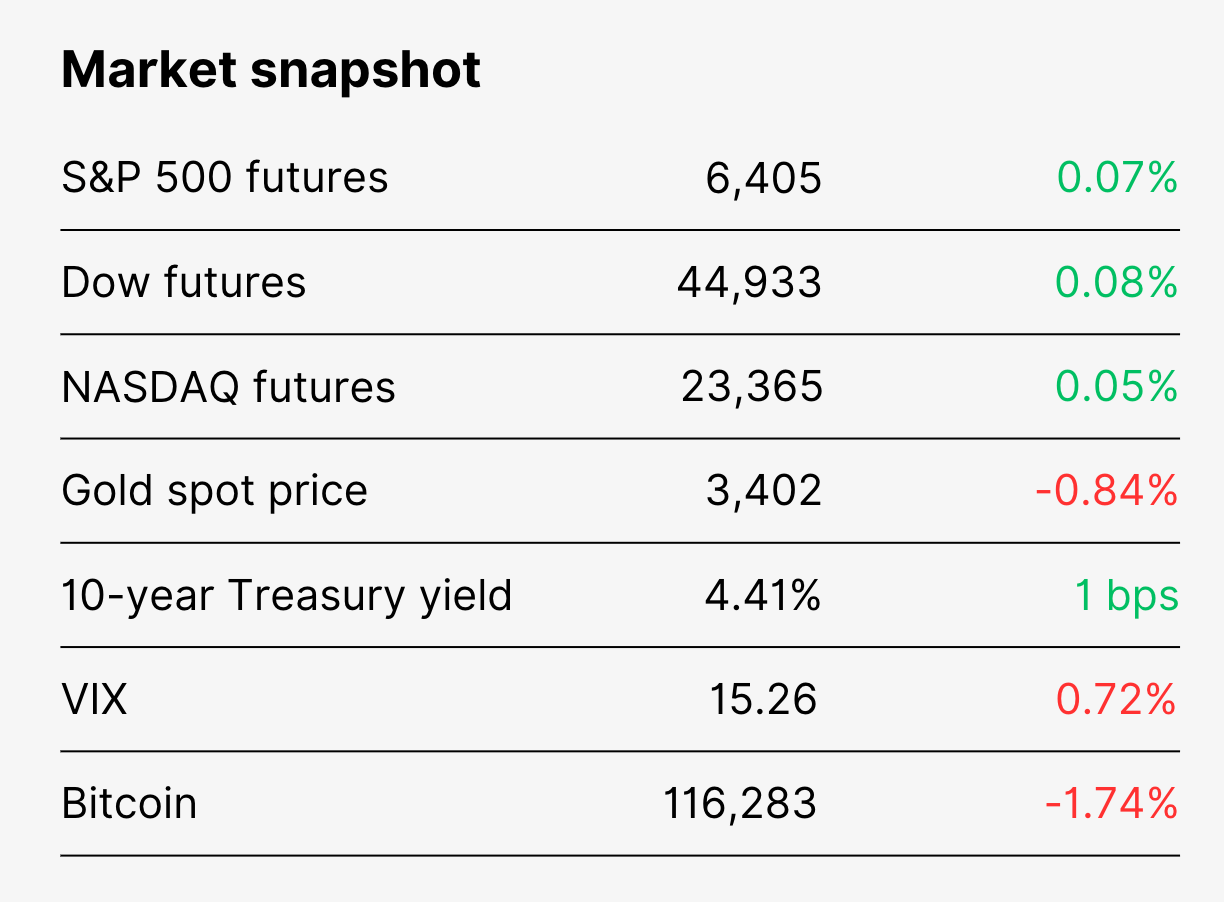
| | Good morning, Trump’s face-off with the Fed took a fresh turn yesterday. The president popped into Powell’s (the first visit by a sitting president in nearly two decades)and called him “a bad job” to his face (more or less). Later that evening, Trump dialed things back a bit, saying Powell doesn’t need to be fired. His priority remains to get rates down. Meanwhile, the central bank chief is staying mum ahead of next week’s rate decision. Stocks ended mostly flat yesterday, and futures are mixed this morning as investors prepping for the busiest week of this earnings season.
Then there’s Bitcoin. The rally’s cooled off a bit, but it just got another vote of confidence from Jim Cramer, who says it's a hedge against deficits and “for his kids’ future.” Considering the infamous Cramer effect (his calls playing out in reverse), it’s hard to say whether that’s bullish or a curse in disguise, though. Oh, and Thailand and Cambodia are now lobbing rockets over a border dispute. So there’s that... let's dig in. | | | | | Hang tight, Dan Runkevicius, Chief Editor | |  | | | | | “I’m not aware of that, Mr. President. I haven’t heard that from anybody at the Fed.” — Fed chair Jerome Powell, in response to Trump’s claim about increased costs of renovating the central bank’s HQ | | | | | Five things to know before opening bell | |
📉 Stocks hit pause ahead of next week After notching its 10th record in 19 sessions, the S&P 500 took a breather Thursday as Wall Street geared up for the busiest earnings week of the season. Investors are also bracing for a curveball from the July 30 Fed meeting after recent data releases. 🏛️ Trump barges into the Fed Trump made an unannounced visit to the Fed yesterday — the first presidential drop-in in nearly two decades — and threw jabs at Powell. “I think he’s done a bad job,” he told reporters. But hours later, Trump said he didn’t think firing Powell was necessary… at least not yet. For his part, Powell is staying silent. 🌍 Thailand 🚀 Cambodia
Thailand’s acting Prime Minister warned that recent border clashes with Cambodia could “potentially develop into a war,” as troops on both sides exchanged rocket and artillery fire for a second day. The dispute has long been a ticking bomb, but this week’s escalation is the most dangerous flashpoint in years. 📊 Bank of America says bubble risk is rising BofA strategists are sounding the alarm on a “bigger bubble” in global markets. In their view, looser monetary policy and lighter regulation are boosting retail participation and volatility. “Bigger retail, bigger liquidity, bigger volatility, bigger bubble,” said BofA's Michael Hartnett. 🍕 Buffett ditches banks for pizza and electronics Warren Buffett’s Berkshire Hathaway has quietly offloaded $1B in Citigroup, 300K Capital One shares, and $2.2B in Bank of America, while adding to Domino’s and Heico, a niche electronics manufacturer. The shift underscores Berkshire’s growing caution toward the banking sector and rising appetite for more resilient, consumer-focused stocks.
| | | | 🧊 Bitcoin cools off. What's next?
| | | | After months of near-relentless gains, Bitcoin's sideways drift has traders wondering if the rally is running out of steam... or just catching its breath. 🧠 What analysts are saying Barring a few minor pullbacks, Bitcoin is still up more than 80% this year and hovering near its all-time high. That’s what analysts are hammering. The trend is still up. It’s just that momentum has cooled for now, which is a natural and necessary part of any healthy cycle. “Bitcoin’s chart is hilariously bullish on the monthly,” said influential pseudonymous trader DonAlt. “People are freaking out just because it’s going sideways.” Arthur Hayes, BitMEX co-founder, is in the same camp. He told followers his family fund is “fully invested” in crypto leaders, setting a bold $250,000 target for BTC by year-end — more than double current levels. Widely-followed Analyst Ali Martinez has also put a positive spin on Bitcoin's sideways trend. “After breaking out of a channel, Bitcoin has reached its first target at $121,000. It is now consolidating at this level, but current buying pressure suggests the uptrend may continue. If momentum holds, the next levels to watch are $131,000, $144,000, and $157,000,” he said. And then there’s Jim Cramer, who weighed in with a surprisingly emotional take.
“I think people want to hold some as a hedge against $37 trillion debt,” he said. “They want to own it for their kids. And you know who else feels like that? Me. I’m worried about my kids.” (Considering Cramer’s calls often play out in the opposite direction, that might be bullish… or not.) 🚀 Not just Bitcoin While BTC grabs all headlines, other tokens are also flashing bullish signals, analysts say. Hayes pointed to Ethereum (ETH) as his next big bet, saying that institutional investors led by Fundstrat’s Tom Lee are now piling into he token after years of being sidelined. “Ever since Solana rose from the FTX ashes from $7 to $280, Ether has been the most hated large-cap crypto. No more.” Hayes sees ETH gaining 179% by the end of 2025. Meanwhile, Martinez also spotlighted XRP, claiming it’s poised for a breakout.“XRP has broken out of a bullish flag, setting its sights on $15!”
| | | | ¯\_(ツ)_/¯ What's up with small caps? | | | | Large-cap stocks are notching all-time highs, but small- and mid caps still haven’t caught up. And nowhere is that more obvious than in the S&P 500 and the Russell 2000. Here’s a fun fact (or not, depending on your portfolio): the Russell 2000 hasn’t hit a new high since late 2021. And as of yesterday, it’s still trading about 8% below that peak. 🤔 Should investors worry? Not necessarily... at least, not yet. Hayes Martin, president of Market Extremes, says long-term divergences like this one aren’t typically useful for spotting tops. “From my work, I find very long-term (e.g. multi-year) divergences to have little value in identifying major tops,” he wrote. “What matters is the degree of diverging over a period of 1–2 months.” That distinction matters. When the Russell peaked in November 2021, it quickly dropped 7% while the S&P kept climbing and that break foreshadowed the broader market slide in early 2022. Today’s divergence looks different. The S&P is hitting fresh highs, and the Russell is flirting with a “golden cross,” a bullish technical milestone it hasn’t seen in 18 months. ☁️ Not all sunshine Ed Clissold, chief U.S. strategist at Ned Davis Research, pointed out that this is now “the longest streak on record” for the Russell 2000 without a new high. That lag isn’t just a technical footnote. It raises structural questions. In a healthy market, all corners of the stock market should participate in a rally. When small- and midcaps fall behind, it can hint at fragility under the surface. And if the Russell stumbles from here, some traders may recall a similar pattern in 2007. Back then, the small-cap index slipped while the S&P marched higher… just before a financial crisis upended the global economy. | | | | 🧸 Santa’s supply chain is broken | | | | At the height of tariff drama earlier this year, Trump tried to manage expectations in the most Trump way possible. “Maybe kids will have two dolls instead of 30 dolls,” he said. “Maybe the two dolls will cost a couple bucks more than they would normally.” Hasbro is now saying be careful what you wish for. 🛒 Start shopping now, parents That’s the message from Hasbro CEO Chris Cocks. The toymaker expects trouble restocking some of its most in-demand brands, including Play-Doh, Barbie, and Nan-Mals. “We’re just not able to [replenish] them,” Cocks said. “If you’re a mom or a dad, you’re probably going to want to go and buy that early.” Gina Goetter, Hasbro’s CFO, added that a delay in orders has contributed to a 16% drop in consumer products revenue last quarter. 🧸 This is bigger than toys Meanwhile, Americans are growing more selective. As noted in yesterday’s newsletter, more shoppers are cutting back on nonessentials in line with the growing “No Buy” trend. And with back-to-school season ramping up, families are having to make tougher calls on how and where to spend.
Katherine Cullen, vice president of industry and consumer insights at the National Retail Federation, said the goal of making holidays special hasn’t changed but the strategy has.
“They want it to feel special for their kids,” she said. But to do that, parents may need to make trade-offs. “Focusing more on who their core family is, their immediate family… rather than buying for extended family, buying for acquaintances.” Whether it’s empty shelves or higher prices, manufacturers, retailers, and consumers could be in for some unpleasant surprises before the year is out. | | | | Rate this newsletter | | | Your feedback matters! Before you go, please rate this newsletter and share your thoughts. | | | | | | | | | | | | InvestorsObserver | | You received this email because you signed up on our website or made a purchase from us. | | | | |