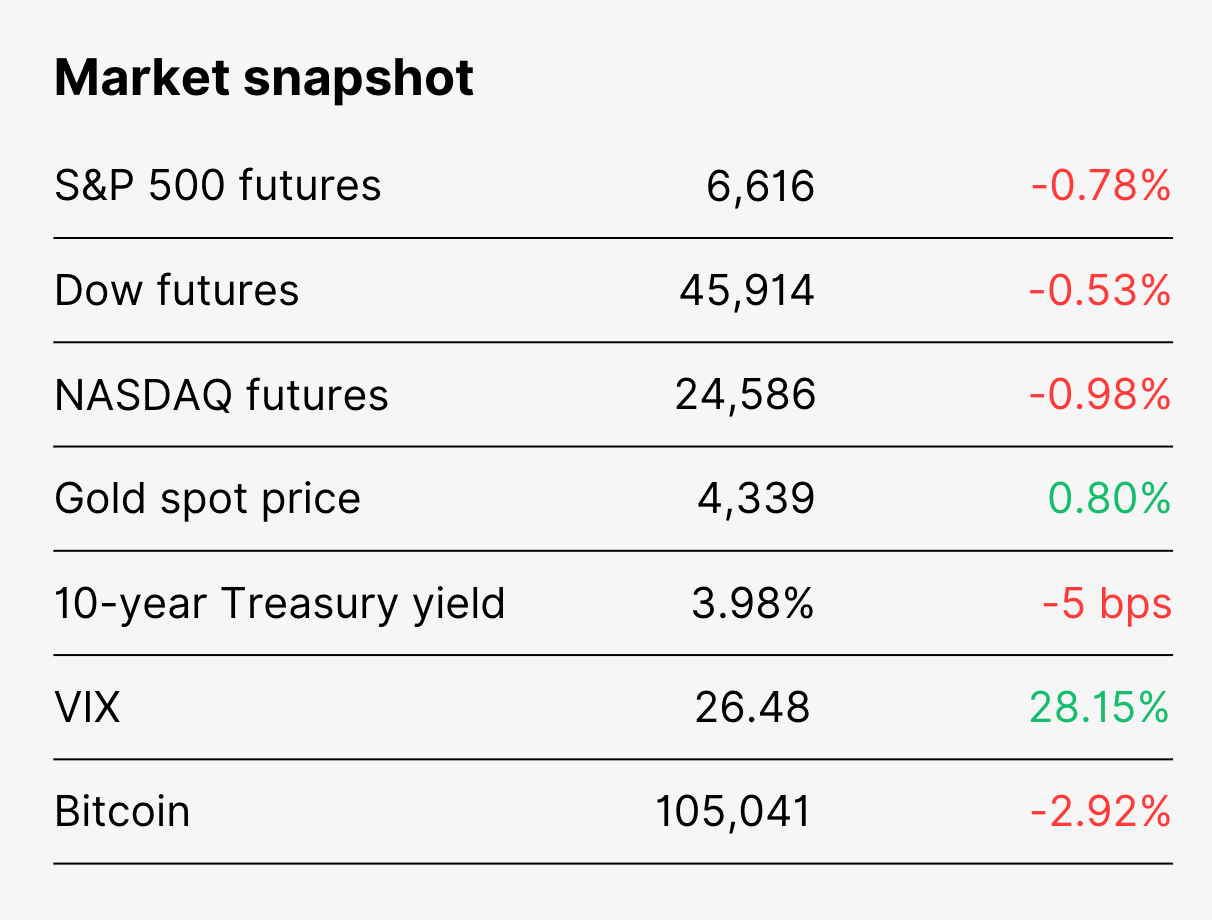
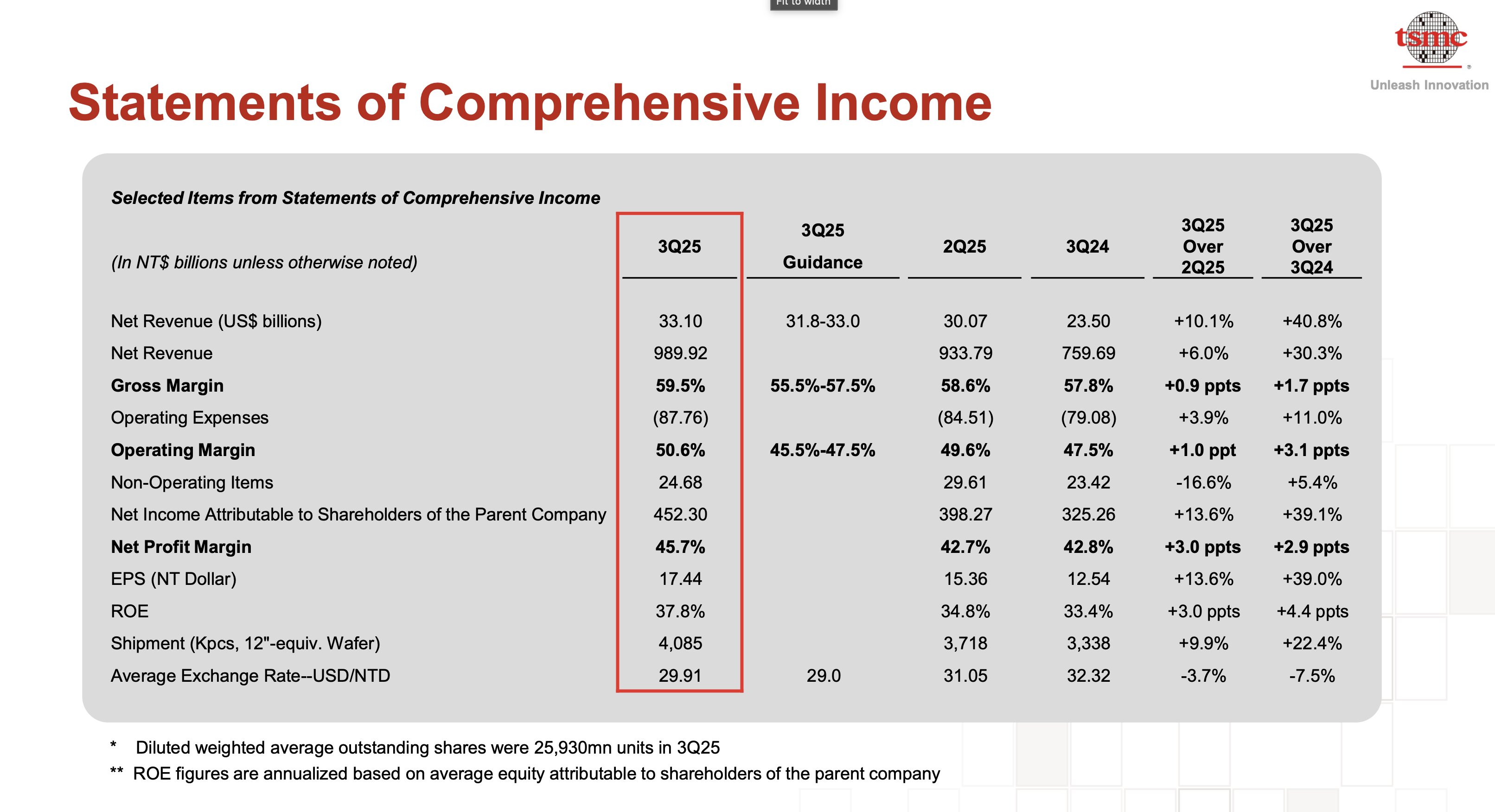
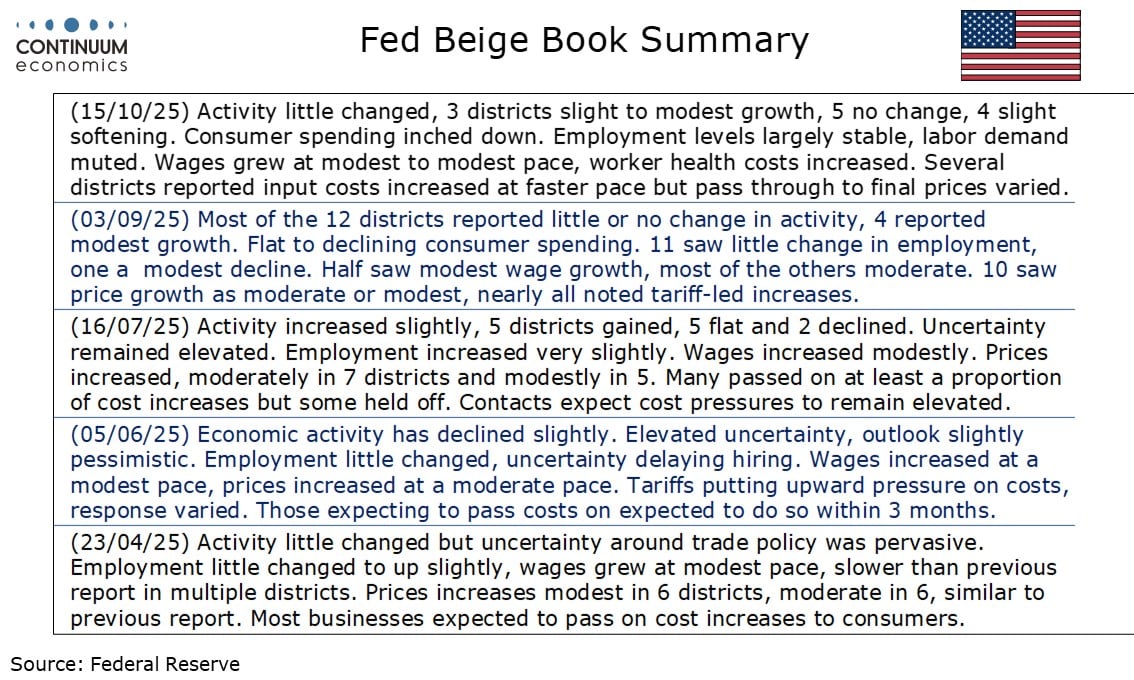
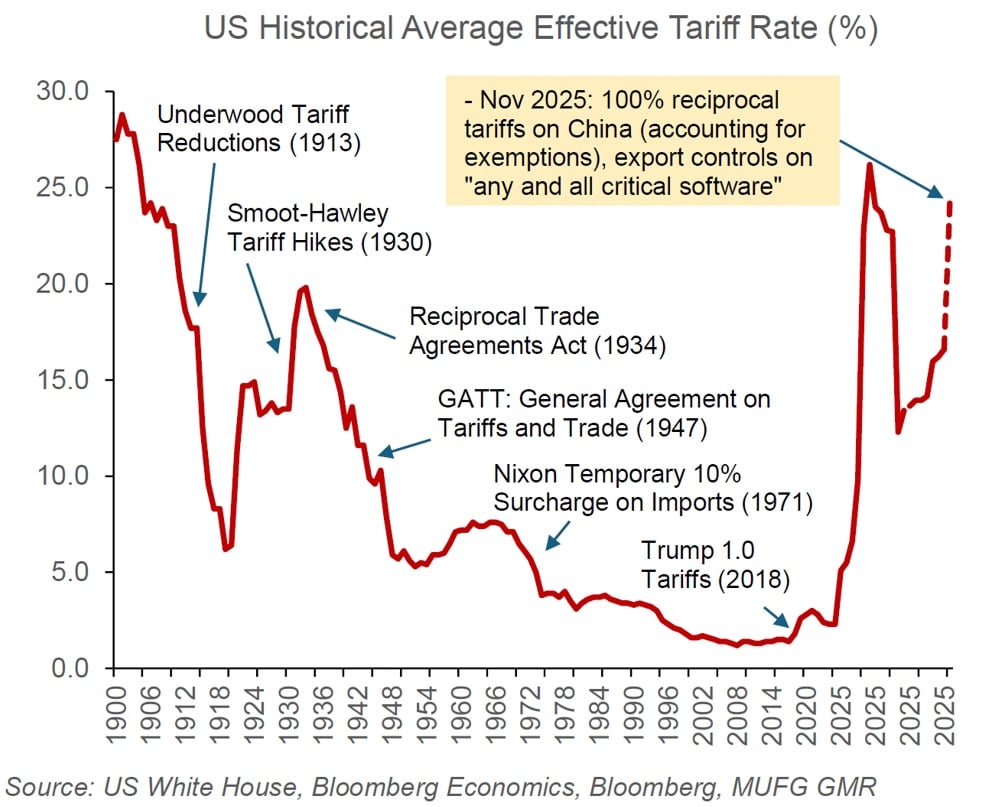
| | Good morning, Wall Street’s anxiety is showing again. Markets closed lower yesterday, and the VIX (Wall Street's "fear gauge") spiked to five-month highs as investors braced for fallout from Trump’s latest 100% China tariff threat. The Fed’s Beige Book also reminded investors that the trade war is no longer just a theoretical concept or political posturing... ... pointing to tariff-driven inflation and slowing hiring despite the promised rate cuts. There were a few bright spots, though. TSMC delivered knockout earnings that gave AI bulls another victory lap, sending chip stocks higher. Nestle also jumped 9% after announcing 16,000 job cuts, signaling how far corporate America is willing to go to streamline and automate. Crypto made a cameo too. BlackRock’s Larry Fink likened it to gold, an “alternative,” but not the core or a “large component” of a portfolio. Between the Beige Book hints, trillion-dollar AI math, and trade tit-for-tats, there’s a lot for markets to juggle heading into the weekend. Let’s dig in.
| | | | | Hang tight, Dan Runkevicius, Chief Editor | |  | | | | | “There is a role for crypto in the same way there’s a role for gold. It’s an alternative for those looking to diversify. This is not a bad asset but I don’t believe that it should be a large component of your portfolio.” — BlackRock CEO Larry Fink | | | | | Five things to know before opening bell | | |
🏭 Nestle surges on job cuts Nestle is slimming down in a big way. The company will cut about 16,000 jobs (mostly white-collar positions) as part of a sweeping restructuring and automation plan. CEO Philipp Navratil said the move will unfold over the next few years, with 12,000 cuts coming first and another 4,000 later. Nestle stock jumped 9% on the news. 🤖 Has OpenAI promised too much? Citi analysts now estimate OpenAI would need to spend more than $1 trillion by 2030 to deliver the 26 gigawatts of computing power it has pledged through Nvidia, Broadcom, and AMD. That’s about $50 billion per gigawatt, dwarfing its projected $163 billion in decade-end revenue. Sam Altman “has the power to crash the global economy or take us to the promised land,” said Bernstein’s Stacy Rasgon. 🏡 Homebuilder confidence rebounds Finally some good news for housing. US homebuilder confidence rose this month by the most since early 2024, according to the NAHB/Wells Fargo index. The gauge climbed five points to 37, which is still below neutral but a big improvement. NAHB chair Buddy Hughes said “most buyers are still on the sidelines, but recent rate declines are encouraging.” 📉 Fear gauge surges as markets slide The Cboe Volatility Index (VIX) spiked to its highest level since May following new trade risks and a prolonged government shutdown. Investors flocked into Treasurys, pushing the 10-year yield down to 4%. Analysts warn that politics could keep markets on a roller coaster. 🛢️ Oil hits five-month low Oil fell 1.4% to around $57 a barrel after President Trump said he’ll meet with Vladimir Putin. The prospect of peace overshadowed supply risks from sanctions and drone attacks on Russian refineries. Demand is crumbling too, with JPMorgan analysts pointing to weaker port activity and the end of the summer travel season. | | | | 🚀 TSMC earnings breathe new life into AI stocks
| | | | The AI chip trade just got another shot of adrenaline. Taiwan Semiconductor Manufacturing (TSMC) delivered blockbuster quarterly results, reminding Wall Street that the backbone of AI's rally is still very much intact... 📈 Booming demand, bigger bets TSMC’s profits soared 39% year over year to about $14.8 billion, while revenue climbed 30% to nearly $33 billion. The company lifted its full-year growth forecast to the mid-30% range and hiked capital spending to $40 billion. That optimism rippled across the market, sending Nvidia, Micron, and Broadcom higher. Investors bought into the idea that AI hardware demand hasn’t peaked.“This isn’t just a transient spike. It’s structural,” said AvaTrade’s Kate Leaman. ⚖️ Confidence meets caution TSMC’s earnings come as analysts start to question whether the meteoric rise of the Magnificent 7 and AI stocks is "priced to perfection." The good news is that TSMC is more insulated than its American peers. Not only do TSMC’s fundamentals look strong, but its global expansion into the US, Europe, and Japan means it’s better positioned to weather the trade war. For now, the backbone of the AI economy looks stronger than ever. We’ll get more clues with each new Big Tech report this earnings season. But if TSMC is any indication, chipmakers still have plenty of room to run. | | | | 📚 The Fed's Beige Book gives mixed feelings | | | | With official data still on pause, the Fed’s Beige Book gives the clearest look under the economy’s hood so far… 👀 What central bankers are seeing The latest report points to sluggish hiring as businesses face higher costs from tariffs. Employers across several Fed districts reported stable yet subdued labor demand, with many leaving open positions unfilled rather than cutting jobs. Meanwhile, tariffs are driving inflation more than wages at this point, according to the Beige Book. Companies are either absorbing the costs or selectively passing them on to consumers. The Fed noted that “tariff-induced input costs increases were reported across many Districts,” though most expect the effects to be temporary. ⚖️ Officials weigh rate cuts Wall Street is almost unanimous on a quarter-point rate cut later this month, but Fed officials aren't so sure. Governor Christopher Waller supports trimming rates this month but favors moving more slowly afterward, warning that “we need to move with care” on monetary policy. In contrast, Stephen Miran aligns more closely with the White House, calling for a deeper 50-basis-point cut to offset trade and labor market risks. Despite their different views, both governors see the same challenge: a slowing economy coinciding with stubborn inflation. Markets have largely priced in two more rate cuts this year, but comments like Waller’s hint that December’s outcome is far from guaranteed. 💡 What it means for your portfolio Record stock valuations are largely hinging on lower borrowing costs, and the Beige Book plus Fed commentary reinforce those bets. But rate cuts aren’t guaranteed. If inflation spikes, Fed officials will have to juggle their goal of supporting a weak labor market with their second mandate: stable prices. What happens then is anyone's guess. | | | | | The latest round of brinkmanship between DC and Beijing is driving Wall Street crazy. After months of calm, markets went back on a roller coaster this week following Trump’s vow to impose 100% tariffs on Chinese imports and and China’s threat of new export controls. 🧐 Where things stand Heading into the final trading session of the week, economists are bracing for fallout. Trump didn’t help when asked about a potential trade war, declaring: “You’re in one now.” Treasury Secretary Scott Bessent offered a more diplomatic tone, providing some reassurance, but both sides appear determined to test each other’s nerves. Perhaps more dangerously, the war isn’t one of mutual destruction and something both sides could engage in if needed. For example, Alejandra Grindal, chief global economist at Ned Davis Research, notes that China is in a strong defensive position. “China has been able to offset weaker US demand with strong shipments almost everywhere else,” she said. Considering that each side has a strong economy and leverage over the other (US: chips, China: rare earths), a quick resolution seems unlikely. 📉 How markets are responding Morgan Stanley’s Michael Wilson warned the dispute could spark “the first meaningful correction since April,” with a pullback of up to 15% possible. Defensive sectors, especially healthcare, have emerged as the “best hedge” against policy turmoil. Without a truce, Morgan Stanley sees a bearish S&P target of 4,900, roughly 25% below current levels. And a 100% tariff on Chinese goods could wipe out any hope of a recovery rally next year. Other moves yesterday: -
Gold +1.5% -
Bitcoin -2.2% -
US Dollar Index -0.12% 🌐 IMF’s global perspective IMF Managing Director Kristalina Georgieva said most other nations have avoided retaliation, helping keep the global economy afloat. “The world, so far, and I cannot stress enough, so far, has opted not to retaliate and to continue to trade pretty much on the rules that have existed,” she said. The IMF raised its global GDP growth outlook from 3.0% in July to 3.2% this week but warned that a US-China trade war would flush that forecast down the drain. | | | | Rate today's newsletter... | | | Your feedback matters! Take a sec and tell us how we did! | | | | | | | | | | | | InvestorsObserver | | You received this email because you signed up on our website or made a purchase from us. | | | | |