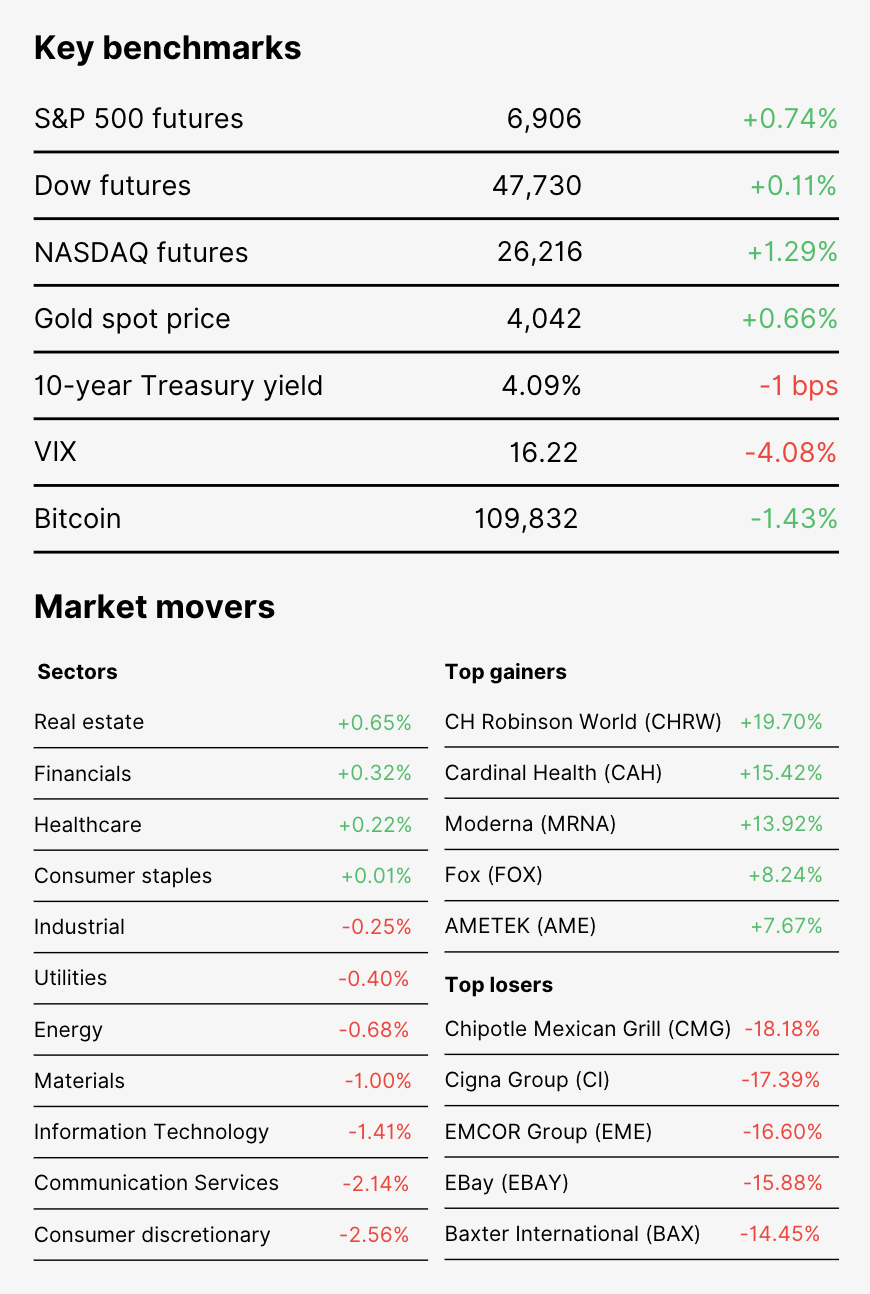
| | Good morning, The jobs machine is sputtering, and there’s no official data to prove it. Amazon, UPS, and others are cutting jobs, hinting that the “no-hire, no-fire” era may be over as automation, tariffs, and weaker demand disrupt corporate America. Wall Street’s tuning into consumer strain, too. Chipotle’s warning about shrinking traffic among younger diners hit a nerve, sending the stock down 18% and stoking fears about America’s middle class. Meanwhile, the shutdown is starting to bite, costing an estimated $3 billion a week for federal contractors, according to the Chamber of Commerce. And it’s not just a number on Uncle Sam’s ledger. These are real businesses and people missing payments for a month now. Airline CEOs visited the White House to warn VP Vance that flight delays and unpaid workers are pushing the industry to the brink. In fact, more than 60,000 TSA and air traffic staff are now working without pay. Over in tech, Amazon’s blowout quarter briefly lifted spirits, AWS revenue jumped to $33 billion, its fastest pace in years, but the Nasdaq still ended 1.5% lower. Wall Street’s starting to worry about ballooning capex that will take years to break even, while the Fed has second thoughts about more cuts. The thinking is simple: No cheap money + cash flows further into the future = valuations down. Let’s get into it.
| | | | | Hang tight, Dan Runkevicius, Chief Editor | |  | | | | | “Overall, we expect the general trend in interest rates will continue to move lower into next year, but the path is likely to be bumpy. There is still a high level of policy uncertainty affecting the outlook for yields.” — Charles Schwab chief fixed income strategist Kathy Jones | | | | | Five things to know before opening bell | | |
🧑🏭 "No-hire, no-fire" no more? Amazon, UPS, and others are trimming headcount as automation, tariffs, and slower demand force a reset across corporate America. Economists warn the long stretch of “no-hire, no-fire” stability that defined most of 2025 may be ending. With Powell in no rush to cut rates again in December, the labor market has become the new wild card in the soft-landing debate. 🏛️ Shutdown’s $3 billion-a-week bite The government shutdown is now draining an estimated $3 billion a week from federal contractors, according to the U.S. Chamber of Commerce... and most of that money isn’t coming back. Roughly 65,000 small businesses have already lost more than $12 billion in payments for everything from office paper to satellite gear. Unlike federal employees, they don’t get back pay when the lights turn back on. 🏆 Record demand for gold A new World Gold Council report shows global demand hit an all-time high of 1,313 metric tons last quarter, thanks to ETF inflows and record bar-and-coin buying. Analysts at UBS and Goldman Sachs think there’s still room to run as investors seek cover from uncertainty, with price targets as high as $4,900/oz next year. ✈️ Airlines warn of shutdown risks While Trump was overseas, VP J.D. Vance gathered top airline CEOs at the White House to talk damage control. Executives from United, American, and industry group Airlines for America warned that unpaid federal workers and mounting flight delays are turning the shutdown into an aviation crisis. More than 60,000 TSA agents and air traffic controllers are still working without pay. 💻 Amazon’s boom can’t lift Big Tech Amazon (AMZN) delivered a monster quarter, but even a 13% surge in its stock wasn’t enough to pull the Nasdaq out of a tailspin. The index closed 1.5% lower Friday, its weakest of the major averages. AWS revenue jumped to $33 billion, its fastest pace since 2022, but mixed results from Microsoft, Meta, and Google kept traders cautious. It seems like even Big Tech’s biggest beats can’t outrun valuation fatigue. | | | | 🇨🇳 Xi knows how to play Trump's game
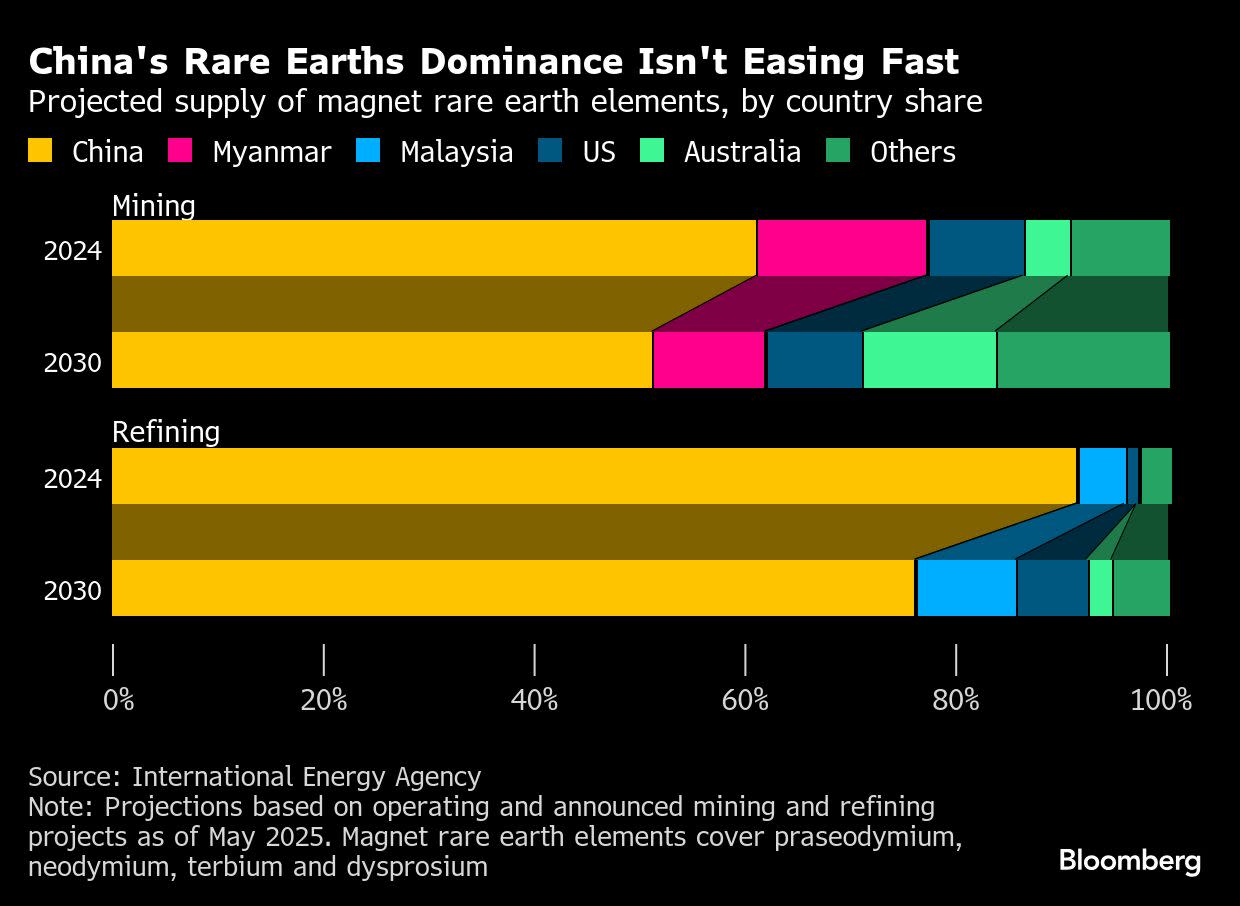
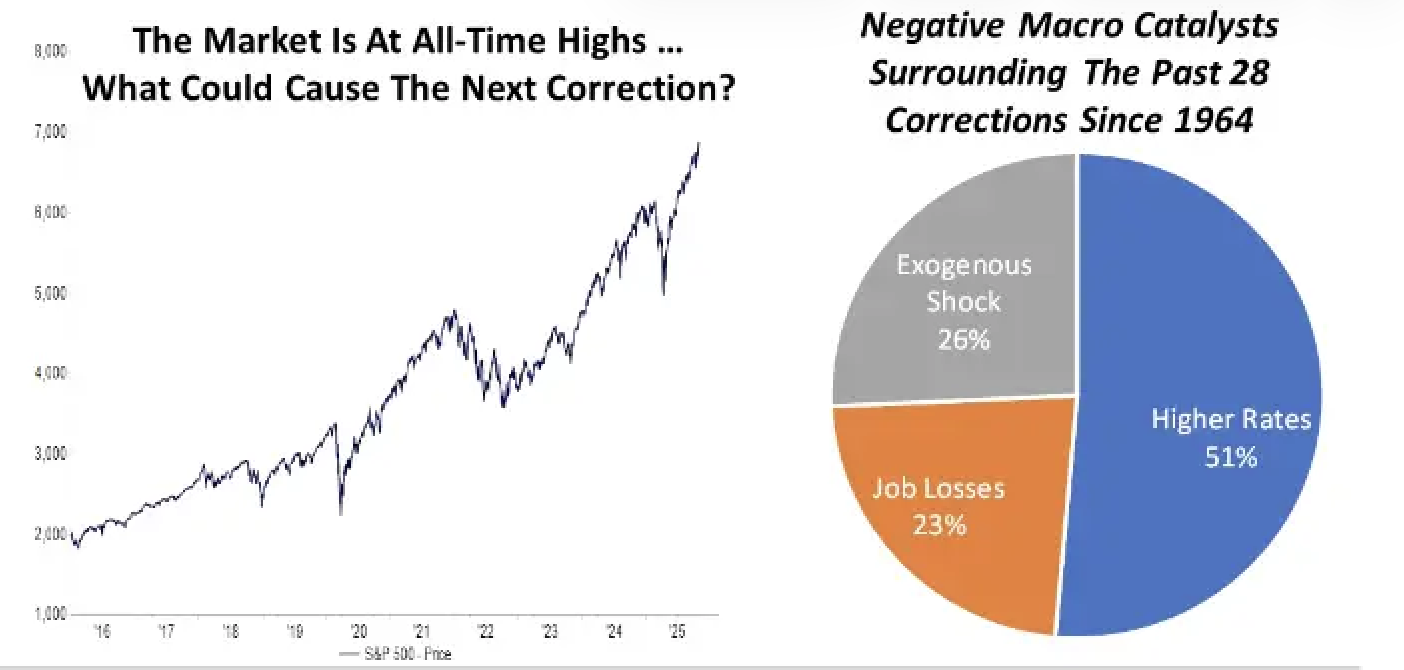
| | | | Trump called it an “amazing meeting.” Xi got what he wanted most: time. After their first sit-down since Trump’s return to office, the two leaders struck what the White House framed as a major breakthrough... ... a one-year pause on China’s new export controls for rare earths. In exchange, Washington agreed to delay a massive expansion of its own export blacklist and halve fentanyl-related tariffs from 20% to 10%. It all sounds like a win for both sides, but the reality is a little more complicated. 🧭 A truce built on trade-offs Beijing’s leverage remains firmly intact. What’s been agreed is a pause on restrictions that were scheduled to take effect soon. The existing export controls that have slowed shipments of rare-earth magnets, vital for jet fighters, chips, and EVs, are still in place. Industry insiders say Beijing’s export process remains just as restrictive, with longer license waits and added requirements for companies to disclose sensitive supply-chain data. As Wade Senti, CEO of Advanced Magnet Lab, put it, “This truce was a lot about everything but rare earths.” And to get even that pause, Washington had to give one of its own. The U.S. effectively linked its semiconductor and AI-chip curbs to Beijing’s mineral policies, which ome national-security officials are calling a “dangerous precedent.” Meanwhile, Trump rolled back multiple tariff threats, including a planned 100% hike and docking fees for Chinese ships. “Instead of punching back, we agreed to roll back,” said former NSC official Chris McGuire. In his view, the one-year ceasefire benefits China more, because American tech controls must be constantly updated to remain effective, while Beijing can simply sit on export licenses. 🧨 Two can play this game Trump may have bought a year of calm, but he also confirmed that China knows how to play his playbook. “Beijing drove a hard bargain, insisting on getting paid for every concession,” said Wendy Cutler of the Asia Society. “Trump has met his match.” The truce lifted markets for a day, but it didn’t resolve anything fundamental. China still controls the minerals, the approvals, and, increasingly, the timeline. This isn’t détente; it’s delay. And both sides know it. | | | | 🎭 The Fed is the main AI puppeteer | | | | As Wall Street debates whether the AI boom is built to last, the real power player may not sit in Silicon Valley... but at the Federal Reserve. After Wednesday’s second-straight rate cut, cheap money is flooding back into markets, giving AI-linked megacaps even more room to run. “You’re going to have a very hard time popping a bubble when the Fed is cutting rates,” said Renaissance Macro’s Jeff deGraaf. In fact, it was Fed tightening that burst the dot-com bubble in 2000. This time, Powell is doing the opposite, keeping valuations stretched as capital costs fall. But Powell wasn’t exactly in cheerleader mode. After the cut, he cautioned that “a further reduction in the policy rate is not a foregone conclusion,” cooling expectations for another move in December. FedWatch odds dropped to roughly 75%. But for now, liquidity is back, and so is investor confidence. 🧠 Big Tech’s AI bill comes due The week’s earnings offered a reality check. Microsoft spent a record $34.9 billion last quarter on AI data centers and infrastructure. Revenue rose, but growth plateaued. Alphabet impressed with 34% cloud growth and $93 billion in capital spending, right in line with forecasts. Meanwhile, Meta sent chills down analysts’ spines after warning it would “significantly” boost spending next year. The stock dropped 11%. All three are betting that AI demand will eventually catch up to their outlays. But if growth slows before those returns materialize, that mountain of capex could start to look more like a liability than a moat... especially if the Fed turns off the tap.
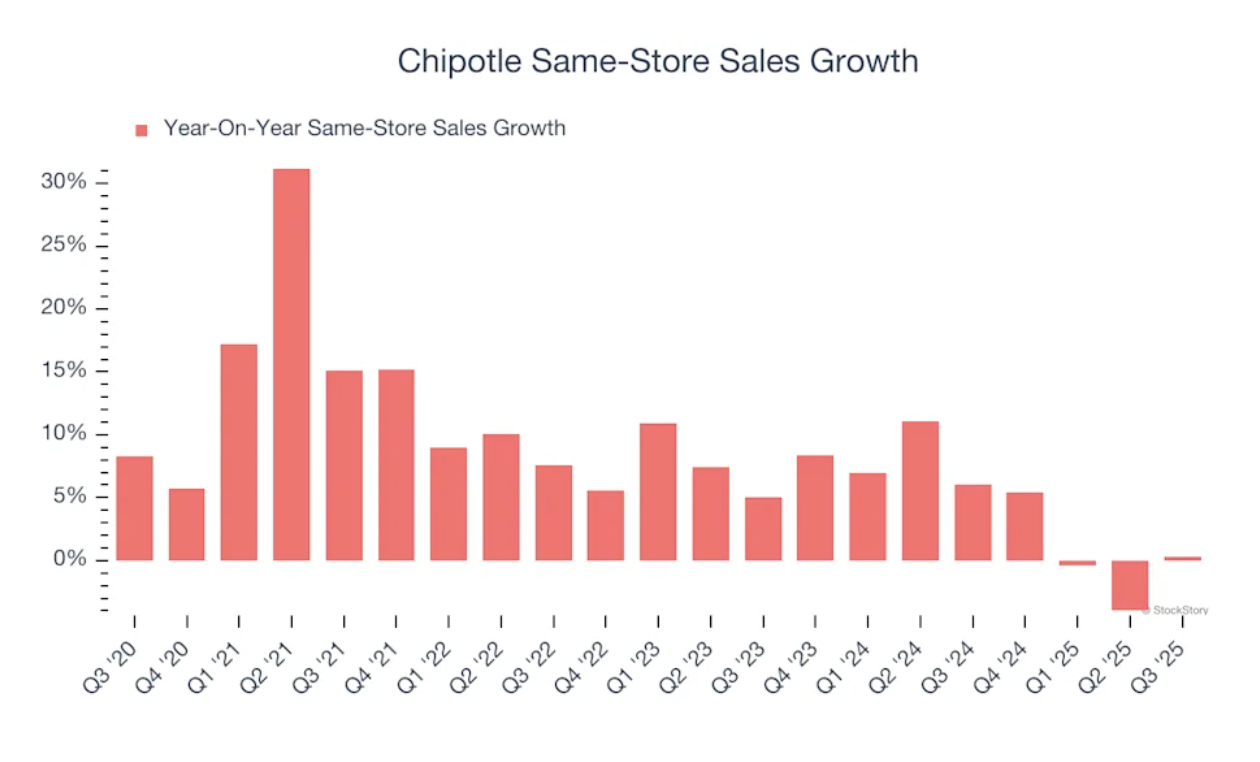
| | | | 🌯 Chipotle thinks the American consumer is not ok | | | | Chipottle's yesterday mesage is less guidenace and more of a statement aboput the economy. For the third straight quarter, the burrito chain cut its sales forecast, citing “persistent macro pressures” and shrinking traffic among its core customers: younger, lower-income diners. CEO Scott Boatwright called the 25- to 35-year-old group “particularly challenged,” pointing to rising debt, layoffs, and eroding disposable income. That’s a problem for a brand built on millennial and Gen Z loyalty. Chipotle now expects same-store sales to fall by mid-single digits this year. The stock plunged 18% on the news as analysts slashed price targets across the sector. 💵 It’s not just Chipotle Wall Street’s calling it this year’s “Halloween Scare.” Morgan Stanley’s Brian Harbor says fast-casual restaurants are feeling the pinch as cash-strapped consumers pull back across the board. The latest Conference Board survey confirms the divide. Confidence rose among households earning $200,000+, but fell for those making under $75,000. “The relationship between sentiment and spending has weakened. Wealthier households, who account for most spending, weren’t as affected by inflation as lower-income groups,” said Oxford Economics’ Grace Zwemmer. 📉 The mystery slowdown Not everyone blames affordability. BTIG’s Pete Saleh said the sudden drop in traffic caught even bulls off guard. “We were surprised by the magnitude that was reported last night,” he wrote. “We’re not convinced affordability concerns are the main driver here.” Whatever the cause, the shift is forcing analysts to rethink how much pricing power even beloved brands really have in this economy. | | | | Rate today's newsletter*... | | | * We are just a messenger. To avoid confusion, please rate the quality of reporting, not news | | | | | | | | | | | | InvestorsObserver | | You received this email because you signed up on our website or made a purchase from us. | | | | |