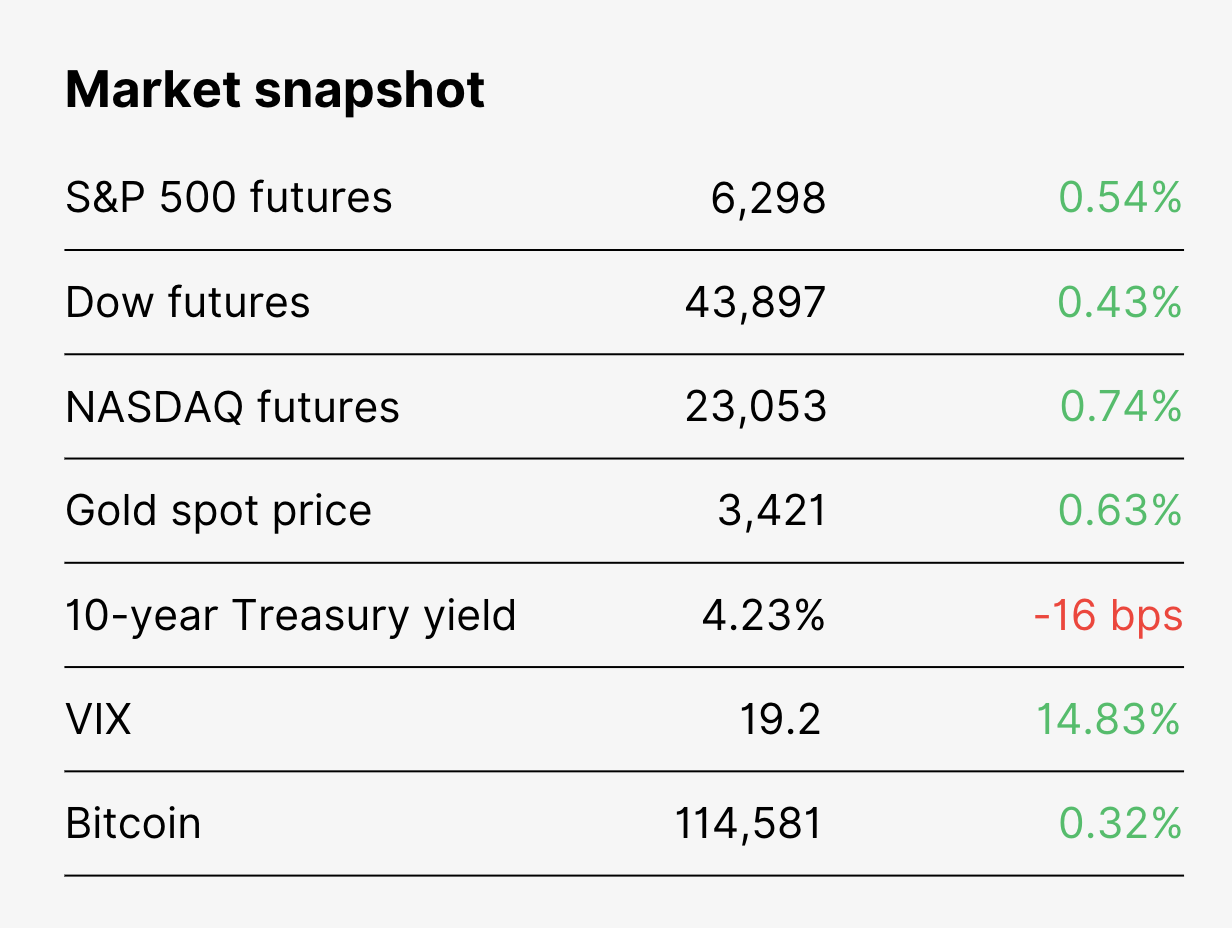
| | Good morning, Wall Street’s jobs-report hangover looks to be wearing off, with futures pointing higher this morning and September rate-cut bets holding near a lock at 80%. Meanwhile, gold is ripping past $3,400, oil’s sliding as OPEC+ opens the taps, and Buffett just sank $3.8 billion on a Kraft Heinz writedown. Trump is not taking it quietly. He's fired the nation’s top jobs statistician and calling the numbers “rigged” against Republicans. Powell’s catching heat, too, roasted for touting “historically low unemployment” just hours before those brutal revisions dropped. Meanwhile Amazon’s earnings flop erased 8% of its value Friday, Berkshire’s waving a giant red flag on valuations, and another 122 S&P heavyweights — including Disney, AMD, Airbnb — are lined up to report this week. It’s a lot and it’s only Monday. Let’s dive in.
| | | | | Hang tight, Dan Runkevicius, Chief Editor | |  | | | | | Disclosure: Just so you know, we’re sharing this because we genuinely think it’s worth your time. That said, we may earn a commission if you sign up through our link. | | | | Six things to know before opening bell | |
🏛️ Trump starts reshaping the Fed Trump says he’ll soon name a new Fed governor to replace Adriana Kugler and a fresh jobs data chief after firing Erika McEntarfer. The moves come after Friday’s ugly labor report and could dramatically tilt his economic agenda, with Powell already under fire. 🛒 Is Amazon a buy after Friday's 8% drop? Amazon’s earnings miss wiped out 8% of its value Friday as cloud growth lagged rivals. Analysts aren't buying the sell-off. JPMorgan nudged its target to $265, Citi lifted to $270, and UBS stuck at $271, calling Amazon “one of the best capital allocators in our space.” 🥇 Gold shines as markets sour Gold ripped above $3,400 an ounce after Friday’s ugly jobs report sent investors running for safety. Stocks and the dollar slumped, making gold Friday’s ultimate winner. With stock futures pointing higher this morning, a reversal could be in play, though. 🛢️ OPEC+ turns up the taps Oil prices slid as OPEC+ members agreed to boost output by 547,000 barrels a day starting in September. WTI crude closed near $67 Sunday, with analysts warning of more downside if demand weakens further. 🧀 Buffett’s Kraft Heinz headache Berkshire Hathaway booked a massive $3.76B writedown on its Kraft Heinz stake, alongside weaker operating profits and plunging net income. “Buffett definitely views the market as overvalued, and will sit back and wait for something to come to him,” said Edward Jones analyst Kyle Sanders. 📊 Earnings season hits full stride Earnings season barrels on with 122 S&P 500 companies set to report this week. Palantir kicks things off today, followed by Disney, Eli Lilly, DoorDash, Airbnb, and AMD. The S&P ended last week down 2.5% as investors look for more clues on corporate America's health. | | | | | Friday capped a wild week with a gut-punch of a jobs report that rattled Wall Street and reset expectations for where the U.S. economy is headed next. Here’s what the Bureau of Labor Statistics dropped: -
Employers added just 73,000 jobs in July, well below forecasts -
The unemployment rate ticked up to 4.2%, a 0.1-point increase in line with expectations -
May’s headline figure was slashed from 144,000 to 19,000 jobs. -
June’s numbers were revised down even harder, from 147,000 to 14,000. “This is a gamechanger,” Heather Long, chief economist at Navy Federal Credit Union, said, adding that the data proves the “labor market is deteriorating quickly.” Long urged the Federal Reserve to “seriously consider a September rate cut,” warning, “It’s clear companies are not hiring at all in this environment of uncertainty.” 🔎 Uncertainty ahead The jobs data wasn’t a lone bad print, with inflation and GDP readings earlier last week already flashing slowdown. But Friday’s revisions was the last staw. “The numbers today, and the revisions in an important way, suggest that maybe the economy and the labor market are weakening more broadly,” said Atlanta Fed chief Rafael Bostic. Daniel Zhao, chief economist at Glassdoor, went even further. “We’re finally in the eye of the hurricane. After months of warning signs, the July jobs report confirms that the slowdown isn’t just approaching — it’s here.” 🐘 Trump takes it personally President Trump took to Truth Social to blast the data and announce that Bureau of Labor Statistics commissioner Erika McEntarfer will be fired over the report. “She will be replaced with someone much more competent and qualified,” Trump wrote. “Important numbers like this must be fair and accurate, they can’t be manipulated for political purposes. In my opinion, today’s Jobs Numbers were RIGGED in order to make the Republicans, and ME, look bad.” | | | | 🍲 The Fed's pressure cooker | | | | It’s no longer just President Trump calling for rate cuts. Wall Street has been vocal for weeks, and Friday’s bombshell turned those dovish whispers into shouts. CNBC's Jim Cramer went out on a limb and made an on-air plea to Jerome Powell, saying he’s “been a big backer” of the Fed chair so far. “We have very little job growth, and we have wages that are not going up,” Cramer said. “That is when you cut.” Powell didn’t help his case by touting “historically low” unemployment just hours before revisions showed the jobless rate jumping. “Surely, Chair Powell wishes he had these numbers 48 hours ago. A much more downbeat view on the health of the labor market would have made a more dovish message easier to deliver with confidence,” said Thomas Simons, chief US economist at Jefferies. For now, the next shot at a rate cut is September, and Wall Street’s already pricing it as a near lock. CME’s FedWatch tool shows September rate-cut odds nearly doubled in two days, jumping from under 40% Thursday to almost 80% by Friday’s close. 🐘 Trump’s influence grows Wednesday’s FOMC vote wasn’t unanimous for the first time in three decades. Two dissenters, Michelle Bowman and Christopher Waller, are now floated as potential Powell replacements. Skanda Amaranth, a former Fed analyst, defended them against accusations of caving to Trump’s pressure. “They have always been nonpartisan in their analysis and deserve to be taken seriously,” she said. Meanwhile, Adriana Kugler resigned last week without explanation, opening another seat for Trump to fill. Kugler was one of the Fed’s more hawkish voices in recent months.
| | | | 🚧 Trump punts tariffs … for now | | | | Friday’s big tariff deadline came and went with a few last-minute deals but even more unanswered questions. 🕰️ A short reprieve After announcing sweeping new tariff hikes on U.S. trading partners, President Trump signed an executive order delaying implementation until Thursday. The UK negotiated early and walked away with a 10% duty on exports. At the other end of the spectrum, Switzerland’s late-stage deal raised tariffs on U.S.-bound goods from 31% to 39%. Canada also took a hit with a 35% duty on a range of goods as part of a crackdown on international fentanyl trafficking. 🐔 Threats or promises? Critics have nicknamed Trump’s approach “TACO” — for “Trump always chickens out” — but the administration has proven willing to hit hard when negotiations stall. Holger Schmieding, chief economist at Berenberg, said these sudden shifts are “scare tactics” designed to win leverage. “I expect many of them to be reduced after negotiations,” he said. “Trump’s deadlines are very flexible, after all.” Greg Daco, chief economist at EY-Parthenon, warned that volatility is already biting. Tariffs are “leading to higher inflationary pressures, which are curtailing consumer spending and prompting businesses to adopt more of a wait-and-see approach,” he said. Meanwhile, Wells Fargo economist Jay Bryson chimed in with Daco, saying Wall Street isn't taking these tariff seriously enough. “There’s a repeated refrain that tariffs are not having an impact, and that assessment misses the mark,” he said. 🔀 Experts split on long-term impact Opinions are all over the map when it comes to Trump’s shifting trade agenda. Stephen Olson, a former U.S. trade negotiator, said the confusion “fundamentally rewrites the rules of global trade,” calling it “an ongoing reality show” that will see “more deals or further tariff increases” ahead. “While we haven’t returned entirely to a ‘law of the jungle’ system, we have taken several huge strides back in that direction,” Olson added. Jamieson Greer, current U.S. trade representative, argued this is exactly how it was planned. “A lot of these are set rates pursuant to deals. Some of these deals are announced, some are not, others depend on the level of the trade deficit or surplus we may have with the country. These tariff rates are pretty much set,” he said. | | | | Rate this newsletter | | | Your feedback matters! Before you go, please rate this newsletter and share your thoughts. | | | | | | | | | | | | InvestorsObserver | | You received this email because you signed up on our website or made a purchase from us. | | | | |