| | Good morning, The Fed’s expected rate cut came and went… and the S&P 500 fell in a classic “sell the news” move. Here are some takes from my inbox on what happens next… If history is any guide, odds are in the bulls’ favor. Since 1982, the S&P 500 has gained an average of 11% in the 12 months after rate cuts, according to BMO estimates. The track record is strong with stocks rising 8 out of 10 times. But cuts don’t always deliver… and that makes total sense because at the end of the day, a rate cut is the Fed’s way of saying the economy needs help. For example, in some cycles, like 2007, lower rates preceded disaster. Back then, 12 months after the first cut, the S&P 500 was down nearly 24%. BMO’s chief market strategist Brian Belski boils this divergence down to one question: Can rate cuts prevent a downturn and extend earnings growth? “In cycles where rate cuts were able to prolong economic expansion and keep corporate earnings on an upward trend, stocks performed quite well,” he wrote. But today there’s another layer of uncertainty: politics. There’s growing belief on Wall Street that if markets sniff out the Fed is cutting more than it normally would to appease Trump, lower rates could backfire big time. If that happens, JPMorgan’s David Kelly warns stocks, bonds, and even the dollar could all take a hit. Meanwhile, the Fed’s balancing act is only getting harder. Powell’s term ends mid-next year, inflation is still above target, and growth is slowing. Which leaves the Fed juggling not two but three balls: inflation, unemployment, and now Trump.
| | | | | Hang tight, Dan Runkevicius, Chief Editor | |  | | | | | “There wasn’t widespread support at all for a 50 basis point. I think we’ve done very large rate hikes and very large rate cuts in the last five years, and we tend to do those at a time when you feel that policy is out of place and needs to move quickly to a new place. That’s not at all what I feel certainly now, I feel like our policy has been doing the right thing so far this year.” — Fed chair Jerome Powell | | | | | Five things to know before opening bell | |
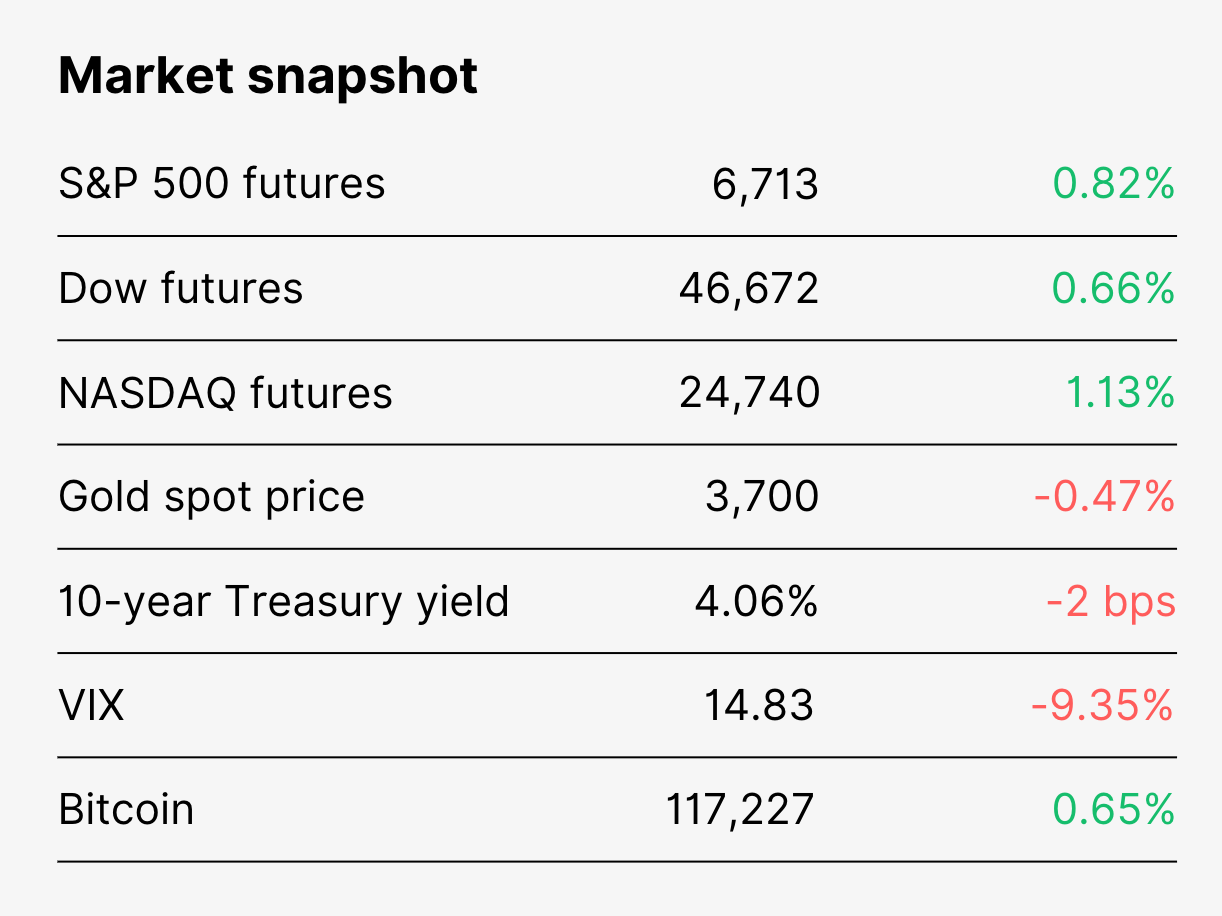
📉📈 Markets mixed after Fed’s rate cut The Fed’s widely expected 25-basis-point cut landed with a muted impact on equities. The Dow climbed more than 0.5% and notched a fresh intraday record, while the S&P 500 and Nasdaq slipped just below flat. Gold and WTI crude each dipped around 1%, and the dollar snapped back from a three-year low. The lone dissent on the FOMC was Trump appointee Stephen Miran, who pushed for a deeper 50bp cut. 🇨🇳🤖 Nvidia's Huang on US-China trade war As US-China talks unfold, Nvidia’s Jensen Huang weighed in on Beijing’s reported chip bans. “We could only be in service of a market if the country wants us to be,” he said, adding that while the moment is “disappointing,” he’s confident a deal is possible. Nvidia stock slid 2.6% on the news. 📺 Netflix gets boost in streaming sector Netflix is proving it’s still king of the couch. After a 39% rally this year, shares jumped another 2% yesterday following a Loop Capital upgrade to “buy” with a $1,350 target. Analysts declared Netflix had “won the streaming wars,” and nearly two-thirds of Wall Street now rate it bullish. ₿ Crypto top dogs could see post-cut upside Crypto bulls see room to run after the Fed’s pivot. Fundstrat’s Tom Lee pointed to yesterday's cut as the main driver for the Nasdaq and crypto, calling Bitcoin and Ethereum prime beneficiaries of global liquidity easing. BTC dipped slightly yesterday while ETH gained 1.6%, but both remain up 24% and 37% year-to-date. 📊 More economic indicators drop today The rate cut was big, but it wasn’t the only important data point this month. Today brings weekly jobless claims, the Philly Fed’s manufacturing survey, and August’s leading indicators. On the earnings front, FedEx, Darden Restaurants, and Lennar headline.
| | | | 📉 Jobs data is behind the curve
| | | | Recent jobs reports have carried at least a spoonful of sugar with the bad news: softer hiring but still relatively few layoffs. That narrative is starting to fade. The unemployment rate is inching higher, and some analysts warn the official numbers aren’t showing the full picture. ⏳ Research is behind the curve Today’s jobless claims will give another read on the labor market, but in a fast-shifting economy, those numbers may already be stale when they hit. In fact, UBS economist Jonathan Pingle argues the jobs market is already much weaker than it looks. “The prevailing narrative that firms are not laying off workers is incorrect. Thus, with layoffs running at a normal clip, if hiring slows much further, the labor market would tip into contraction,” he said. Pingle notes that BLS data often lags real-world trends, especially on job separations, meaning upticks in layoffs don’t show up until they’re already entrenched. According to a recent study from consulting firm Challenger, Gray & Christmas, last month’s layoff announcements were 13% higher than a year ago. That's a clear shift from “low” layoffs to at least a moderate level. | | | | 🛍️ K-shaped recovery in consumer spending | | | | A consumer-driven economy only runs as fast as people believe it can, and analysts are scouring every retail trend they can find for signs of fading confidence. So far, the signals are mixed. ✅ First, the good news According to the Commerce Department’s latest retail report, spending rose 0.6% last month, with sectors like online sales, clothing, and restaurants outperforming that average. “The economy seems to be doing just fine for now and perhaps the slowdown in payroll jobs is one gigantic head fake," said Fwd Bonds chief economist Christopher Rupkey. "Consumer spending is resilient. Interest rates do not need to be adjusted as the economy is sailing along just fine.” Of course, rates were adjusted yesterday, and the effect on consumer sentiment is still unknown. When retail is the only bright spot in a cooling economy, there’s very little margin for error. ⚠️ Now... the bad news Confidence is faltering in labor, inflation, trade, and other key sectors. Bullish analysts are increasingly leaning on the consumer to keep the economy afloat. But FICO data shows a warning flag: Gen Z borrowers saw their average credit score drop three points this year, the steepest decline of any age group since Covid. “We’ve seen a K-shaped economy where those with wealth tied to stocks and rising home values are doing well, and others are struggling with high rates and affordability problems,” said FICO senior director Tommy Lee. Likewise, Oxford Economics’ Michael Pearce called retail spending “back on track” after a slow first half but noticed the same skew. The rebound is “concentrated among higher-income households,” while low-income consumers are still squeezed by a weak labor market and policy headwinds. In spite of that, he remains optimistic about spending. “We expect that dynamic to persist in 2026, even as overall spending holds up,” he said. | | | | ⏳ The Fed’s waiting game is over | | | | The Fed did exactly what everyone expected: a 25-basis-point cut. But while the move was all but priced in, the real question is what it means for your portfolio a week, a month, or a year from now. 🏛️ A Jekyll and Hyde moment Part of what makes being on the FOMC such a thankless job is that any policy move is likely to disrupt some segment of the economy in a negative way. And as we saw with President Trump’s ongoing feud with Fed president Jerome Powell, a wait-and-see perspective doesn’t help central bankers make many friends either. While the general vibe on Wall Street over the past few months is that a rate cut is the right prescription to reinvigorate the economy, historical trends tell a more complicated story. For starters, investors have been pricing in a rate cut for at least a few weeks, since Powell delivered remarks signaling the likelihood of monetary easing at this month’s meeting. Investors also realize that rate cuts tend to come in response to a slowing economy… and there’s plenty of evidence of that in the market data released this summer. Then there’s the risk of a politicized Fed, adding another layer of uncertainty. So how do stocks perform after rate cuts? Short answer: It depends on your timeframe. By recent BMO estimates, the S&P 500 gains an average of 11% in the 12 months after a cut, with stocks rising 8 out of 10 times. But the short-term track record isn't so strong. Seasonax data going back 25 years shows a median 0.31% drop in the 30 sessions after a Fed cut. 🛒 What’s the real world impact? While Wall Street speculates on where stocks are headed, Americans are still dealing with inflation above the Fed’s target. As Tyler Schipper, associate professor at St. Thomas University, put it: “It isn’t likely to do much for the kitchen-table issues plaguing so many Americans.” “It’s pretty clear that the labor market has shifted into a lower gear,” he said. “But what consumers are hearing is, ‘My job is at risk, and grocery store prices are still accelerating.’ And I don’t know that a headline that the Fed cuts interest rates by [a quarter point] is really going to be the salve that makes the problem go away.” | | | | GIFs in newsletter: Yes or no? | | | Your feedback matters! Before you go, please cast your vote! | | | | | | | | | | | | InvestorsObserver | | You received this email because you signed up on our website or made a purchase from us. | | | | |