| | Good morning, “We have seen this before in 2008, 2020, and even in August 2024. Times like these are good buying opportunities,” said Goldman Sachs’ Lina Thomas. But she wasn't talking about stocks... For the first time, gold crossed $3,700 and is at an inflation-adjusted record high, surpassing the peak of 1980 set off by the end of Bretton Woods and America’s biggest stagflation breakout. And Wall Street almost unanimously agrees this is just a warm-up. Goldman is probably the most notorious gold bull in this cycle. Its base case is $4,000 by mid-2026. That’s assuming nothing bad happens and things effectively stay the way they are. But if the status quo breaks and investors start diversifying away from dollar assets, Goldman thinks gold will blow through the roof. By Goldman estimates, it would take just 1% of private Treasury holdings moving into gold for prices to hit $5,000. But why would anyone plan to sell off their Treasuries and buy gold now? There are a couple of reasons. First, opportunity costs. When the Fed cuts rates and bond yields go down, the opportunity cost of holding gold (which doesn’t generate any income) is lower because your bonds are simply earning less. That’s why gold prices typically move in opposition to real interest rates. Second, losses. There’s a concern that a politicized Fed would be more prone to lower rates to finance deficits and artificially boost the economy. That would push up inflation expectations and drag down Treasury prices. Finally, the unknown. Since the end of Bretton Woods, the whole financial system has relied on Washington’s pinky promise. If there’s even a small chance of that not being the case anymore, all paper assets are at risk. So naturally, investors who have most of their wealth tied to the dollar want some insurance and gold fits the bill perfectly.
P.S. On GIFs, we’re leaning toward keeping them, but I want to get more votes from you. I’ll keep the ballot open until the end of the week.
| | | | | Hang tight, Dan Runkevicius, Chief Editor | |  | | | | | “We have seen this before in 2008, 2020, and even in August 2024. Times like these are good buying opportunities, because gold typically rebounds shortly afterwards as investors seek safe assets.” — Goldman Sachs Research economic analyst Lina Thomas | | | | | Five things to know before opening bell | |
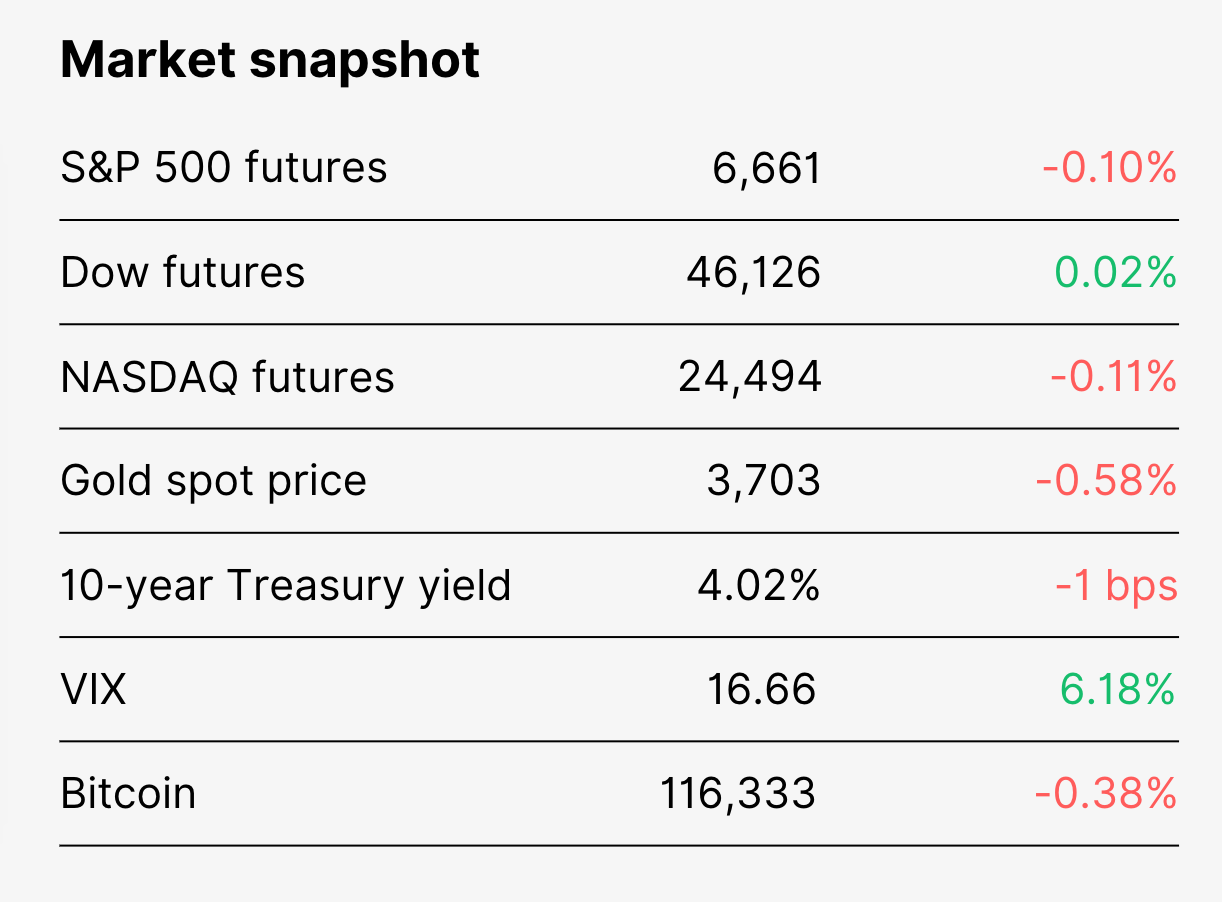
🇺🇸 Miran confirmed, Cook safe for now Just in time for the Fed’s most anticipated meeting in years, two central bankers just locked in their seats. The Senate narrowly approved Trump’s pick Stephen Miran to a governor slot, giving him an immediate say on today’s rate cut. Meanwhile, a federal court blocked White House efforts to oust Lisa Cook, clearing her to vote despite mortgage fraud allegations. 📉 Traders cautious ahead of Fed call Wall Street played it safe yesterday, with the Dow slipping 0.3% and all three major indexes in the red ahead of today’s rate decision. Gold held firm above $3,700, the dollar slid to a four-year low against the euro, WTI crude popped nearly 2% on Russian supply jitters, and Bitcoin surged near $117,000. Markets are hedging, but the real move comes when Powell speaks. 📦 Inventories inch higher Business inventories ticked up 0.2% in July, lagging a stronger 1% rise in sales. On an annual basis, inventories were up 1.5%. Motor vehicles (+0.5%) and manufacturing (+0.3%) led the increase, but the bigger story is that Q2 saw inventory declines and GDP still grew thanks to a shrinking trade deficit. 💸 Import prices jump again Import prices rose 0.3% in August, double July’s pace, with core prices (ex-food and fuel) climbing an even steeper 0.5%. Economists had expected some relief, but the surge suggests foreign exporters may be offsetting tariffs by passing costs directly to US buyers. For consumers, it’s yet another sign retail prices are headed higher. 🤝 US-UK strike historic tech deal Trump’s UK visit produced a splashy $42 billion pact with US tech giants. Microsoft, Google, and Nvidia all pledged major investments, from building the UK’s most powerful AI supercomputer to rolling out Nvidia’s newest chips. The deal was billed as a boost for science, energy, and economic ties, but investors weren’t impressed. All three stocks ended the day lower. | | | | 📈 Will ‘jobless expansion’ keep Wall Street up and Main Street down?
| | | | The stock market keeps setting records while anxiety about jobs piles up. JPMorgan analysts call it “the curious case of a jobless expansion.” 📊 By the numbers: -
👶 Youth unemployment (ages 16–24) jumped into double digits last month for the first time since the COVID lockdowns. -
📉 Nearly half of retail investors surveyed by AAII now call themselves bearish, the most since the initial backlash to Trump’s tariffs five months ago. -
📊 Yet the S&P 500 is still circling all-time highs, with some forecasts eyeing 7,000 by year-end. So if Americans sense trouble ahead, why are stocks still climbing? While uncommon and seemingly irrational, Piper Sandler chief investment strategist Michael Kantrowitz says it's not unprecedented. “We have seen rising stocks and unemployment before,” he said, pointing back to a few analogs from 30 to 70 years ago that looked eerily similar to today. In the 1950s, ‘60s, and ‘90s, Kantrowitz noted, rising unemployment spurred rate cuts, which in turn pushed stocks higher. 🧊 Cool labor market = more profits Goldman Sachs strategists offer a more blunt take on this phenomenon. “A cooling labor market is a tailwind to corporate profits, all else equal,” they wrote. That tracks with what’s happening now. Payrolls are shrinking, more Americans are losing work, and corporate margins are fattening as labor costs ease. But treating a “jobless expansion” as a silver lining is risky. EY chief economist Gregory Daco cautioned that tariffs, AI, immigration, and more make it dangerous to assume this rally can last. “We’re seeing conflicting winds,” he said. “There is a little bit too much exuberance relative to the downside risk to the economy.” | | | | 🔮 Last-minute predictions for the big day | | | | While the FOMC meeting kicked off yesterday, it’s today’s policy decision that’s had everyone glued to screens for weeks. With the announcement imminent, opinions are flying on the size of the rate cut and what it could mean for markets in the weeks, months, and even years ahead. 🗣 More from the bully pulpit Unsurprisingly, President Trump had thoughts to share on the eve of the Fed’s big meeting. Using his familiar nickname for Fed Chair Jerome Powell, he wrote: “‘Too Late’ must cut interest rates now, and bigger than he had in mind.” It was just the latest call for the central bank to slash rates deeper than even the 50-basis-point cut some market-watchers expect today. A couple of months ago, he said current rates — hovering between 4% and 4.5% — were “at least” three full percentage points too high. While Trump isn’t alone in calling for deep cuts, the odds of anything bigger than a 25bp trim today are shrinking. 🔢 Why 25 is the magic number According to CME Group’s FedWatch tool, traders are locked in on a quarter-point cut, giving it a 96% probability based on bond futures trends. Regions Financial chief economist Richard Moody summed it up: a 25bp cut “seems all but a given” even though there’s “plenty of intrigue around the rest of the meeting.” Unemployment data is pushing central bankers toward cuts, but the threat of even more inflation, nearly twice the Fed’s 2% target, keeps them cautious. As Deutsche Bank chief US economist Matthew Luzzetti noted, Powell is probably in for a “challenging press conference” today at 2:30 p.m. Eastern. 🔮 Planning for the future No matter what the short-term indicators show, Pantheon Macroeconomics chief US economist Samuel Tombs warned that all bets are off once a “substantial loosening” starts impacting markets. He also advised against looking to the Fed for validation. “Our view remains that a substantial easing cycle will be warranted incrementally by the mix of inflation and labor market data, rather than telegraphed by the FOMC in advance,” he said. | | | | | Americans are opening their wallets and not just because prices are rising. Census Bureau data for August showed retail sales coming in well above economist forecasts. 📊 By the numbers Before diving into the implications, here’s how August stacked up: -
Retail sales ticked up 0.6% last month -
July’s results were revised upward, suggesting even stronger performance -
All of this came despite forecasts predicting a slowdown There were more surprises. Motor vehicle sales and other tariff-hit sectors posted gains, while online retailers outpaced overall growth with a 2% jump in August alone. “The spending was rather broad-based as consumers even spent generously on discretionary goods such as those related to hobbies and recreation and restaurants and bars,” said Nationwide chief economist Kathy Bostjancic. 💄 Is it the lipstick effect? One way to interpret this trend is that consumers are spending despite economic worries, though cause and effect may be reversed. A phrase from the Great Depression, known as the “lipstick effect” — meaning that discretionary spending rises despite a grim outlook — is making a comeback in Wall Street vocabulary. The term originally described a spike in makeup sales during downturns, but it now applies to broader discretionary spending. Peel Hunt retail analyst John Stevenson described the phenomenon, sometimes called “treatonomics”: “Buying yourself small treats when you’re under financial pressure.” Its impact extends beyond cosmetics, particularly in homewares. “You can’t afford a new dress or outfit, but you can always get a new lipstick. You can’t afford to get a new sofa, but you can get a throw or some cushions. You can’t redecorate the house, but you can get a new tablecloth,” he said. If you tried to pin August’s strong retail performance on a single factor or past period, eToro US investment analyst Bret Kenwell would call it a fool’s errand. "It’s a weird macro environment right now," he said. "Inflation continues to edge higher, while labor market measures — like payroll, unemployment, layoffs, and job openings — are moving in the wrong direction." All things considered, Kenwell anticipates a 75bp Fed cut by the end of this year, followed by another 75bp trim in 2026. | | | | GIFs in newsletter: Yes or no? | | | Your feedback matters! Before you go, please cast your vote! | | | | | | | | | | | | InvestorsObserver | | You received this email because you signed up on our website or made a purchase from us. | | | | |