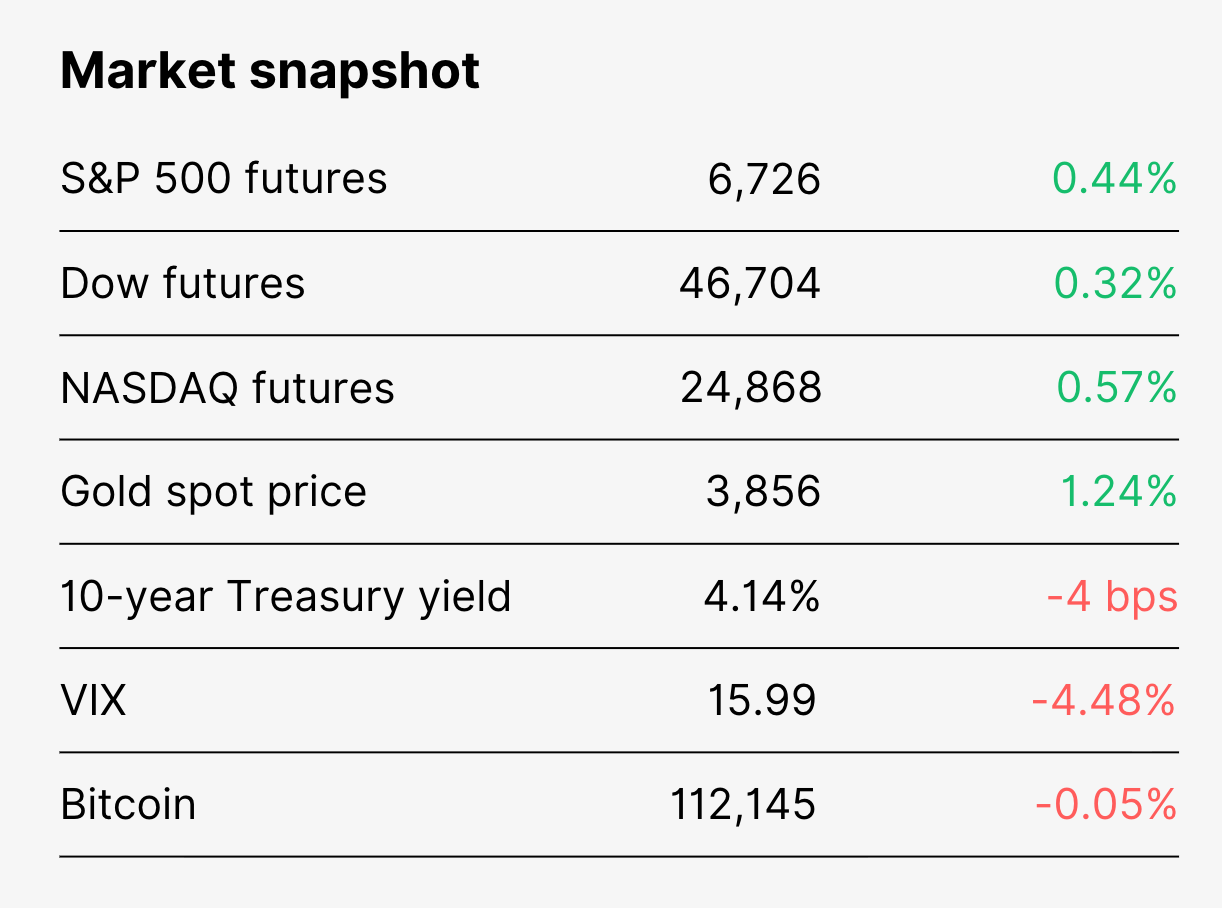
| | Good morning, Wall Street’s “fairly highly valued” sticker is looking more like a warning label than a compliment. Last week's Powell caution joined a barrage of red flags: Buffett's favorite gauge — the Shiller CAPE — just passed dot-com highs, and 19 of 20 valuation indicators are sitting in the danger zone. Yet bulls insist this is a “new normal” fueled by AI and balance-sheet discipline. Bitcoin slumped below $110k over the weekend, but the bounce late Sunday night gave bulls a flicker of hope as they head into the new week. Betting markets still aren’t convinced, with Polymarket putting the odds of a five-figure BTC by year-end at 60%. Back in the real economy, homeowners are skipping full-blown renos for lipstick fixes as tariffs and inflation hit home improvement budgets. Lowe’s calls it “uncharted waters,” and consumer sentiment shows just how uneven this recovery is. Wealthier Americans are still spending — propping up GDP — but as Oxford Economics warns, the gap between the haves and have-nots is now “wider than ever.” This isn’t shaping up to be an ordinary week... with Fed speeches looming, EV credits about to vanish, and Trump taking shots at Microsoft’s leadership Let's dive in. | | | | | Hang tight, Dan Runkevicius, Chief Editor | |  | | | | | “If you’re an investor trying to guess where the top is, your odds are very much against you.” — Ritholtz Wealth Management CIO Barry Ritholtz | | | | | Five things to know before opening bell | |
🏚️ Home renos hint at sagging sentiment Homeowners are pulling back. Big-ticket remodels are out, smaller jobs are in. Harvard’s housing researchers say spending growth is slowing, exacerbated by Trump’s latest tariffs on cabinets and vanities. Renovation spending has long been a proxy for consumer confidence... and right now, it’s not looking good. 🏛️ Trump takes aim at Microsoft exec Microsoft’s Lisa Monaco became Trump's weekend target. He blasted the company’s president of global affairs, calling for her immediate firing over her ties to past Democratic administrations. This comes on the heels of his demand earlier this month for Intel’s Lip-Bu Tan to resign, which ended with Trump praising Tan once the White House took a stake in Intel. ⚡ EV market set to take another hit Federal EV credits expire tomorrow, and that’s bad news for a market already struggling with price and infrastructure concerns. Nearly 80% of buyers say the $7,500 rebate factors into their decision, and almost half admit they’d speed up plans to beat the deadline, according to Cars.com. After that, demand could dry up fast. 📊 Fed remarks to usher in jobless data The Fed’s inflation headache is shifting to jobs. Friday’s employment report — the first since the rate cut — is expected to show just 54,000 jobs added, flat with the last two months. While a government shutdown could delay the release, Wall Street won’t be short on Fed speeches. Today brings a packed slate of speakers, including governor Christopher Waller and the chiefs from Cleveland, New York, St. Louis, and Atlanta. 💸 Bitcoin's six-figure test Bitcoin slipped under $110K this weekend, now off more than 10% from its peak just weeks ago. A late Sunday bounce gave bulls something to cling to, but the market still feels fragile. Fundstrat’s Sean Farrell says it’s “tough to feel extraordinarily optimistic” short term, though he sees ETFs setting up a strong Q4. Polymarket disagrees, putting the odds of Bitcoin ending the year back in five digits at 60%. | | | | 🐻 Where are all the bears?
| | | | Fed chair Jerome Powell made waves last week when he declared that Wall Street is “fairly highly valued” these days. It was both a statement of the obvious and a reminder of the risk still hanging over this rally. Stocks wobbled on his comment midweek, but by Friday’s close, the stock market was back in the green. 🚩 Red flags are everywhere Valuations are hot by nearly every measure, and the capital flooding into equities is increasingly concentrated in Big Tech. A few stats backing Powell’s warning: -
Bank of America tracks 20 valuation indicators — 19 are sitting at historically elevated levels, and four just hit all-time highs -
The Shiller CAPE ratio shows the S&P 500 hasn’t been this expensive since the dot-com bubble -
Forward P/E ratios are pressing against 2021 and Y2K peaks -
And the Buffett Indicator — market cap vs. GDP — just reached a new record More than two decades ago, Warren Buffett called his favored gauge “probably the best single measure of where valuations stand at any given moment.” At levels he once described as “playing with fire,” investors today don’t seem too worried. ⏳ That was then, this is now History usually suggests what goes up must come down, at least when it comes to valuations. But bulls aren’t convinced that the old rules apply today. Bank of America’s Savita Subramanian has a positive spin on this. Investing in stocks, she said, “at these multiples feels bad, but there are good ways (sales/EPS/GDP booms) and bad ways (price declines) to resolve this seemingly untenable situation.” "Perhaps we should anchor to today’s multiples as the new normal rather than expecting mean reversion to a bygone era,” she added. Meanwhile, Barclays' head of research Ajay Rajadhyaksha points to a “new economy … driven by technology, digital innovation, and knowledge-based industries” that is “thriving” despite the negative news. With stronger balance sheets, disciplined capex, and booming AI demand, he argues that “today’s AI surge is fundamentally different” from the dot-com crash.
And the last bullish spin comes from CFRA’s chief investment strategist Sam Stovall, who argues that stretched valuations are effectively stocks’ second nature.
“Over the past 20 years, the S&P 500 is trading at roughly a 40% premium to its long-term average on forward estimates,” he said. “But on a five-year basis, when mega-cap tech began to dominate market cap and earnings growth, that premium shrinks to a high single-digit range.” | | | | 📊 Why everyone is watching next PCE print | | | | Last week ended with inflation creeping higher just as economists expected. And analysts are already biting their nails ahead of the next reading... 📈 What the numbers say The Personal Consumption Expenditures index, the Fed’s favorite gauge of inflation, hit 2.7% annual in August, or 2.9% excluding volatile food and energy. Total PCE nudged up from July’s 2.6%, while month-to-month core inflation held steady. The Philadelphia Fed’s latest survey forecasts fourth-quarter CPI will reach 3% annually, its highest in nearly 18 months. Meanwhile, Goldman Sachs expects PCE to hit 3.2% in December — the fastest rise in over two years — before gradually dialing back next year. 💰 What it means for investors A few readings of sustained high inflation could dampen expectations for big rate cuts at upcoming FOMC meetings. And if wealthy Americans keep spending through it all, the Fed’s dovish turn could be short-lived. On that note, it’s shaping up as a tale of two economies. The silver lining is that many economists expect inflation to peak this year, driven by tariffs, before moderating through 2026. Until then, Americans are bracing for more sticker shock. | | | | 💰 “The privileged few" powering entire GDP | | | | Three-quarters of the way through a chaotic year, the gap between haves and have-nots is glaring... ADP chief economist Nela Richardson found that income disparity is “wider than ever,” with high-wage workers earning roughly 530% more than low-wage employees. Oxford Economics notes that this split makes one-size-fits-all economic forecasts nearly impossible. “We’re optimistic about the US consumer outlook for next year, but prospects by age and income differ,” the researchers wrote. “Younger, less affluent households face ongoing challenges, while older, wealthier consumers will drive overall spending growth, making it more vulnerable to equity and house price shock.” "We’re also likely to see continued depressed consumer sentiment readings, even as spending, driven by a narrow slice of households, remains strong,” said Oxford deputy chief US economist Michael Pearce 🏦 What it means for you Heavy spending by the wealthy could mask deeper vulnerabilities in the economy. CIBC economist Ali Jaffery said that American households look good on paper largely because of the spending from the wealthiest households. By Brookings Institute senior fellow Aaron Klein's estimates, “the privileged few" can power the entire GDP while the majority experience a very different economic reality. Analysts say that's a big problem for the Fed and forecasters. "That presents an underappreciated risk that the Fed is going to have to take a slower route back to neutral than the market would like,” Jaffery said. | | | | Rate today's newsletter... | | | Your feedback matters! Take a sec and tell us how we did! | | | | | | | | | | | | InvestorsObserver | | You received this email because you signed up on our website or made a purchase from us. | | | | |