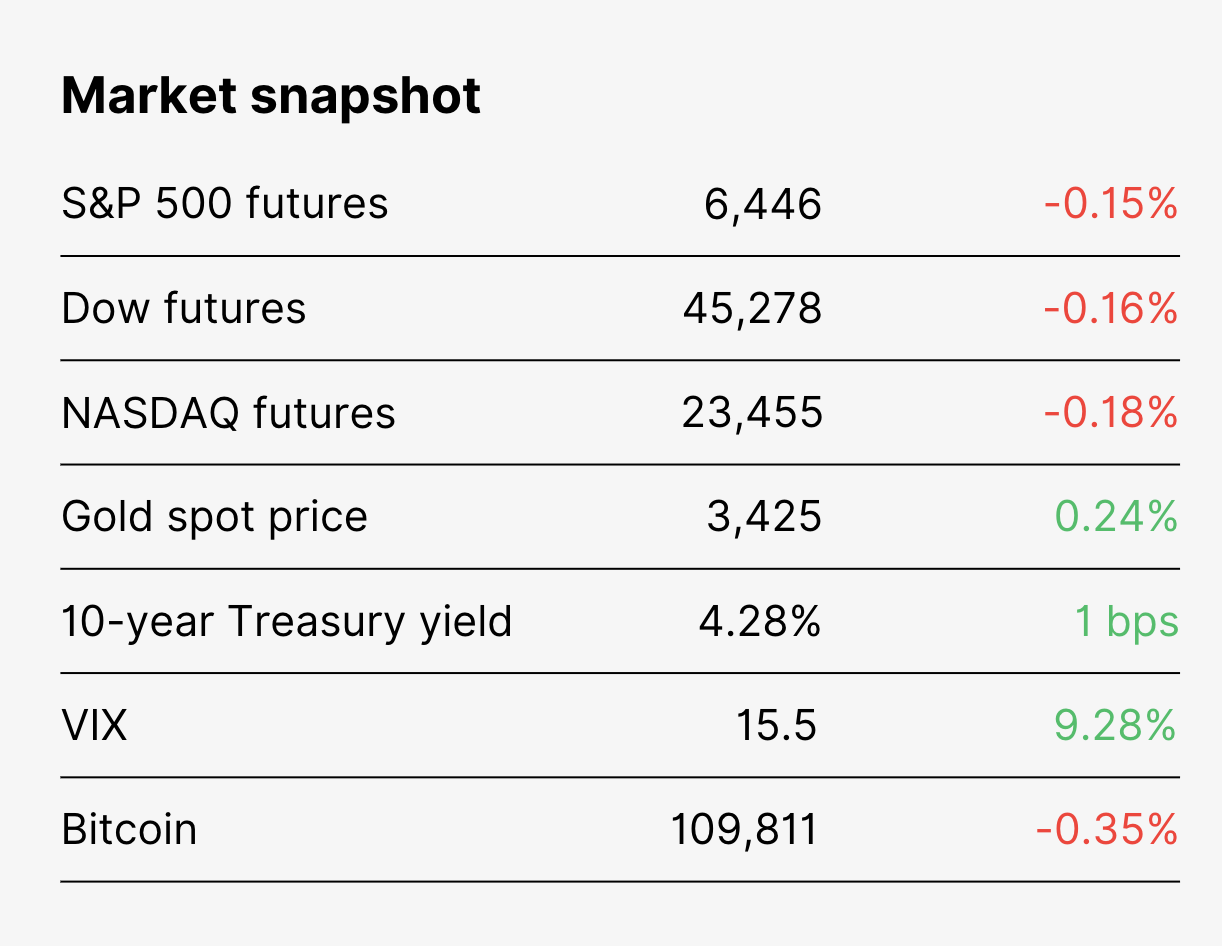
| | Good morning, Trump just did what no president has before; he fired a Fed governor. The dollar slipped and analysts are warning that Fed independence is officially on the line. At the same time, Trump is threatening new tech tariffs, touting Washington’s $11 billion stake in Intel as a model for more “public-private deals,” and floating the idea of a sovereign wealth fund. That may not turn out as bullish as analysts had thought. After the initial pop, Intel stock tumbled... and even its CEO admits government ownership could spook global customers. Meanwhile, Wall Street’s fixated on September rate cuts after Powell’s Jackson Hole remarks, with small caps, banks, and construction plays looking like frontrunners. And away from trading desks, Las Vegas is flashing red. Visitor traffic is plunging... offering another sign Americans are tightening their belts.
| | | | | Hang tight, Dan Runkevicius, Chief Editor | |  | | | | | “It’s a lot like 1971 when the US dollar went off the gold standard. That created the innovation of Wall Street, because they had to sort of essentially create this synthetic dollar. Wall Street moving on to the blockchain is a bigger moment. And I think that’s why Ethereum is essentially having its 1971 moment equivalent.” — Fundstrat managing partner Tom Lee | | | | | Five things to know before opening bell | |
⚡ Trump fires Fed governor Lisa Cook is out after weeks of public clashes with the White House, stoking fears about the Fed’s independence. Analysts say the shake-up could tilt the FOMC more dovish. And OCBC’s Christopher Wong flagged “concerns over the Fed’s independence weighing on the dollar.” 🛋️ Tariff talk shakes up furniture stocks Furniture retailers got slammed after Trump said imports are next on the tariff list. Wayfair sank nearly 6%, RH more than 5%. Domestic players like La-Z-Boy and Ethan Allen barely budged higher. Trump insists tariffs will revive U.S. manufacturing, but Fed data shows the last round barely moved the needle. An “investigation” will now decide how steep the new duties go. 🚫 Tariff crosshairs on tech Trump is threatening fresh tariffs and export restrictions on advanced tech in retaliation for digital services taxes abroad. That puts U.S. trading partners back on edge, despite the recent deal with the EU meant to cool tariff tensions. 🪙 ETHZilla buyback bites ETHZilla — a rebranded pharma firm turned crypto treasury — has been hoarding Ether and riding a massive rally. But it stumbled Monday after announcing a $250 million stock buyback. Both ETHZilla and Ether slid about 6% on the day… though they’re still up triple-digits over the past six months. 🛒 Temu shrugs off tariff loss PDD Holdings, parent of Temu, looked vulnerable after Trump killed the de minimis tariff exemption for small imports. Instead, Q2 earnings beat expectations. While growth stalled, analysts note Chinese stimulus helped pad results. VP of finance Jun Liu admitted heavy investment will take a heavy toll on the bottom line. | | | | 💻 Trump wants more Intel-style deals… but even Intel has concerns
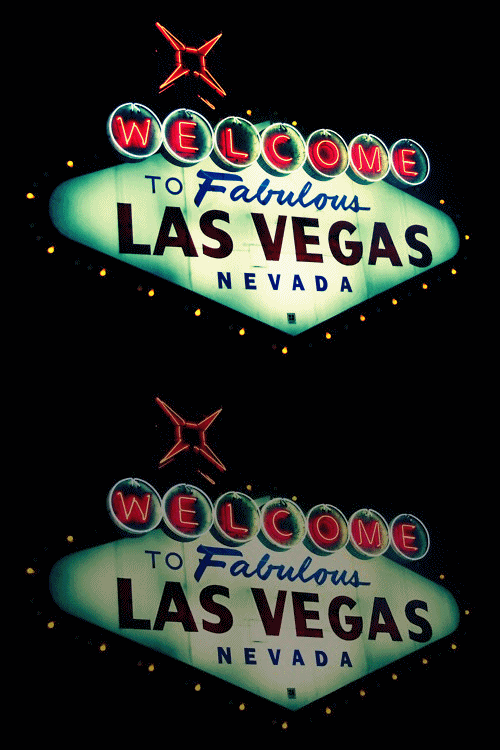
| | | | Trump called Uncle Sam's 9.9% stake in Intel a “great deal” for taxpayers and said the chipmaker's “leading-edge” chips would be “fundamental” to America’s future. Kevin Hassett, director of the National Economic Council, quickly backed Trump, hyping up the move as a step toward something bigger. “The president has made it clear all the way back to the campaign, he thinks that in the end, it would be great if the U.S. could start to build up a sovereign wealth fund,” Hassett said. “So I’m sure that at some point there will be more transactions, if not in this industry then other industries.” 🏭 Intel plays along... cautiously Trump and Intel haven't been on good terms lately. Earlier this month, the president called on Intel chief executive officer Lip-Bu Tan to resign. But in the wake of the deal, Tan struck a diplomatic note, praising Trump and saying Intel looked forward to “advancing U.S. technology and manufacturing leadership.” Tan acknowledged the risks, though. The company warned that U.S. government ownership could complicate international sales and might even limit access to future grants. Tan also stressed that Washington’s stake isn’t about handouts. “I don’t need the grant,” he said. “But I really look forward to having the U.S. government be my shareholder.” ⚖️ A precarious bet Not everyone is convinced this model works. Andy Li, senior analyst at CreditSights, called the arrangement “precarious.” “On one hand, a government stake could be seen as a signal that Intel is ‘too big to fail,’” Li said. “On the other, people worry about governance implications and whether the company can still act fully in shareholders’ interests. The company is not receiving incremental government funding, which suggests a marginally weaker appetite from Washington to provide additional support.” | | | | 📉 Wall Street's playbook for rate cuts | | | | Powell’s closing remarks at Jackson Hole all but locked in a September rate cut. No guarantees yet, but strategists are already gaming out which sectors stand to gain most if rates drop. 📊 Small-cap surge incoming? The Russell 2000 led last week’s rally, and analysts say that’s no accident. Smaller companies tend to carry more variable-rate debt, making them the first to feel pain when rates rise... and the first to bounce when they fall. Jill Carey Hall, equities analyst at Bank of America, noted small-cap performance “has been more mixed in non-recessionary cutting cycles,” but said today’s backdrop makes them especially receptive to lower rates. 🏗️ Other sectors in the spotlight Caterpillar and Goldman Sachs both jumped roughly 4% on Friday, showing how construction and banks could be early winners if rates fall. That tracks with the forecast from Larry Tentarelli, chief technical strategist at Blue Chip Daily Trend Report. “Our view is to expect a September rate cut and sectors that should benefit the most include home construction, small caps and banks,” he said. Mark Newton, head of technical strategy at Fundstrat, expects “about four cuts between now and next summer” and sees that as rocket fuel for gold and silver. “I think both of them are actually bottoming today and should actually make a beeline toward the highs between now and October,” he said, recommending the metals for investors “too top-heavy in software.” Meanwhile, Tom Lee, managing partner at Fundstrat, isn’t just watching small caps. He sees room for a rally across the “Mag-7, Bitcoin, [and] Ethereum,” while also pointing to financials, industrials, and small caps as the biggest beneficiaries of rate cuts. | | | | 🎰 What happens in Vegas… might not stay in Vegas | | | | Few places on earth are more tethered to discretionary spending than Las Vegas and that’s why analysts are worried about the city’s sudden visitor slump. 📉 Putting it in perspective The Las Vegas Convention and Visitors Authority (LVCVA) has the numbers: -
Travel to Sin City was down 7% through the first half of 2025 -
June alone saw an 11% plunge -
A 7% annual drop would outpace the hit Vegas took after the Great Recession The LVCVA points to the usual suspects: economic uncertainty, weaker consumer confidence, and less demand for conferences.
But some of the drag has nothing to do with the economy. - Online betting is eating into Vegas’s appeal as the gambling capital of the world.
- Trump’s foreign policy is weighing on international tourism.
- And younger adults just don’t seem as eager to indulge in the old Vegas-style debauchery as generations before them.
🧩 Another piece of the puzzle No single data point calls the economy’s direction, but the Vegas indicator is lining up with other signs of weakening sentiment. Today’s consumer confidence report and Friday’s consumer sentiment index will give more clarity. For now, LVCVA President Steve Hill says the split is clear: wealthy travelers are still spending, but middle-market visitors are pulling back. “The top third-ish of the market is still doing exceptionally well,” Hill said. “It becomes more acute, the more budget-conscious the visitor needs to be.” | | | | Rate this newsletter | | | Your feedback matters! Before you go, please rate this newsletter and share your thoughts. | | | | | | | | | | | | InvestorsObserver | | You received this email because you signed up on our website or made a purchase from us. | | | | |