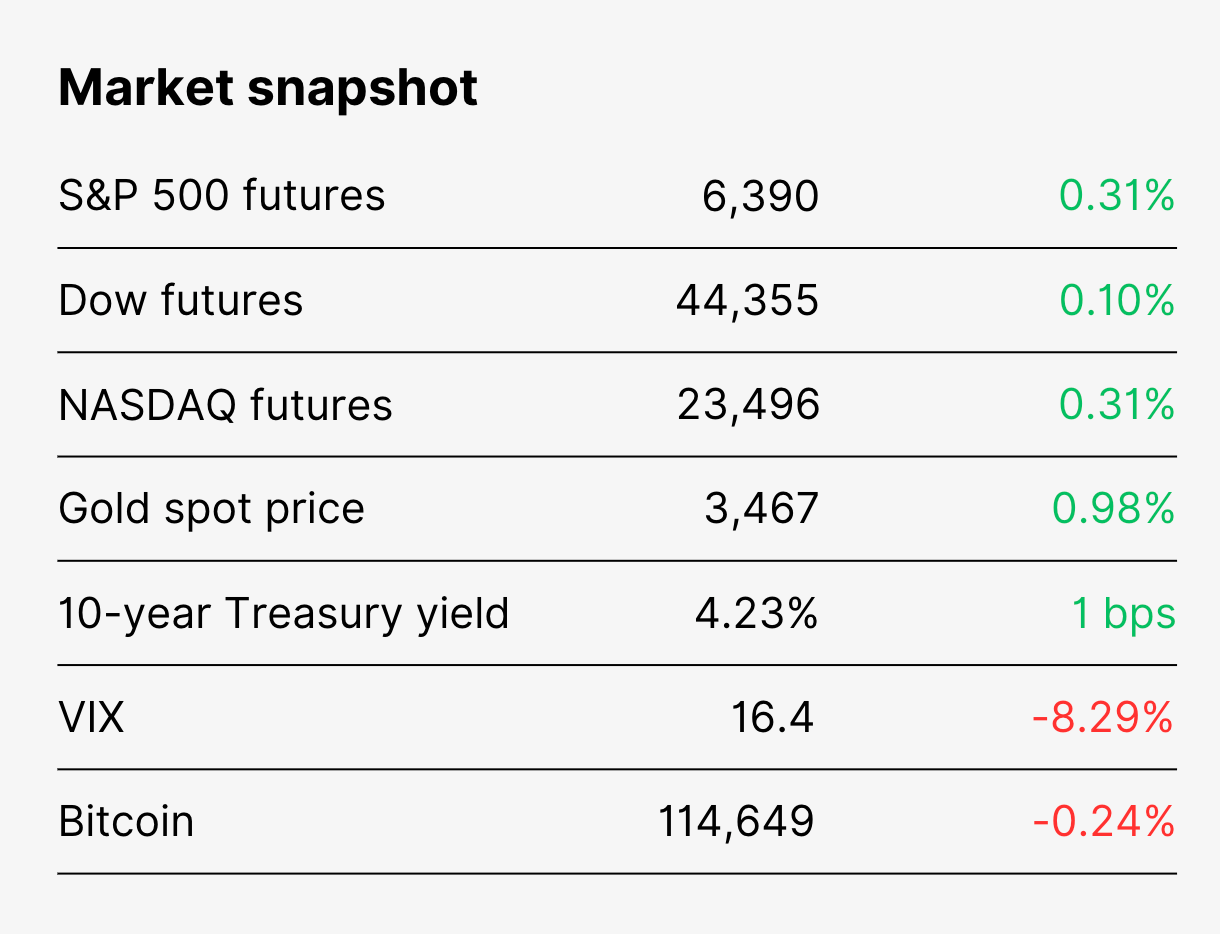
| | Good morning, Wall Street’s risk-on rally isn’t slowing down, but behind the scenes, things are getting a lot more complicated. Futures are up again this morning after a strong session for tech stocks, with the Nasdaq climbing 1.2% midweek and Bitcoin tagging along for the ride. But the collision course between big money and big politics is getting harder to ignore. Trump’s sweeping new tariffs officially take effect today, adding another layer of uncertainty to an already fragile global trade order. India just got slapped with a 50% duty for buying Russian oil, and more hikes on key sectors — from chips to pharma — are reportedly in the pipeline. And now there’s a new White House order brewing that could shake up the banking sector. Meanwhile, Apple seems to have gotten the message, pledging $100 billion to build more on U.S. soil, which Wall Street took more as a geopolitical hedge than a patriotic gesture. On the policy front, the Fed is drifting closer to a rate cut, with officials like Kashkari and Daly laying the groundwork as the labor market starts to buckle. It’s shaping up to be another eventful day, so let’s dive in. | | | | | Hang tight, Dan Runkevicius, Chief Editor | |  | | | | | "It's no mystery why the economy is struggling; blame increasing U.S. tariffs and highly restrictive immigration policy. The tariffs are cutting increasingly deeply into the profits of American companies and the purchasing power of American households. Fewer immigrant workers means a smaller economy." — Moody’s Analytics chief economist Mark Zandi | | | | | Seven things to know before opening bell | |
📈 U.S. tariffs hit WWII-era highs Trump’s sweeping tariffs took hold overnight, raising duties on nearly all major trading partners after months of threats and reversals. By Bloomberg Economics estimates, the average U.S. tariff rate is now 15.2%, up from just 2.3% last year and the highest since World War II. 🇮🇳 Trump hits India with 50% tariff President Trump officially doubled tariffs on Indian goods to 50% Thursday, punishing New Delhi for buying Russian oil. The move adds a new 25% duty on top of the 25% tariff announced last week, and will take effect in 21 days, giving both sides a brief window to negotiate. 🍏 Apple pledges $100B for U.S. buildout Tim Cook swung by the White House and unveiled an impressive $100 billion investment in U.S. manufacturing.
The move follows an earlier half-trillion-dollar commitment that included plans for an AI server hub in Texas. This latest round looks less like strategy and more like a concession to Trump, who reportedly told Cook in May: “We’re not interested in you building in India … we want you to build here.”
🛡️ Hedge funds hit the brakes While individual investors are "buying the peak", hedge funds are quietly pulling back. Goldman Sachs data shows a third straight month of heavy rotation out of tech and into defensive names. “Retail investors are buying equities at full speed … while hedge funds have trimmed their equity long positions,” said Barclays strategist Emmanuel Cau. 🛍️ Shopify shrugs off tariff fears Shopify was one of Wednesday’s biggest gainers, soaring nearly 22% after beating earnings expectations and showing little sign of tariff-related drag. CEO Jeff Hoffmeister said the company had baked potential tariff fallout into its guidance but hadn’t seen any impact so far. 💸 Treasury yields rebound Yields on 10-year Treasurys nudged higher midweek after hitting a three-month low, snapping a slide sparked by last week’s weak jobs data and rising odds of rate cuts. Meanwhile, the U.S. dollar index slipped to its lowest point in a week. 🗣️ Mary Daly doubles down on cuts San Francisco Fed President Mary Daly stepped up her push for multiple rate cuts by year-end, warning that slowing job growth could spiral if left unchecked.“Inflation, absent tariffs, has been gradually trending down,” Daly said Wednesday. “With a slowing economy and ongoing restrictive monetary policy, [it] should continue to do so.”
| | | | 🎤 Fed’s Kashkari says it's time to cut
| | | | After last week's jobs flop, Wall Street is increasingly baking a September rate cut into their forecasts. And the odds just got another boost thanks to fresh comments from one of the Fed’s most vocal officials. 🎯 Kashkari makes the case Minneapolis Fed President Neel Kashkari added his voice to the growing chorus in favor of rate cuts, citing softer labor data and waning consumer strength. “That tells me, as one policymaker, I need to start leaning more on the data that I’ve got confidence in — the economy is slowing — and that means, in the near term, it may become appropriate to start adjusting the federal-funds rate,” he said Wednesday. Kashkari said he’s comfortable with the expectation of two cuts by year-end but warned tariff-driven inflation could complicate the Fed’s timing. “What I’m realizing is we may not know the answer to that for quarters or a year or more,” he added. His remarks follow San Francisco Fed President Mary Daly’s warning earlier this week that even two cuts may not be enough. The Fed has just three meetings left this year. Both Daly and Kashkari will rotate into voting seats on the FOMC next year, but Trump may move to reshuffle the board sooner. 🏛️ Trump eyes Fed shake-up President Trump is reportedly weighing candidates to replace outgoing Fed Governor Adriana Kugler, who’s stepping down Friday. Advisors are urging him to install a temporary successor, which would buy time to consider a broader reset, including a potential Powell replacement. “We’ll either decide on one for permanence or the four-month period — the term,” Trump said this week. Even a short-term appointment must clear Senate confirmation, and the stakes are high. “It’s a lot of trouble to do it for four months,” said Derek Tang, economist at LH Meyer/Monetary Policy Analytics. “But it’s a critical four months — and Trump really wants the Fed to follow through on some of the cuts that have been on the table.” Tang warned that nominating someone seen as a White House rubber stamp could backfire. “It might actually un-anchor the long end of the Treasury yield curve,” he said. “Inflation expectations might go up because even though you’re saying this is a four-month position, you’re setting a precedent that you’re willing to use this vacancy in this manner.” | | | | | It's official. President Trump has pushed forward with his sweeping global tariffs. Here's where things stand as of last night. 🇮🇳 India hit with 50% duty The biggest headline came out of New Delhi, with Trump signing an executive order doubling tariffs on Indian goods to 50%. The move adds a fresh 25% duty on top of an existing 25% rate, in retaliation for India’s ongoing purchases of Russian oil.
“India has been fueling the war machine,” Trump said in a CNBC interview defending the hike. Indian opposition leader Rahul Gandhi blasted the move as “economic blackmail” and warned that Prime Minister Modi “better not let his weakness override the interests of the Indian people.” 🌍 Other notable tariff hikes While some of the new tariffs are slightly lower than the eye-popping levels Trump floated back in April, they’re still dramatically higher than recent norms. And they’re aimed at several of America’s top trading partners: -
🇯🇵 Japan: 15% (down from 24%) -
🇮🇩 Indonesia: 19% (down from 32%) -
🇬🇧 United Kingdom: 10% (unchanged) -
🇨🇦 Canada: 35% -
🇲🇽 Mexico: 90-day reprieve More hikes are expected soon, including on imported pharmaceuticals and semiconductors. And talks with the EU are ongoing, with lower auto tariffs reportedly in the works. 🕰️ A quick history check Bloomberg Economics puts the effective U.S. tariff rate at 15.2% while Fitch Ratings at 17%. Both are still below the post–Liberation Day spike but far above early-year levels. That’s prompting some historical comparisons. Nobel-winning economist Paul Krugman called the policy shift “the second coming of the 1930 Smoot-Hawley tariff,” warning that average U.S. duties are now “roughly back to Smoot-Hawley levels” after 90 years of trade liberalization. | | | | 🏦 Trump targets ‘debanking’ with executive order | | | | Banks are back in the spotlight, but this time, it’s not about earnings or interest margins. President Trump is reportedly prepping an executive order that would penalize financial institutions for engaging in so-called “debanking” for political reasons. 💬 Trump’s beef with big banks Trump has long accused major banks of partisan discrimination, and this week, he made it personal. “They did discriminate,” he said of JPMorgan Chase, claiming the bank refused to accept his cash deposits. “I had hundreds of millions, I had many, many accounts loaded up with cash … and they told me, ‘I’m sorry, sir, we can’t have you. You have 20 days to get out.’” He said Bank of America gave him the same treatment. “I ended up going to small banks all over the place. I was putting $10 million here, $10 million there, did $5 million, $10 million, $12 million,” he told reporters. 📜 What the order would do According to Reuters, the pending order — which could drop by week’s end — calls for tougher oversight of “politicized or unlawful debanking.” Financial institutions found in violation could face fines and other penalties. The Bank Policy Institute argues the real issue isn’t discrimination but overregulation. “The heart of the problem is regulatory overreach and supervisory discretion,” the group said, adding that current rules often tie bankers’ hands when managing certain accounts. Both JPMorgan and Bank of America have indicated they’re willing to work with the White House to address concerns.
“What the White House is doing is telling the banks not to hide behind regulations to deny loans or banking relationships,” said Wells Fargo analyst Mike Mayo. “Banks can use their normal underwriting standards and deny services, but not blame regulators or use reputational risk as a justification.” Shares of both JPMorgan and Bank of America dipped slightly on the day. | | | | Rate this newsletter | | | Your feedback matters! Before you go, please rate this newsletter and share your thoughts. | | | | | | | | | | | | InvestorsObserver | | You received this email because you signed up on our website or made a purchase from us. | | | | |