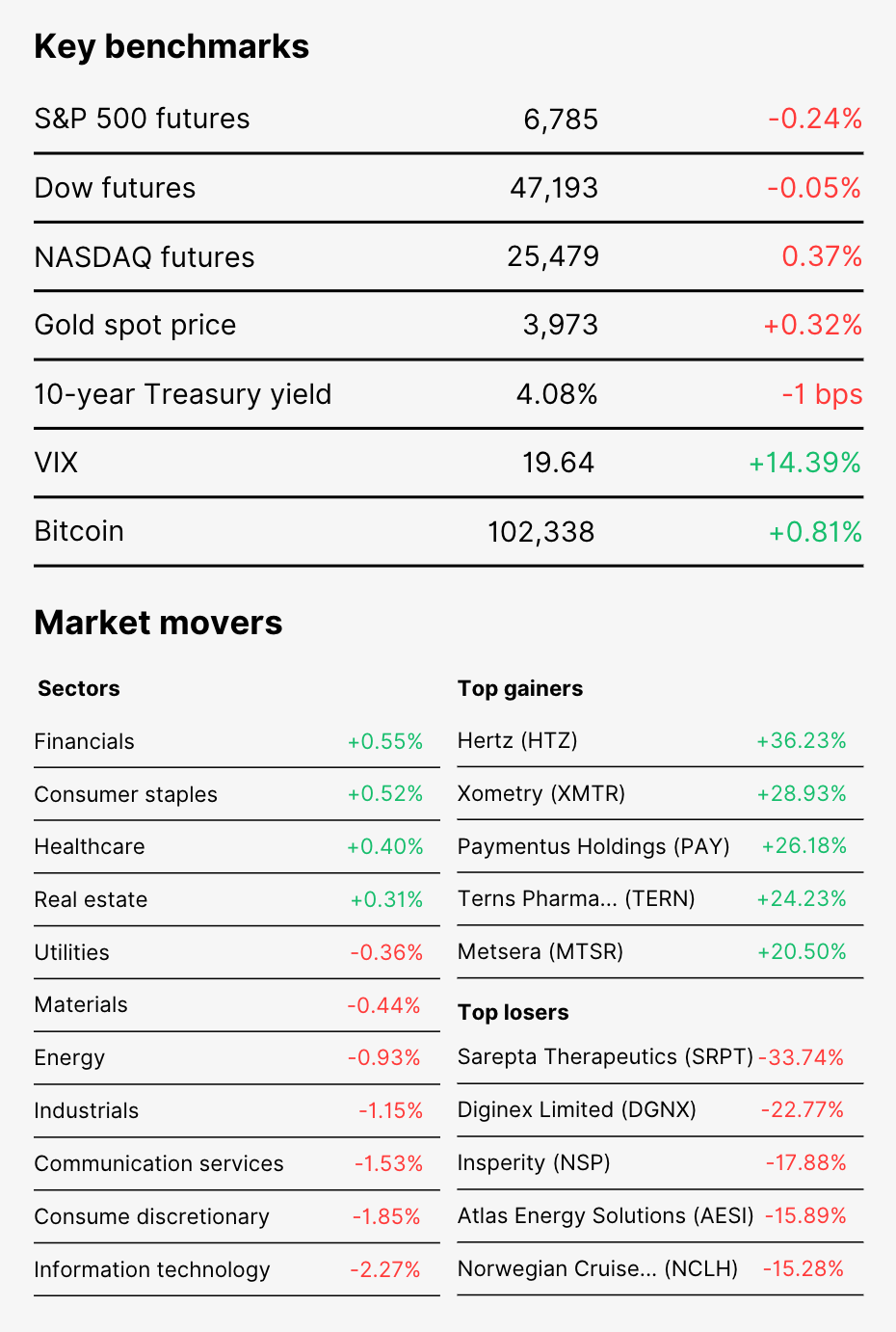
| | Good morning, Tech led yesterday’s selloff, with the Nasdaq closing 2% lower, nearly twice the loss of the S&P 500. Palantir plunged 8% on good news, Nvidia, AMD, and Intel all stumbled, and SoftBank dropped double digits. Bitcoin also slipped briefly below $100K as long-term holders quietly took profits. Gold and bonds were, of all things, the day’s safe place to hide. There’s more behind this pullback than AI fears. Inflation isn’t dead, rate cuts aren’t guaranteed, and the government is now officially in the longest shutdown in U.S. history.
And with job postings sinking to a near five-year low, no one is pretending the labor market is invincible anymore. But policymakers are flying with half a dashboard until Washington decides to function again. All of this sets the stage for today’s big story. The Supreme Court is hearing arguments on Trump’s emergency-powers tariffs. Depending on how nine justices interpret one statute, the White House could walk away with expanded executive trade authority or a bill for billions in refunded duties. Either way, the volatility around trade isn’t going anywhere. | | | | | Hang tight, Dan Runkevicius, Chief Editor | |  | | | | | “Rising healthcare costs and insurance premiums are top of mind. In the data, inflation is spreading across categories, both goods and services. Inflation has been running above the Fed’s 2% objective for more than four years.” — Kansas City Fed president Jeffery Schmid, who voted against last month’s rate cut | | | | | Five things to know before opening bell | | |
📉Tech leads the sell-off Stocks took a leg down yesterday, with tech dragging everything lower. Palantir dropped 8% on strong earnings, as did other AI darlings including Nvidia, AMD, and Intel. SoftBank sank as much as 14%. Tesla lost 5% after Norway’s sovereign wealth fund publicly rejected Elon Musk’s $1T pay package. 🧴 Consumers are choosing “better,” not cheaper Procter & Gamble and Colgate say shoppers are buying less, but being more intentional about what they do buy.
The strongest demand right now is for premium toothpaste, detergents, and cleaning products instead of discount versions. Translation: Americans are prioritizing durability and quality over rock-bottom prices. ₿ Long-term holders cash out Bitcoin dropped as much as 7.4% on Tuesday, slipping below $100K for the first time since June, and is now down more than 20% from its recent high. But this time, it’s not just forced liquidations. Long-time holders have sold roughly 400,000 BTC over the past month (about $45B), according to 10x Research’s Markus Thielen. 🧳 Job openings hit a near 5-year low Indeed data shows job postings have fallen to the lowest level since early 2022, with wages rising just 2.5% year-over-year.
The labor market is cooling, but because of the shutdown, the Fed is missing half the data it needs just as it tries to juggle price stability and employment. 🏛️ Shutdown sets a new record The government shutdown hits Day 36 today, officially becoming the longest funding lapse in U.S. history.
Republicans want a “clean” stopgap bill to reopen agencies at current funding levels, while Democrats are pushing to attach healthcare subsidies and other priorities first. With no votes scheduled and key programs frozen, any breakthrough still looks distant
| | | | ⚖️ Why today’s Supreme Court showdown matters
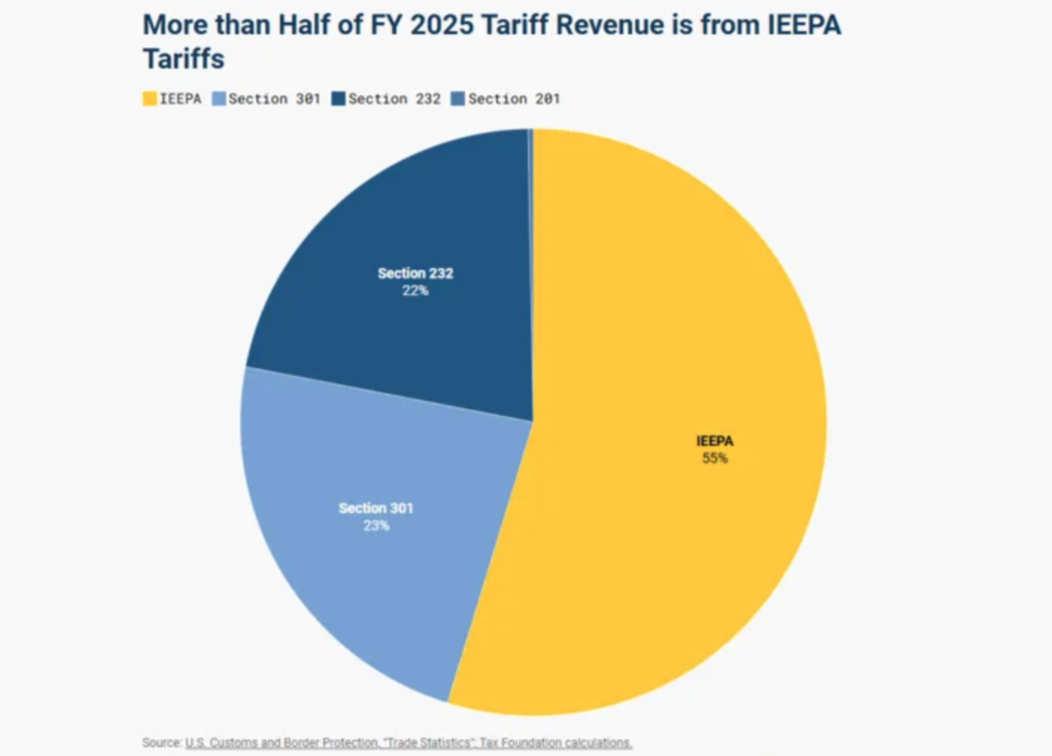
| | | | The Supreme Court is taking up one of the biggest questions in trade policy today: how far a president can go in using emergency powers to impose tariffs without Congress. At issue is whether Trump exceeded his authority when he used the International Emergency Economic Powers Act (IEEPA) to levy broad tariffs on trading partners. The ruling won’t just decide the legality of those actions but will shape how future presidents handle trade, tariffs, and economic retaliation. Why it matters If the Court upholds Trump’s use of IEEPA, it effectively confirms that presidents can act unilaterally on trade whenever they deem it an “emergency.” If the Court strikes it down, the administration could be on the hook for billions in refunded duties, and the White House would need Congress to approve similar moves going forward. Either result means more volatility for markets that have been trying to price tariff risk for months. How the odds look A conservative majority doesn’t guarantee a win for the White House. The Court has a long history of avoiding direct interference in foreign policy, but it has also pushed back when presidents stretch emergency powers too far. Arguments today will include: -
Three lawyers representing small businesses -
A coalition of 12 states -
44 friend-of-the-court briefs from economists, ex-judges, and policy groups The decision could hinge on just one swing vote. Several justices have shown they’re willing to break ideological lines on major separation-of-powers questions. The administration’s fallback plan Treasury Secretary Scott Bessent stressed the White House isn’t betting everything on IEEPA.
“There are lots of other authorities that can be used,” he said, pointing to the Trade Act of 1974 and Trade Expansion Act of 1962.
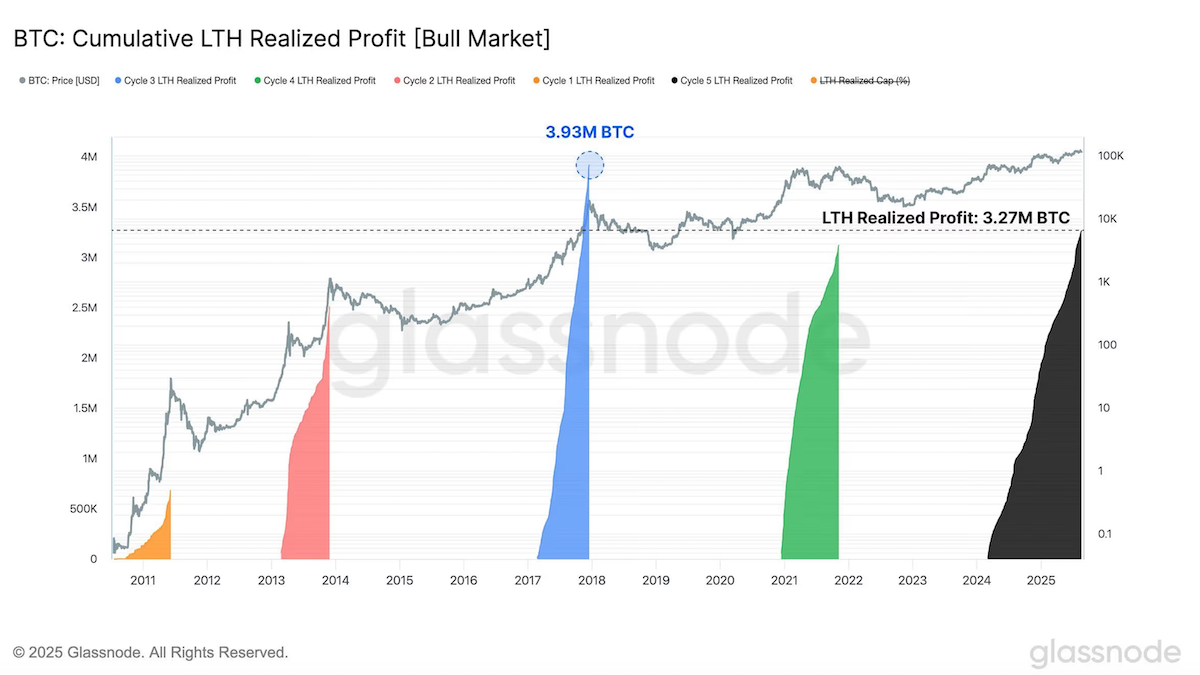
Those options are slower and more complex yet still theoretically viable. Tariffs have become one of the Trump administration’s signature policy levers. And, as markets have learned over the past year, they’ve also become the main source of economic uncertainty. 📌 Bottom line: The Court’s ruling won’t end the debate, but it will define the rules of the game. | | | | ₿ What's actually driving Bitcoin's sell-off | | | | Bitcoin is down again, but this time it’s not leverage blowing up the market. The cryptocurrency fell as much as 7.4% on Tuesday, briefly dipping below $100,000 for the first time since June. It’s now more than 20% off the record high it hit just a month ago. In October, the selloff was driven by forced liquidations. This time, it’s long-time holders (a group that usually buys dip) who are selling: -
Roughly 400,000 BTC have been offloaded over the past month -
That’s almost $45 billion in supply hitting the market -
Many of these coins had been held 6–12 months, suggesting profit-taking rather than panic “Over 319,000 Bitcoin has been reactivated in the past month,” notes K33’s Vetle Lunde. “While some of that is internal transfers, much reflects real selling.” Not a liquidation wave About $2B in crypto positions were liquidated in the past 24 hours... meaningful, but nothing like the $19B wipeout that drove October’s crash. Instead, Thielen at 10x Research says long-term holders are unloading faster than new buyers are stepping in. Earlier this year, “mega whales” (1,000–10,000 BTC wallets) were net buyers. Now, supply is coming not just from those whales, but also from mid-sized holders (100–1,000 BTC). In other words: the whales aren’t buying the dip. Where does this go from here? Thielen doesn’t see a collapse, but he does think the consolidation could take time. During the 2021–2022 bear market, large holders sold for nearly a full year. In his view, the unwind could last months and his maximum downside target is $85,000. “I would assume we consolidate and potentially drift a bit lower from here,” he says. “I’m not a believer in the market cycle narrative.” The bull case from here depends on: -
Fresh inflows (ETFs, corporates, or new spot buyers) -
Whales stopping distribution -
Macro conditions stabilizing enough to re-bid risk Right now, none of those are in place. 📌 Bottom line: The next move in Bitcoin will depend less on momentum and more on whether long-term holders decide they’re done selling. | | | | 🧼 "AI washing" is sweeping corporate America | | | | Job cuts are back in the headlines, and with them, fresh fears about AI replacing workers. Amazon, UPS, Target, and others have announced tens of thousands of white-collar layoffs in recent weeks, with some executives pointing to AI adoption as the reason. But many analysts say that explanation is a little too convenient. The rise of “AI washing” Some companies may be using AI as cover for layoffs that are really being driven by slower growth, thinner margins, and strategic missteps, aka "AI washing." Wharton professor Peter Cappelli calls it the “bandwagon effect” when firms try to impress investors by claiming efficiency gains through AI. The problem is research shows little evidence that recent layoffs at Salesforce, Duolingo, or Klarna were actually caused by automation. “Using AI to save jobs turns out to be enormously complicated,” Cappelli says. “In most cases, it doesn’t cut headcount at all.” UPS and Target have openly linked layoffs to weaker demand and higher costs. And even Amazon CEO Andy Jassy didn’t pin their 14,000 job cuts directly on AI. He framed them as part of reshaping Amazon into “the world’s largest startup.” The bigger picture As always, the truth sits somewhere between hype and hardship. AI changing workflows. But layoffs are also a natural feature of an economy that’s slowing. And without full labor-market data, Wall Street is flying half-blind. Until the data pipeline turns back on, any attempt to read the labor market will carry a margin of error... and plenty of room for spin. | | | | Rate today's newsletter*... | | | * We are just a messenger. To avoid confusion, please rate the quality of reporting, not news | | | | | | | | | | | | InvestorsObserver | | You received this email because you signed up on our website or made a purchase from us. | | | | |