| Within hours of the fatal shooting of Alex Pretti on January 24, Senate Minority Leader Chuck Schumer announced that Senate Democrats would refuse to approve an appropriation for the Department of Homeland Security (DHS) unless it included an overhaul of two DHS law enforcement agencies, U.S. Immigration and Customs (ICE) and U.S. Customs and Border Patrol (CBP). |
| DHS had sent thousands of ICE and CBP officers to Minneapolis-Saint Paul. It called this deployment the “largest immigration enforcement operation ever“ and named it Operation Metro Surge. Its campaign led to dozens of allegations of serious law enforcement abuse. Wikipediachronicles many of them. The fatal shootings by ICE and CBP officers of U.S. citizens Renee Good and Alex Pretti prompted intense concern. |
| The failure of Senate Democrats and Republicans to agree on ICE reforms led to a brief, partial shutdown of the federal government on January 31 and then to a longer shutdown of DHS that began on February 14. That shutdown continues as this article goes to press. |
| Before the current shutdown, Senate Majority Leader Chuck Schumer and House Minority Leader Hakeem Jeffries sent a list of ten “Urgent ICE Reform Demands“ to Republican leaders, and this article urges congressional approval of one of these demands. It is headed “Ensure State and Local Coordination and Oversight” and reads in part: “Require that evidence is preserved and shared with jurisdictions.” That demand may sound technical and much less significant than demands for “stop racial profiling and “no masks.” But if Congress does not approve this measure or something like it, the shameful efforts of federal officials to thwart the investigation and possible prosecution of the ICE and CPB officers who killed Renee Good and Alex Pretti are likely to succeed. The proposal ought to rank high on the Democrats’ negotiating list, ought to be accepted by Republicans, and ought to be approved as separate legislation if Congress fails to include it in an appropriations package. |
| Three Weeks, Three Shootings, Three Coverups |
| On January 7, 2026, ICE officer Jonathan Ross shot and killed Renee Good. On the morning of the shooting, federal and state authorities agreed to a joint investigation of the case. Late in the afternoon, however, the FBI withdrew from the agreement and said that it alone would investigate. Homeland Security Secretary Kristi Noem then denied that the Minnesota Bureau of Criminal Apprehension (BCA) had been “cut out.” She said the state agency could not have been “cut out” because it had no “jurisdiction” to begin with. |
| BCA Superintendent Drew Evans said that, without access to “case materials, scene evidence, or investigative interviews,” his agency could not “meet the investigative standards that Minnesota law and the public demand.” Minnesota Attorney General Keith Ellison observed that the federal agencies’ refusal to share evidence made determining the facts “very hard,” and he added: “I’m urging them publicly now to reverse this incorrect and improper decision.” |
| On January 14, a federal officer shot and wounded Julio Sosa-Celis. Again, the BCA attempted to investigate. But the FBI refused to identify the officer, permit an interview, or reveal whether he was wearing a body camera. It also told the BCA that it would not share the results of its investigation. |
| Sosa-Celis and a co-defendant then were charged with assaulting a federal officer with dangerous weapons (a snow shovel and broom handle). But, on February 12, at the request of the United States Attorney, a court dismissed these charges. The prosecutor told the court that “newly discovered evidence [was] materially inconsistent with allegations” made in the charging document and in courtroom testimony. The officer who shot Sosa-Celis and another officer had been suspended and were being investigated. |
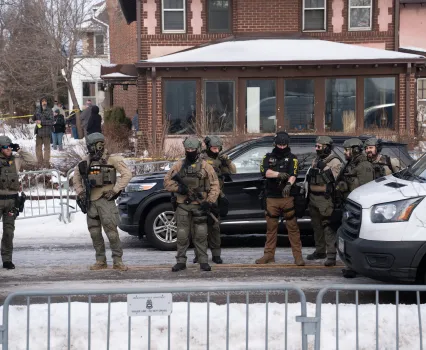
| On January 24, two CPB officers shot and killed Alex Pretti. Governor Tim Walz declared: “Minnesota’s justice system will have the last word on this. It must have the last word. . . . The state will handle it, period.” But federal officers blocked BCA investigators from examining the scene of the shooting. The state investigators then obtained a judicial warrant entitling them to enter the area, but the federal officers blocked them a second time. The next day, at the request of Attorney General Ellison, a federal district judge temporarily enjoined the federal officers from destroying or altering evidence. |
| Jurisdiction |
| Secretary Noem’s statement that Minnesota lacked “jurisdiction” to investigate Renee Good’s shooting was poppycock. As the FBI acknowledges, “state and local law enforcement agencies are not subordinate to the FBI.” When a homicide might have violated both state and federal law, state and federal agencies have the same authority to gather evidence. |
| Vice President J.D. Vance’s declaration that Minnesota could not prosecute Ross even if the killing was unlawful was another clear misstatement of the law. He said: “The precedent here is very simple. You have a federal law enforcement official engaging in federal law enforcement action. That’s a federal issue. That guy is protected by absolute immunity. He was doing his job.” Vance added that a state prosecution would be “preposterous,” “unprecedented,” and would certainly be “tossed out by a judge.” |
| Federal law does afford federal officers important protections against unfair state prosecution, but, if the evidence against Ross is strong enough, the state may charge him with murder, bring him to trial, and punish him. Ross probably could remove a state prosecution to a federal court for trial, but the prosecution would be led by a state prosecutor and Minnesota homicide law would apply. The U.S. Justice Department could not dismiss his case, and President Trump could not pardon the defendant. Ross would be entitled to immunity from this state prosecution only if he had “an objectively reasonable and well-founded basis to believe that his actions were necessary to fulfill his duties.” |
| Although neither the state nor the federal government has more authority than the other to investigate the Minneapolis shootings, one jurisdiction does have a stronger interest than the other. Despite the expansion of federal criminal jurisdiction over the past 200-plus years, the primary responsibility for safeguarding personal security remains with the states. Traditional crimes like murder and manslaughter are state crimes. The federal government punishes them only in special circumstances. The most serious federal crime of which the officers who shot Good and Pretti might be guilty is willfully depriving them of their constitutional rights. If any of these officers deserves to be punished for murder, only Minnesota can do it. The Justice Department’s Principles of Federal Prosecution recognize that federal prosecution is secondary. They advise U.S. Attorneys not to file federal charges when a “person is subject to effective prosecution in another jurisdiction.” |
| Just as neither the state nor the federal government can block investigation by the other, neither has an obligation to assist the other. That is why the Trump administration has been unable to persuade courts that the refusal of sanctuary cities like Minneapolis to aid the enforcement of federal immigration law is unconstitutional. Paradoxically, while the federal government still argues in court that Minnesota must aid ICE agents in their enforcement of immigration law, it refuses to aid Minnesota in enforcing the law that prohibits ICE agents from murdering Minnesotans. |
| The Coverup: Part I |
| The Shooting of Renee Good |
| Dividing the Evidence |
| Among the things prosecutors, law enforcement officers, and a grand jury should have done or should be doing in investigating the shooting of Renee Good are: identify the federal officers on the scene and interview them; interview Becca Good (Renee Good’s widow); identify and interview any officers who spoke with Ross after the shooting (or about the shooting at any time); review the statements Ross might have given to investigators; determine whether Ross’s examination at a hospital after the shooting revealed bruises or other injuries; learn whether Ross was tested for drug or alcohol consumption; learn the reason, if any, for Ross’s failure to render medical assistance to Good; learn the reason for other officers’ failure to provide assistance during the six minutes after the shooting that Good continued to breathe; examine whether Ross’s phone contained significant evidence apart from the video already released; examine the extent and possible causes of Ross’s later reported internal bleeding; determine Ross’s assigned duties on the day of the shooting; review ICE and CPB radio communications during the relevant hours; identify and interview protestors at the scene and other eyewitnesses; assemble all the available videotapes of the event; determine the identities of the voices heard and the people seen on the tapes; determine the sequence and timing of events and statements; review Good’s autopsy; inspect the bullet hole in Good’s windshield; analyze Ross’s firearm, spent bullet casings, bullets, blood spatters, and other forensic evidence; inspect the automobile’s mechanics; subpoena uncooperative witnesses; and consider whether to seek evidence from some witnesses by granting them immunity or striking bargains. |
| The evidence, however, is divided between two governments, and the federal government has most of it. Of course, all the authorities have seen the publicly available videos. In addition, the Hennepin County Attorney’s Office has encouraged the public to submit evidence through a secure portal, and it reports that a “substantial number” of people have done so. The Hennepin County Medical Examiner conducted an autopsy, and the County Attorney has his report. Federal investigators, however, have possession of a shell casing, other evidence collected at the scene, the records of Ross’s hospital examination, evidence taken from Ross’s home, Ross’s phone, the records of eyewitness interviews, and Good’s SUV. It apparently hasn’t shared any of this material with the state investigators. When a reporter asked President Trump whether he thought the FBI should share evidence with state officials, he replied: “Well normally I would, but they’re crooked officials.” |
| Although the FBI seized Good’s SUV on the morning of her killing and obtained a warrant to search this vehicle, it remains doubtful six weeks later that investigators have conducted a search. The FBI obtained its warrant by establishing probable cause to believe that a search could reveal evidence of Ross’s violation of Good’s constitutional rights. But FBI Director Kash Patel and other senior FBI officials were concerned that executing that warrant might contradict President Trump’s statement that Ross had shot Good in self-defense after she had deliberately run him over. These officials directed agents not to execute the warrant but instead to apply for a second warrant authorizing a search of the SUV for evidence that Good assaulted Ross. The agents did apply for that warrant, but a federal magistrate refused to issue it. |
| Splitting the evidence between two law enforcement agencies is a terrible way to run an investigation. But the apparent goal of the federal authorities is not to conduct an effective criminal investigation of Ross’s conduct but to prevent one. These authorities are not only impeding the state’s investigation of a serious possible crime but also refusing to conduct a criminal investigation themselves. |
| According to Justice Department standards, the FBI may open a preliminary criminal investigation when “[a]n activity constituting a federal crime . . . may have occurred . . . and the investigation may obtain information relating to the activity.” On the morning of Good’s shooting, Tracee Mergen, a supervisor in the FBI’s Minneapolis field office, did open an investigation, but FBI leaders in Washington pressed her to end the inquiry. Mergen ended it and then resigned. |
| One week after the shooting, Deputy Attorney General Todd Blanche declared: “There is currently no basis for a criminal civil rights investigation.” As the two-week mark approached, Blanche and Noem confirmed that no criminal investigation by either the Justice Department or the Department of Homeland Security was underway or expected. Noem said that no investigation was needed because there was “no doubt” Ross shot Good in self-defense. |
| Contested Facts |
| But there was doubt. There were cries of murder as well. |
| The statements of administration officials all insisted that Good was a villain, not a victim. President Trump declared that she “violently, willfully, and viciously“ ran over Ross and that Ross “seem[ed] to have shot her in self-defense.” Vice President Vance said that the “tragedy [was] of [Good’s] own making“ and that Ross “deserves a debt of gratitude.” Secretary Noem maintained that Good was a “domestic terrorist“ and that Ross “followed his training [and] did exactly what he has been taught to do.” |
| Mayor Jacob Frey of Minneapolis, however, said that the federal authorities’ claims of self-defense were “bullshit.” House Minority Leader Jeffries called the Secretary of Homeland Security “a stone-cold liar.” Many people who viewed the tapes echoed the judgment that Los Angeles Mayor Tom Bradley had offered about four Los Angeles police officers 31 years earlier. Those officers had been videotaped kicking and beating Rodney King as he lay on the ground, and Bradley said: “We saw what we saw, and what we saw was a crime.” Fifty-three percent of the respondents to a USA Todaypoll said they considered the shooting unjustified, while 35% considered it justified. Analyses of the videotapes by experienced investigators also called the administration’s account into question. |
| The discussion of Ross’s and Good’s conduct was largely free of reference to the applicable legal standards. If Ross were to be tried for a federal offense and claimed self-defense, the jury would be instructed that he was not entitled to use force likely to cause death or great bodily harm unless that force was necessary to protect himself or another from what he reasonably believed to be a substantial risk of death or great bodily harm. |
| A bump or a bruise is not great bodily harm. Killing a driver after she has inflicted harm cannot prevent the harm. Killing a driver whose moving vehicle is within a second or two of causing harm cannot prevent the harm either. Shooting someone for protesting abusive law enforcement tactics, blocking traffic, disobeying a command to step out of a vehicle, and being “highly disrespectful“ and a “fucking bitch“ is not self-defense. |
| Mass Resignations |
| The subdivision of the Justice Department that, together with the FBI, normally investigates shootings by law enforcement officers is the Criminal Section of the Civil Rights Division. That division is headed by Assistant Attorney General Harmeet Dhillon, an ardent political supporter of the President who has transformed many of the division’s priorities. When, even before Deputy Attorney General Blanche’s announcement, Dhillon said that the division would not investigate Good’s killing, four career Civil Rights Division lawyers, including the head of the Criminal Section, resigned (some of them by accelerating their departures pursuant to previously arranged buy-outs). |
| At about the same time, six lawyers in the United States Attorney’s Office in Minneapolis quit. Their resignations apparently were prompted by both the Justice Department’s refusal to cooperate with state authorities and its insistence on investigating the political associations of Good’s widow. These lawyers included a 17-year veteran who recently had served as Acting U.S. Attorney, who had impressively led an investigation of a more-than-billion-dollar fraud of state-managed welfare programs, and who was currently the office’s second-in-command. After meeting with the U.S. Attorney to voice their frustrations, eight other lawyers left the office or announced plans to do so. |
| At the scene of Good’s killing, Minnesota allowed federal investigators to take the lead, relying on their express agreement to conduct the same sort of joint investigation they had conducted in the past. Withholding the evidence the FBI gathered before it rescinded this agreement is especially offensive. |
| Fist fights between federal and state investigators to determine which group will investigate a crime scene would not serve justice, and neither would a rush to examine the evidence first because other investigators might cover it up. |
| The Coverup: Part II |
| The Shooting of Alex Pretti |
| No fist fights between state and federal investigators occurred after the shooting of Alex Pretti, but ICE officers standing a few feet apart with batons did block the Minnesota BCA from investigating the scene of this shooting. Their obstruction continued when the state investigators returned with a search warrant. |
| An ICE unit called Homeland Security Investigations (HSI) conducted a preliminary investigation of the shooting. Two former Homeland Security officials wrote that HSI “does not have the mandate or expertise to conduct [a criminal] civil-rights use-of-force investigation.” They said that the FBI rather than HSI should investigate the case. A former federal prosecutor who had investigated and prosecuted police misconduct cases noted possible missteps in the early HSI investigation. The Minnesota BCA has a specialized Force Investigations Unit that has investigated most officer use-of-force incidents throughout the state since its establishment by the state legislature in 2020. This unit is staffed by highly trained experts. |
| The dispute about the circumstances of Pretti’s killing resembled the dispute about Good’s. Again, high ranking federal officials quickly told the public that the villain was the person shot to death. Noting that Pretti was armed and carried ammunition, Secretary Noem suggested that he had “arrived at the scene to inflict maximum damage on individuals and to kill law enforcement.” According to Noem, Pretti “reacted violently” to the efforts of officers to disarm him, and one of them then fired the “defensive shots” that killed him. White House Deputy Chief of Staff Stephen Miller described Pretti as “an assassin [who] tried to murder federal agents.” FBI Director Kash Patel maintained that he “attacked law enforcement officials.” CPB Commander Greg Bovino told an interviewer that Pretti both “wanted to massacre law enforcement” and did “assault” them. |
| But few outside the administration were convinced. After analyzing the videos, the New York Timesreported that two CPB officers shot Pretti ten times. All of their shots came after Pretti had been disarmed. Four were fired while he was “on his knees and restrained” and six while he was lying “motionless on the ground.” |
| Former President Barack Obama said that the official explanations of both Pretti’s killing and Good’s “appear[ed] to be directly contradicted by video evidence.” Commentator Heather Cox Richardson observed that Pretti’s killing “looked like an execution.” Senator Rand Paul (R-KY) declared that “no American believes that [Pretti] was assaulting the officers.” Two other Republican Senators, Thom Tillis (R-NC) and Lisa Murkowski (R-AK) called for Noem’s resignation. A Republican candidate for Governor of Minnesota withdrew from the race, and the Republican Governor of Texas proposed that the White House “recalibrate.” Sixty-two percent of the respondents to a Quinnipiacpoll said they considered the shooting unjustified while 22% considered it justified. |
| After a week of protests, Deputy Attorney General Blanche announced that the FBI would conduct a criminal investigation of Pretti’s killing. He declined to say whether he might reconsider his refusal to authorize a similar criminal investigation of Good’s killing. On February 13, the FBI “formally notified“ the Minnesota BCA that it would “not provide the BCA with access to any information or evidence that it has collected in the . . . shooting death of Alex Pretti.” |
| Once again, federal officials obtained the statements of suspects and witnesses and controlled the physical evidence. Once again, they blocked state agencies from investigating and refused to share their findings with these agencies. Once again, their evident goal was to impede the investigation and possible prosecution of the killers they had rushed to defend with false and misleading statements. Governor Walz commented: “Trump’s right hand cannot be responsible for investigating his left hand. We need an independent, impartial investigation now.” |
| Congress Should End the Coverup |
| Congress can stop the federal agencies’ stonewalling, and it should. Ordering these agencies to share their investigative files and to allow state access to the evidence should be an easy call for members of Congress who champion states’ rights, established traditions, and effective law enforcement—notably, Republicans. |
| Several prominent Republicans have in fact voiced concern about the Minneapolis shootings and the adequacy of the administration’s explanations. Senator Bill Cassidy (R-LA) called the shooting of Alex Pretti “incredibly disturbing” and urged a “full joint federal and state investigation.” Senator Thom Tillis (R-NC) also called for “a thorough and impartial investigation” and for “cooperation and transparency between federal, state, and local law enforcement.” Among the other Republican Senators demanding a thorough bipartisan investigation are Mike Crapo (R-ID), Jerry Moran (R-KA), Rand Paul (R-KY), Dave McCormick (R-PA), Pete Ricketts (R-NE), Susan Collins (R-ME), and Lisa Murkowski (R-AK). |
| Representative Andrew Garbino (R-NY), Chair of the House Homeland Security Committee, opened a hearing on February 10 by calling both a recent increase in attacks on federal law enforcement officers and the deaths of Good and Pretti “unacceptable and preventable.” Garbino pledged: “There must be a complete and impartial investigation. . . . And I will ensure that happens.” But a full investigation of the Minneapolis shootings did not begin at the hearing that followed. Instead, the Acting Director of Immigration and Customs Enforcement and the Commissioner of Customs and Border Protection said they would not discuss the shootings, citing ongoing investigations. |
| Garbino also observed: “State and local officials should be partners, not obstacles, when it comes to public safety. And federal officials should keep in mind that this kind of partnership is a two-way street.” He and other members of Congress can mandate the federal cooperation they favor. |
| Should Cooperation Extend to Sanctuary Cities? |
| Some members might oppose aiding the homicide investigations of “sanctuary” jurisdictions like Minneapolis because these jurisdictions limit their assistance to federal agencies in enforcing immigration laws. As Garbino commented, cooperation is a two-way street. Like other “sanctuary” jurisdictions, however, Minneapolis aids federal agencies in investigating people reasonably suspected of committing murder, manslaughter, and other crimes against person or property. Whether these suspects are undocumented aliens, law-enforcement officers, or others does not matter. But the federal government has converted what previously was an effective two-way partnership into an empty street. |
| When Minneapolis calls itself a sanctuary, it does not mean what the word once meant—a place where a criminal can be free from arrest and punishment for his or her crime. Operation Metro Surge is reported to have resulted in 4000 federal arrests. Minneapolis also does not use that word to refer to the active concealment or protection of criminals or the obstruction of any government’s authorized enforcement efforts. Those acts are crimes even when performed by state officials. |
| Minneapolis uses the word sanctuary only to describe its refusal to aid affirmatively in the enforcement of another jurisdiction’s laws. It justifies this refusal as an exercise of its power to set priorities in the allocation of finite law-enforcement resources. The city has chosen to use its police force to apprehend bank robbers and car jackers rather than to aid abusive federal officers in detaining and deporting people who might have crossed a border illegally or overstayed a visa, but who then became friends, neighbors, and law-abiding, hard-working contributors to their communities. |
| More U.S. cities now call themselves “Second Amendment sanctuaries“ or “gun sanctuaries” than call themselves “immigration sanctuaries.” These cities refuse to aid in enforcing federal firearms regulations. Neither these “gun sanctuaries” nor “immigration sanctuaries” like Minneapolis are engaged in nullifying the law or in civil disobedience. Instead, they are exercising a constitutional right. Requiring them to aid the enforcement of federal law would violate what the Supreme Court calls the anti-commandeering doctrine. In the Court’s words, “The Federal Government may [not] command the States’ officers . . . to administer or enforce a federal regulatory program.” The Court has held that even withholding Medicare grants from states that won’t approve an expansion of Medicare benefits can be coercive and can deprive these states of the autonomy guaranteed by the Tenth Amendment. |
| Just as states have no obligation to aid in enforcing federal laws, the federal government has no obligation to aid in enforcing state homicide laws. But for the federal government to become a “homicide sanctuary for ICE officers” would not be a wise choice. And if the choice to become America’s first “homicide sanctuary jurisdiction” is to be made, it should be made by Congress, not the Secretary of Homeland Security or the Deputy Attorney General. |
| Making Cooperation Happen |
| Including an evidence-sharing requirement in a shutdown-ending appropriations bill would ensure its speedy approval. But, even if Congress does not include that reform measure in whatever legislation ends the shutdown, legislators should continue to press for it. This requirement could take the form of a specific directive to DOJ and DHS or of a protocol for federal law-enforcement agencies to follow whenever a federal law-enforcement officer has killed or inflicted a serious injury. Even nonbinding resolutions expressing the sense of each house could be productive. |
| Enabling a thorough state-federal criminal investigation of the Minnesota shootings would be good politics for both Republicans and Democrats (as well as good government). Elected officials should recall that the coverup of a “third-rate burglary“ by a president and “all the president’s men“ ended Richard Nixon’s career. Moreover, a legislative proposal might accomplish its purpose in whole or in part even if a Senate filibuster or a presidential veto ultimately were to block its enactment. If enough Republican legislators supported the measure to make clear that they oppose a federal coverup and fear its political consequences, that might be enough to prompt reform. |
| Conclusion |
| An AI chatbot can produce a list of more than 20 motion pictures in which one police officer commits a crime and other officers rush to support him by concealing the evidence and lying. But the list doesn’t include a single film in which the dishonest police officers have included the President of the United States, his Deputy Chief of Staff, the Vice President of the United States, the Secretary of Homeland Security, the Director of the FBI, and the Deputy Attorney General. |
| Perhaps, some years ago, an imaginative screenwriter did write a script in which these officials agreed to support a “weaponized automobile” cover story or an “assassin planning to murder” story and then concealed evidence, opposed an investigation, blamed the victim, misrepresented the law, subpoenaed the good cops, and threatened to mobilize an army to control protestors. But no production company would have been likely to purchase this script. |
| Because of course it could never happen. |
| And, besides, how would it end? |

 Have friends who like law? Forward this email.
  Like Verdict for legal discussions on Facebook.
  Follow @verdictjustia for news and updates on Twitter.


