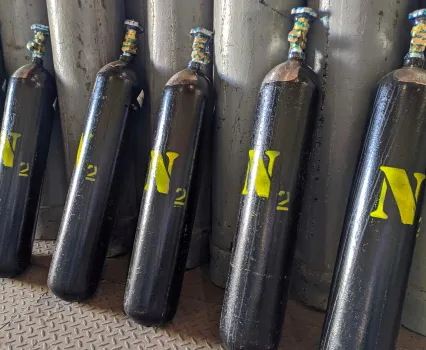
| Nitrogen hypoxia is a failure as an execution method. It works by depriving people of oxygen until they die in a gruesome spectacle. |
| It is just the latest in a series of fads in the ongoing and futile search for a way of killing death row inmates that would be safe, reliable, and humane. Electrocution, the gas chamber, lethal injection, and now nitrogen hypoxia—each of them was introduced with great fanfare and the hope that they would allow executions to continue in a way that would soothe our conscience. |
| Each of them has been unable to deliver on its promise, with nitrogen hypoxia, which was first used when Alabama put Kenneth Smith to death in 2024, most recently joining the list. |
| Using oxygen deprivation as a way for states to put people to death was proposed thirty years ago in a National Review article entitled “Killing With Kindness: Capital Punishment by Nitrogen Asphyxiation.” Other sources agreed that nitrogen hypoxia would kill with kindness, including a BBC documentary called “How to Kill a Human Being“ and Slate’s Tom McNichol, who wrote a piece called “Death by Nitrogen“ in 2014. |
| In 2015, Oklahoma became the first state to include it in its menu of execution techniques, but only as a backup if it could not carry out lethal injections. At the time, Mike Christian, the state representative who introduced the legislation, claimed, “The process is fast and painless…. It’s foolproof.” |
| Since then, four other states have followed suit, but only two, Alabama and Louisiana, have actually used it. |
| Eight people have been killed by nitrogen hypoxia, seven in Alabama and one in Louisiana. Their executions were neither fast nor painless. In fact, each execution by nitrogen hypoxia resulted in what Supreme Court Justice Sonia Sotomayor has called “psychological terror” and “excruciating suffocation.” |
| The latest took place on October 23, when Alabama killed Anthony Boyd, a Black man who was convicted and sentenced to death in 1995 for murdering Gregory Huguley. He did not fare any better than others executed by nitrogen hypoxia. |
| What this means is that the search for a technological magic bullet with which to put people to death has proved futile yet again. Doing the same thing and expecting a different result is not only the definition of insanity; it is, as the Atlantic’s Elizabeth Bruenig writes, “absurd.” |
| Bruenig is right to say that “there is no way to kill someone without some element of torture, either psychological, physical, or both.” |
| Now, with the memory of Boyd’s death still fresh, it is time to say no more, no more nitrogen hypoxia executions, no more capital punishment. |
| Justice Sotomayor tried and failed to convince the conservative majority on the Supreme Court to spare Boyd from death by nitrogen hypoxia and to allow him to die by the firing squad. She called his request “the barest form of mercy.” |
| Having failed to convince them to grant it, she did America a real service by offering a graphic description of the way nitrogen hypoxia works in terms all of us could understand. |
| “Take out your phone,” she wrote, “go to the clock app, and find the stopwatch. Click start. Now watch the seconds as they climb. Three seconds come and go in a blink. At the thirty-second mark, your mind starts to wander. One minute passes, and you begin to think that this is taking a long time. Two. . . . three. . . . The clock ticks on. Then, finally, you make it to four minutes. Hit stop.” |
| “Now,” she asked her readers, “imagine for that entire time, you are suffocating. You want to breathe; you have to breathe. But you are strapped to a gurney with a mask on your face pumping your lungs with nitrogen gas. Your mind knows that the gas will kill you. But your body keeps telling you to breathe.” |
| Then, accurately predicting what would happen to Anthony Boyd, Justice Sotomayor continued, “For two to four minutes, Boyd will remain conscious while the State of Alabama kills him in this way. When the gas starts flowing, he will immediately convulse. He will gasp for air. And he will thrash violently against the restraints holding him in place as he experiences this intense psychological torment until he finally loses consciousness. Just short of twenty minutes later, Boyd will be declared dead.” |
| Sotomayor joined a long line of death penalty critics who have tried to educate the public about the realities of execution in the hope that they would be less likely to support capital punishment. |
| For example, in the 1972 case of Furman v. Georgia, Supreme Court Justice Thurgood Marshall suggested that if the American public were fully informed about the death penalty, they would reject it. |
| Fifteen years earlier, writing about the guillotine, the French writer Albert Camus argued, “If people are shown the machine, made to touch the wood and steel and to hear the sound of a head falling, then public imagination, suddenly awakened, would repudiate…the penalty.” |
| That’s why Justice Sotomayor provided detailed descriptions about the executions already carried out by nitrogen hypoxia. “Start with Kenneth Eugene Smith,” she said, “the first person to be executed using nitrogen hypoxia in our country’s history. When the nitrogen gas started flowing, Smith made 'violent movements’ immediately as he 'gasp[ed] for . . . air.’ His 'feet and head left the gurney [and] his arms appeared to strain against his restraints. Smith convulsed for about two to four minutes, shaking the gurney several times. His wife testified that it was like 'watching someone drown without water.’” |
| Summarizing what happened in each execution by nitrogen hypoxia, in each of them, “witnesses have reported similar observations each time: apparent consciousness for minutes, not seconds; and violent convulsing, eyes bulging, consistent thrashing against the restraints, and clear gasping for the air that will not come.” |
| The Boyd execution followed suit. |
| Witnesses reported that when it started, “Boyd clenched his fist, raised his head off the gurney slightly and began shaking. He then raised his legs off the gurney several inches…. [A few minutes later], he began a long series of heaving breaths that lasted at least 15 minutes, before becoming still.” |
| One of them, the Rev. Jeff Hood, Boyd’s spiritual advisor, who stood near him as he died and who was also at the first nitrogen gas execution, characterized what he saw as “the worst one yet. I think they are absolutely incompetent when it comes to carrying out these executions.” |
| He said, “he believed Boyd planned to try to communicate through his leg movements. He said he believed there was 'some level of consciousness, in my opinion, for at least 16 minutes.’” Hood pointed out that “Alabama had promised nitrogen was a 'quick, painless, easy form of execution and this is by far nothing anywhere close to that.’” |
| Not surprisingly, state officials insisted that everything in Boyd’s execution had gone according to plan. |
| If that is so, then they want us to join them in concluding that what happened to Boyd is acceptable. Before we do, we should remember that how a society punishes reveals as much about those who impose it as those who receive it. |
| All Americans should read Justice Sotomayor’s opinion and consider whether we want to be the kind of people who use an execution technique that imposes “conscious terror and psychological pain” and adds to the condemned person’s suffering after “it begins and while it is being carried out to completion.” |
| As the Justice put it, “Allowing the nitrogen hypoxia experiment to continue despite mounting and unbroken evidence that it violates the Constitution by inflicting unnecessary suffering fails to “'protec[t] [the] dignity’ of 'the Nation we have been, the Nation we are, and the Nation we aspire to be.’” |


 Have friends who like law? Forward this email.
  Like Verdict for legal discussions on Facebook.
  Follow @verdictjustia for news and updates on Twitter.


