| California is justifiably regarded as a progressive state. Among other things, it regularly casts its presidential votes for Democrats; its policies to protect the environment lead the nation, and it has vibrant multi-cultural traditions. |
| As Governor Gavin Newsom put it in his 2026 State of the State address, “We don’t run from change, we drive it. We are proving that inclusive democracy works. We are proving that expanding human rights works. We are proving that legal immigration works.” |
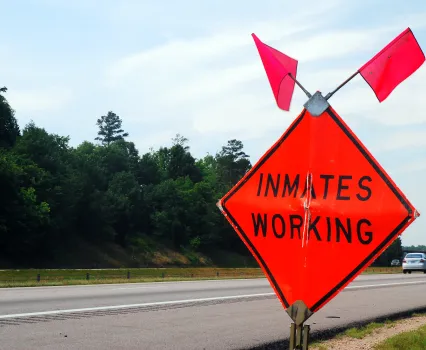
| The governor could further expand human rights in his state is by improving the treatment of incarcerated individuals. He could take executive action to end forced labor inside its prisons. |
| The voters have not been willing to do so, and neither has the legislature. Gov. Newsom has a chance to drive change and improve the lot of those whom the state puts behind bars. |
| It is true that California’s penal policies have not always driven change or embodied progressive values. For example, in 2024, voters approved Proposition 36, which, among other things, “increase[d] penalties for specific drug and theft crimes…and allow[ed] felony charges for shoplifting with two or more prior convictions.” |
| But it has still come a long way from the tough-on-crime 1990s, when its prison population mushroomed, and it embraced “three-strikes-and-you’re-out” approaches to sentencing repeat offenders. According to a report from the Public Policy Institute of California, “The state’s incarceration rate is now 36% lower than it was three decades ago, down from 613 to 393 per 100,000 residents.” |
| As this was happening, and the state hung onto a few vestiges of its punitive past remain. One of the most important is found in Article I, Section Six of the California Declaration of Rights, which states: “Slavery is prohibited. Involuntary servitude is prohibited except to punish crime.” |
| A similar provision is found in the Thirteenth Amendment to the United States Constitution. It is a remnant of an ugly, racialized past in which prisoners were regarded as “slaves of the state.” |
| Since before the Civil War, California “allowed private contractors to use prison labor for agricultural and construction work…. For example, arrested on vagrancy charges and housed in the local county jail, Native American detainees were auctioned to white employers.” However, in 1879, a post on OnLabor observes, “California ’became the first state to abolish the contract system.’” |
| But its penal code currently says that “The Department of Corrections shall require of every able-bodied prisoner imprisoned in any state prison as many hours of faithful labor in each day and every day during his or her term of imprisonment as shall be prescribed by the rules and regulations of the Director of Corrections.” |
| In 2024, California voters had a chance to end forced labor in prison, but they defeated Proposition 6, an effort to amend the state constitution to do so, with 53% voting no. |
| The defeated ballot proposition, as an article in the Guardiannoted, “would…have allowed people in prison to choose their jobs, with a related proposal that would have created voluntary work programs within the prison system.” Supporters of Prop 6 argued that “Incarcerated people’s relationship to work should not be one of exploitation and little-to-no agency.” |
| They said that forced labor in prison was incompatible with the “dignity and humanity…[of] the often-forgotten individuals behind bars.” |
| Prior to the defeat of Prop 6, the state legislature passed and the governor signed legislation to end the work requirement for inmates, but it was contingent on passage of Proposition 6. |
| Two years ago, the Los Angeles Times Editorial Board urged the legislature “to remove mandatory work from the Penal Code…. While the Constitution allows forced labor in prison,” it said, “it is the Penal Code that mandates it. Only voters can change the constitutional provision, but lawmakers have the power and duty to change the law.” |
| In 2025, the Black Caucus introduced a new proposal to ban what one person called “legalized constitutional slavery.” |
| In the meantime, according to the ACLU more than 65% of people imprisoned in California reported being forced to work, and the state profits from the extremely cheap labor they provide. Inmates are doing things like “fighting wildfires, janitorial work, construction and cleaning.” |
| Others work for the California Prison Industry Authority, which, the California Department of Justice says, “creates products and provides services to the state, other public entities, and the public.” |
| In whatever setting they work, California’s incarcerated individuals get paid next to nothing, with most earning less than a dollar an hour. And they are not protected by the state’s workplace health and safety laws. |
| A 2025 state supreme court decision held that they are not entitled to a minimum wage for their work. |
| In response, the state legislature should raise wages paid to inmates who work. But even if it did, that would not address the larger issue of coercing prisoners into working. |
| Multiple states—including Alabama, Colorado, Nevada, Tennessee, and Vermont—have voted to remove forced labor provisions from their constitutions in recent years. In California, as the Los Angeles Timesobserved, “ Only voters can change the constitutional provision, but lawmakers have the power and duty to change the law.” |
| Unless or until they do, Gov. Newsom direct the Department of Corrections not to punish inmates who choose not to work, so long as they exercise that choice in a way that does not disrupt the operation of the institutions in which they are incarcerated. |
| Writing in 1871, a judge in Virginia said: |
The bill of rights is a declaration of general principles to govern a society of freemen, and not of convicted felons…. They are the slaves of the State undergoing punishment for heinous crimes committed against the laws of the land. While in this state of penal servitude, they must be subject to the regulations of the institution… and the laws of the State to whom their service is due in expiation of their crimes.
|
| It is time for the Golden State to put such thinking in the rearview mirror. |


 Have friends who like law? Forward this email.
  Like Verdict for legal discussions on Facebook.
  Follow @verdictjustia for news and updates on Twitter.


