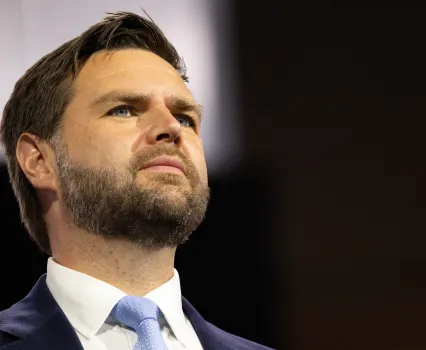
| On June 20, Vice President JD Vance travelled to Los Angeles for the ostensible purpose of visiting a multi-agency federal joint operations center and a mobile command center set up to coordinate and direct the Trump administration’s “invasion” of that city. But his whirlwind schedule suggests he was not there to do the serious business of governing. |
| As The Guardianreports, “A review of Vance’s movements…suggests that he had very little time to evaluate the situation in the city. His flight from Washington touched down at…1:35 pm local time. Vance’s motorcade arrived at the federal building in Westwood that is being guarded by active-duty Marines at 2 pm.” |
| He made time for an interview with Fox News, andone hour and eleven minutes after he reached downtown, Vance held a press conference that lasted approximately twenty minutes. That was followed by a Republican National Committee event. |
| “By 6:05 pm,” The Guardian observes, “he was back on Air Force Two at LAX and ready for departure just four and a half hours after he had arrived.” |
| The serious business of governing and Vice President Vance hardly belong in the same sentence. Vance has brought the traditional attack dog mentality of a vice-presidential candidate to Washington, DC, and played a prominent role in the politics of provocation that is so near and dear to the Trump administration. |
| Stirring the pot, adding fuel to a burning fire, name-calling, race-baiting, all of them Vance’s specialties, were on display during his brief Los Angeles visit. But they are hardly the attributes that contribute to effective governance in a constitutional democracy. |
| Political thinkers from time immemorial have recognized that the government’s most important job is to foster peace and stability within society and that political leaders have an important role to play in that endeavor. Our own James Madison thought that “enlightened statesmen” would not, on their own, “be able to adjust…clashing interests, and render them all subservient to the public good.” |
| But he believed that “the public voice, pronounced by the representatives of the people, will be more consonant to the public good than if pronounced by the people themselves….” |
| In 1910, speaking at the Sorbonne in Paris, former President Theodore Roosevelt offered a similar vision of government when he famously praised “the man who is actually in the arena….” Most often, commentators focus on Roosevelt’s emphasis on the importance of “daring greatly” in political leaders. |
| But here I want to note something else Roosevelt said. |
| He insisted that in democracies, “the quality of the leaders is all-important. If, under such governments, the quality of the rulers is high enough, then the nations for generations lead a brilliant career, and add substantially to the sum of world achievement….” He noted the importance of a leader’s “character—the sum of those qualities which we mean when we speak of a man’s force and courage, of his good faith and sense of honor,” and extolled leaders who “spend…[themselves] in a worthy cause.” |
| A half-century after Roosevelt, John F. Kennedy used his inaugural address to urge “citizens of America or citizens of the world,” to “ask of us here the same high standards of strength and sacrifice which we ask of you.” |
| “With a good conscience our only sure reward,” Kennedy said, “with history the final judge of our deeds, let us go forth to lead the land we love, asking His blessing and His help, but knowing that here on earth God’s work must truly be our own.” |
| The “public good,” “a worthy cause,” “God’s work”—those words do not seem to fit Vice President Vance’s conception of his role and responsibilities. Writing in The Atlantic, George Packer said about him, “With his gifts of intellect and rhetoric, Vance might have brought the country’s conflicting strands together. They had combined to make him, and he knew them deeply—their flaws, their possibilities, their entwined fate.” |
| “Instead,” Packer argues, “he took a path of extreme divisiveness to the peak of power, becoming a hard-line convert to the Catholic Church, post-liberal populism, and the scorched-earth cause of Donald Trump. Vance became a scourge of the elites among whom he’d found refuge, a kingpin of a new elite, avenging wrongs done to his native tribe.” |
| Recall Vance’s role in the February’s infamous Oval Office meeting with the Ukrainian President Volodymyr Zelenskyy. Forty minutes into the meeting, Vance took a question about the administration’s posture toward Russia as the occasion to denounce former President Biden for talking tough but doing nothing to prevent the invasion of Ukraine. |
| Then he turned on Zelenskyy and accused him of being disrespectful by coming to the Oval Office and “litigating” his grievances “in front of the American media.” He badgered Zelenskyy to express his gratitude to President Trump for trying to bring an end to the war. |
| As the meeting deteriorated into a shouting match, Vance did his bit. Further stoking the fire, Vance asked aggressively, “Have you said thank you once this entire meeting?” Trump followed suit, denouncing Zelenskyy for not acting “at all thankful.” |
| Also in February, Vance used the Munich Security Conference to drop another bombshell. There, he “launched a brutal ideological assault on Europe, accusing its leaders of suppressing free speech, failing to halt illegal migration, and running in fear from voters’ true beliefs.” |
| In what The Guardianlabeled “a chastising speech,” Vance “openly questioned whether current European values warranted defence by the US, he painted a picture of European politics infected by media censorship, cancelled elections, and political correctness.” |
| His “blistering and confrontational remarks,” The Guardian notes, “were met with shock….” |
| Packer argues that “Like Trump, Vance shows no interest in governing on behalf of anyone outside MAGA.” He is “quick to anger, ready with a jibe, picks fights on social media, and brandishes insults such as 'moralistic garbage’ and 'smug, self-assured bullshit.’” |
| Vance knows, Packer observes, that “MAGA can’t breathe without an enemy.” |
| This brings us back to Los Angeles, where Vance fed that need. |
| Not two minutes into his press conference, he launched a broadside against California Governor Gavin Newsom and Los Angeles Mayor Karen Bass. He claimed that they had “actively encouraged illegal migration” and “actively encouraged violence.” |
| Vance said rioters were “egged on by the governor and the mayor.” Answering a question from a journalist, the vice president tried to drive a wedge between the police and California’s Democratic governor. |
| As he put it, “Gavin Newsom is endangering law enforcement…. Gavin Newsom and Karen Bass have basically said that it is open season on federal law enforcement…. [Newsom] is absolutely endangering the lives of mothers and daughters and fathers and sons who have been sent here to enforce the law.” |
| Then, in a moment of racist provocation, he misnamed California Senator Alex Padilla, calling him “Jose Padilla.” He accused the senator of hating law enforcement and to make that point associated him with a man who was convicted of terrorist activities in 2007, “after being arrested in Chicago on suspicion of planning to set off a radioactive dirty bomb.” |
| There you have it. While accusing Democrats of engaging in political theater rather than seriously addressing the nation’s problems, Vance showed his own well-developed skill at the kind of theatrics that divide the nation, denigrate opponents, and turn political leadership into political provocation. |
| Packer paints a convincing picture of a vice president who “justifies every cruel policy, blatant falsehood, and constitutional breach by aligning himself with the unfairly treated people he grew up with, whether or not his administration is doing them any actual good.” Sadly, Vance’s rise signals how far we have fallen from Madison, Roosevelt, and Kennedy. |

 Have friends who like law? Forward this email.
  Like Verdict for legal discussions on Facebook.
  Follow @verdictjustia for news and updates on Twitter.


