| We saw a by now familiar tactic in the early days of his Administration when President Donald Trump went after lawyers whom he considered his political enemies and threatened the firms that employed them. Over several weeks in February and March, he singled them out for various punishments. |
| For example, the president suspended security clearances for Peter Koskifor and others at Covington & Burling who assisted former special prosecutor Jack Smith in bringing cases against Trump. In March, when Trump turned his ire against Paul, Weiss, he noted that the firm had employed Mark Pomerantz who had helped in the case against Trump for falsifying business records. |
| That same month, President Trump rescinded security clearances and access to classified Information from Alvin Bragg, Norman Eisen, Letitia James, and others, each of whom had been involved in some action against him. And he went after Jenner & Block where Andrew Weismann had worked, noting his role in the Mueller special counsel investigation. |
| Each of these actions represented the executive equivalent of a bill of attainder. Such bills declare a person or group guilty of a crime and impose punishment without a trial. |
| Late last month, while the attention of the world was focused on the president’s vendetta against late-night talk show hosts, the president demanded that Microsoft fire Lisa Monaco, its global affairs president. Her “crime” is that, while serving as Deputy Attorney General in the Biden administration, she “helped coordinate the Justice Department’s response to the January 6, 2021, attacks by Trump supporters on the U.S. Capitol.” |
| The president was reacting to Fox TV’s Maria Bartiromo, who posted on X about Monaco joining Microsoft. As CNBC reported, “The appointment happened in July.” |
| And on September 25, Microsoft drew the president’s ire when it announced, “it would cut off cloud-based storage and artificial intelligence subscriptions to a unit of the Israeli military, after investigating a claim that the division had built a system to track Palestinians’ phone calls.” |
| But whatever the reason, his demand that Microsoft fire Monaco is another occasion on which the president has run afoul of the spirit if not the letter of the Constitution. In response, we might expect a large and powerful corporation to push back and to rally other big businesses to resist the president’s meddling in their internal affairs. |
| So far, crickets. As CNBC noted, “Microsoft declined to comment.” |
| The president was hardly subtle in his denunciation of Monaco or in reminding Microsoft of its financial interests. “Monaco,” he wrote, “has been shockingly hired as the President of Global Affairs for Microsoft, in a very senior role with access to Highly Sensitive Information. Monaco’s having that kind of access is unacceptable and cannot be allowed to stand.” |
| Trump also made sure everyone knew the “offenses” she committed. |
| “Corrupt and Totally Trump Deranged Lisa Monaco (A purported pawn of Legal Lightweight Andrew Weissmann), was a senior National Security aide under Barack Hussein Obama, and a Lawfare and Weaponization obsessed Deputy Attorney General under Crooked Joe Biden and Lisa’s Puppet “Boss” Attorney General Merrick Garland.” |
| They “were all the architects of the worst ever Deep State Conspiracies against our Country (RUSSIA, RUSSIA, RUSSIA, the January 6th Hoax, the Illegal Raid on Mar-a-Lago, the Biden “Autopen” Scandal, the Documents Witch Hunt, and more!).” |
| “She is a menace to U.S. National Security, especially given the major contracts that Microsoft has with the United States Government.” |
| The reminder about those contracts put teeth into the president’s indictment of Monaco. |
| Then delivering the verdict, he added, “Because of Monaco’s many wrongful acts, the U.S. Government recently stripped her of all Security Clearances, took away all of her access to National Security Intelligence, and banned her from all Federal Properties. It is my opinion that Microsoft should immediately terminate the employment of Lisa Monaco.” |
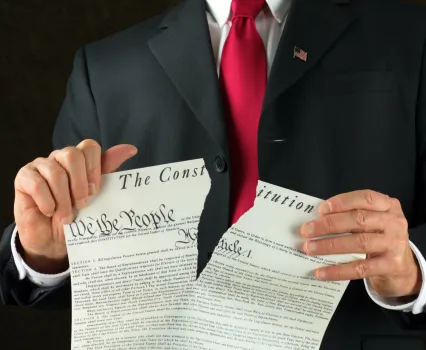
| No investigation, no presentation of evidence, no trial. What would the people who wrote the American Constitution think? |
| We get a hint by remembering that Article I, Section 9, of the Constitution explicitly prohibits so-called “bills of attainder.” Those bills impose punishments outside the judicial process and, as such, strip their targets of due process of law. |
| As the Supreme Court explained in 1867, they are “aimed at past acts, and not future acts,” and are used to deprive people “of the right to hold certain offices and trusts, and to pursue their ordinary and regular avocations.” |
| In that case, the Court struck down a provision of the Missouri Constitution which “required priests and clergymen, in order that they may continue in the exercise of their professions and be allowed to preach and teach, to take and subscribe an oath that they have not committed certain designated acts, some of which were at the time offences with heavy penalties attached, and some of which were at the time acts innocent in themselves.” |
| There is, the Court observed, as if anticipating life in the Trump era, “no practical difference between assuming the guilt and declaring it. The deprivation is effected with equal certainty in the one case as in the other. The legal result is the same, on the principle that what cannot be done directly cannot be done indirectly.” |
| The prohibition of bills of attainder, the Court observed, was intended “to secure the rights of the citizen against deprivation for past conduct by legislative enactment under any form, however disguised….” It made clear that punishment of the kind imposed by bills of attainder included “disqualification from the pursuits of a lawful…vocation, or from positions of trust, or from the privilege of appearing in the courts, or acting as an executor, administrator, or guardian….” |
| That is exactly the kind of thing that the president set out to do in his campaign against lawyers and law firms, a campaign carried out through the executive equivalents of bills of attainder, namely executive orders. That is exactly what he is now trying to accomplish in the entertainment industry and in the corridors of some of America’s biggest businesses. |
| As Politicoput it, “The move to pressure Microsoft to fire Monaco continues his mission to punish those who he viewed as seeking to undermine him.” |
| So far, the president is getting away with these tactics. |
| What University of California professor Robert Reich wrote in 2016 remains true today. “[T]he CEOs of America’s largest firms,” he argued, “have the power to constrain the most dangerous, divisive, and anti-democratic president ever to occupy the Oval Office.” But then as now they are not using that power. |
| Reich suggested that they are making a serious mistake by remaining silent. He reminded his readers of “a time when CEOs were thought of as 'corporate statesman’ with duties to the nation. As one prominent executive told Time Magazine in the 1950s, Americans 'regard business management as a stewardship,’ acting 'for the benefit of all the people.’” |
| On September 22 of this year, Reich observed how far CEOs have fallen from that position, noting that “[s]ome CEOs have gone over to the dark side, competing to suck up to the tyrant-in-chief, eager to lavish him with praise, gush over his accomplishments, even hand him gifts of solid gold bullion.” In Reich’s view, “[P]eople in positions of significant responsibility have succumbed to greed, small-mindedness, insularity, and cowardice. During a crisis like the one we’re now in, these so-called leaders have abdicated their moral responsibility.” |
| It remains to be seen whether the attack on Lisa Monaco changes any of that. In the meantime, as Reich puts it, “We can no longer wait to be led by those with the power and authority to lead. You must lead, I must lead, all of us must lead. We are the leaders we’ve been waiting for.” |


 Have friends who like law? Forward this email.
  Like Verdict for legal discussions on Facebook.
  Follow @verdictjustia for news and updates on Twitter.


