| On January 20, 2025, the President of the United States took an oath “to preserve, protect, and defend the Constitution of the United States.” A lot has happened since then to give the American people reason to wonder what constitution the president is preserving, protecting, and defending. |
| One of the key features of the American Constitution is federalism. While the people who wrote it had different views about what would be the right balance of powers between the states and the national government, the document they produced clearly gave states control of certain things and allocated responsibility for others to the national government. |
| One of the things left to the states was primary control over certain elections. Article I, Section 4 says, “The Times, Places and Manner of holding Elections for Senators and Representatives, shall be prescribed in each State by the Legislature thereof; but the Congress may at any time by Law make or alter such Regulations, except as to the Places of choosing Senators.” |
| Note Article I, Section 4 does not assign any responsibility to the president. But you would never know that from reading what President Trump posted to Truth Social on August 30. |
| “Voter I. D.,” he said, “Must Be Part of Every Single Vote. NO EXCEPTIONS! I Will Be Doing An Executive Order To That End! ! ! Also, No Mail-In Voting, Except For Those That Are Very Ill, And The Far Away Military. USE PAPER BALLOTS ONLY! ! ! President DJT.” |
| If he follows through with the planned Executive Order, the president will not be preserving, protecting, and defending the Constitution. He will be turning it on its head. |
| Moreover, he will be putting his thumb on the scale to ensure that the 2026 congressional elections come out the way he wants them to. |
| This is not the first time that the president has ignored the Constitution to pursue his own agenda of electoral reform. On March 25, he issued an executive order directing the Election Assistance Commission to “Enforc[e] the Citizenship Requirement for Federal Elections.” |
| At the time, the president offered no evidence for the proposition that “the United States has not adequately enforced Federal election requirements that, for example, prohibit States from counting ballots received after Election Day or prohibit non-citizens from registering to vote.” But he went ahead with the executive order nonetheless. |
| On June 13, a federal district court judge in Massachusetts issued a preliminary injunction to stop the implementation of the March 25 Executive Order after finding that there is no “source of authority for the President to impose this requirement on the States.” |
| That has not deterred President Trump from continuing to act as if there was. |
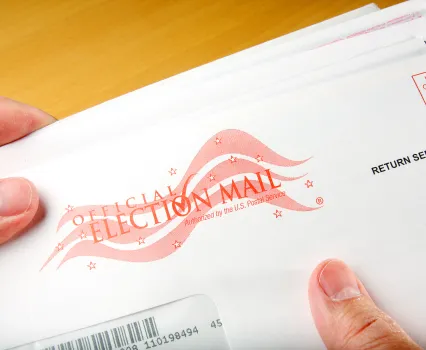
| Take mail-in ballots. On August 18, President Trump posted the following to Truth Social: “We are now the only Country in the World that uses Mail-In Voting. All others gave it up because of the MASSIVE VOTER FRAUD ENCOUNTERED. WE WILL BEGIN THIS EFFORT, WHICH WILL BE STRONGLY OPPOSED BY THE DEMOCRATS BECAUSE THEY CHEAT AT LEVELS NEVER SEEN BEFORE, by signing an EXECUTIVE ORDER to help bring HONESTY to the 2026 Midterm Elections.” |
| “Remember,” he argued in a way that the people who wrote the Constitution would not recognize, “the States are merely an 'agent’ for the Federal Government in counting and tabulating the votes. They must do what the Federal Government, as represented by the President of the United States, tells them, FOR THE GOOD OF OUR COUNTRY, to do.” |
| And never one to hide the ball, the president showed that beneath his passion to end mail-in voting was a nakedly partisan purpose. “With their HORRIBLE Radical Left policies, like Open Borders, Men Playing in Women’s Sports, Transgender and 'WOKE’ for everyone, and so much more, Democrats are virtually Unelectable without using this completely disproven Mail-In SCAM.” |
| Two days later, the president returned to this theme in Oval Office remarks. “Mail-in ballots are corrupt. Mail-in ballots, you can never have a real democracy with mail-in ballots, and we as a Republican Party are going to do everything possible [to] get rid of mail-in ballots…. The Democrats want it because they have horrible policy. If you have mail-in voting, you’re not going to have Democrats get elected…That’s bigger than anything having to do with redistricting. And the Republicans have to get smart.” |
| Beyond his desire to end the use of mail-in ballots, requiring voters to show a valid ID before allowing them to vote has also been part of the president’s election reform agenda for a long time. |
| Thirty-six states already have such laws on the books. And we know that they have a dramatic impact on who can cast ballots. |
| The Brennan Center for Justice reports: |
As many as 11 percent of eligible voters do not have the kind of ID that is required by states with strict ID requirements, and that percentage is even higher among seniors, minorities, people with disabilities, low-income voters, and students. Many citizens find it difficult to obtain government photo IDs because the necessary documentation, such as a birth certificate, is often difficult or expensive to acquire.
|
| Whether in spite of or because of that fact, the president has been so fixated on voter ID laws that last January, soon after taking office, he threatened not to provide federal emergency relief after the wildfires that devastated Los Angeles unless the state adopted new voter ID laws. “In California,” he said, “I have a condition—We want them to have voter ID so people have a voice. Right now, the people don’t have a voice because you don’t know who is voting. It’s very corrupt.” |
| As outrageous as that demand was, at least it recognized that the decision whether use voter ID was not his to make. Nine months later, that seems to have changed. |
| But unfortunately for Trump, nothing in the Constitution has changed. With regard to the power to regulate elections, it is today what it was when Alexander Hamilton went to great lengths to explain the roles of the states and of Congress in that regard. He noted that the Constitution said nothing about the president. |
| In 1931, Chief Justice of the United States noted that Article I, Section 4 gives states |
authority to provide a complete code for congressional elections, not only as to times and places, but in relation to notices, registration, supervision of voting, protection of voters, prevention of fraud and corrupt practices, counting of votes, duties of inspectors and canvassers, and making and publication of election returns; in short, to enact the numerous requirements as to procedure and safeguards which experience shows are necessary in order to enforce the fundamental right involved.
|
| The “Congress,” he continued, “may supplement these state regulations or may substitute its own.” The president’s only role would be to decide whether to sign or veto any legislation Congress might pass under its Article I, Section 4 authority. |
| Hamilton foresaw the danger of empowering anyone in the federal government to do what President Trump wants to do. He called that idea “an unwarrantable transposition of power, and “a premeditated engine for the destruction of the State governments.” |
| Sorry, Mr. President, that’s why the Constitution you swore to preserve, protect, and defend does not allow you to issue executive orders on mail-in voting or voter ID, however odious you find current practices. |


 Have friends who like law? Forward this email.
  Like Verdict for legal discussions on Facebook.
  Follow @verdictjustia for news and updates on Twitter.


