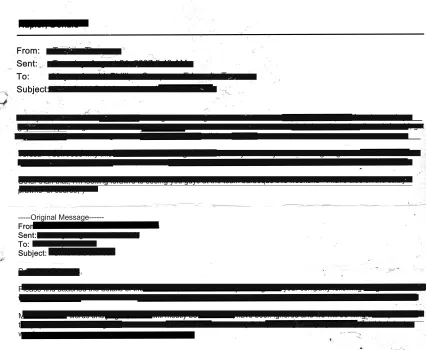
| The double-edged sword of redaction: privacy without protection, disclosure without accountability. | | It is commonly assumed that, during moments of moral crisis, adherence to proper procedures under principled leadership will ensure just outcomes. Deliberate action, thorough documentation review, judicious redaction, and restrained communication are expected to yield justice. Confidence in procedural integrity is a hallmark of American civic culture and law, reflecting enduring commitments to fairness, equitable order, and the rule of law. These basic principles have historically benefited the nation, parties on either side of the adversarial “v.” | | Then there are the Epstein victims. | | There are instances when procedural mechanisms are expected to bear more weight than they can sustain. Rather than serving as a means to achieve moral clarity, process may become a substitute for it. In these cases, procedure functions as a tool for deferring and delaying responsibility while providing the illusion of proper practice. | | Redaction exemplifies this tension. Ideally, it demonstrates care by safeguarding privacy, exercising restraint in judgment, and minimizing harm, as is the intent of Rule 5.2 (a) of the Federal Rules of Civil Procedure. However, in practice redaction often impedes accountability and justice. Names are omitted, timelines become ambiguous, and patterns of behaviors are obscured. Institutions frequently justify these actions by citing the need for discretion. Yet discretion without moral guidance often results in concealment. | | The process of redaction offers a double-edged sword. Injustice running simultaneously in two opposite directions—one way, the redaction to protect the powerful, and the other way, the failure to redact as an instrument of harm. The U.S. Department of Justice got it wrong in both directions, failing twice—they concealed wrongdoing and violated the privacy of those harmed. | | For survivors of Jeffrey Epstein, uncontrolled disclosure of names, personal histories, addresses, phone numbers, and other intimate details is not experienced as openness but as exposure. Such disclosure carries an implicit warning that speaking has consequences. Privacy may dissolve, reputations may be questioned, and private lives may be subjected to public scrutiny without consent or care. What is framed as full transparency can, in practice, function as a deterrent to truth-telling. | | For survivors of child sexual abuse more broadly, this dynamic is familiar. It mirrors the initial harm and the frame of secrecy, as powerful systems determine what can be known and what must remain hidden through the silencing by redactions, protective orders, and NDAs. Survivors are repeatedly asked to trust that confidentiality serves their interests, despite substantial evidence that secrecy has historically protected institutions rather than individuals, most notably, children. | | The U.S. Justice Department requested additional time, citing the need to “get it right.” While this request may appear reasonable, the passage of time alone does not guarantee sound judgment or principled practice. When the outcome is a release that is both excessively redacted for wrongdoers and insufficiently protective for survivors, shielding those in power while exposing the vulnerable victims, the purported commitment to care becomes questionable. | | Public officials frequently employ managerial language, such as stating that files are “on the desk” or matters are “under review.” These expressions are intended to reassure the public that governance processes are operating effectively. However, they also reveal a subtle detachment from moral responsibility to uncover the truth. Time seems to work generously on behalf of perpetrators, blunting scrutiny and dispersing responsibility, while leaving survivors to live indefinitely with what cannot be forgotten. | | The burdens survivors bear are not neatly categorized, indexed, or contained. These experiences manifest physically and psychologically, affecting physical and psychological health and the trajectory of their lives in ways that cannot be erased. When Attorney General Pam Bondi stated that “the files are sitting on my desk,” the remark may have been intended to convey seriousness. Instead, it revealed a familiar institutional habit: mistaking the careful handling of paperwork for the harder work of moral responsibility. | | The stakes here are not insignificant. In the United States, approximately one in eight children will experience sexual assault before reaching the age of 18. This issue extends beyond isolated scandals of the rich and famous and is embedded within families, educational settings, camps, religious organizations, and other youth-serving organizations. Any approach to disclosure or concealment that does not prioritize survivors is not merely flawed; it is fundamentally misaligned with the magnitude of harm it seeks to address. | | When secrecy and selective disclosure become institutional habits, they do more than complicate accountability; they create cover for sexual predators. Patterns remain buried, warning signs stay fragmented, and individuals who should be identified, monitored, or removed continue to move through systems that prioritize their image over the protection of children. Children are endangered not because danger is unknowable, but because it is concealed. | | Recent statements by Melinda French Gates highlight the profound human consequences of institutional failure and cover-up. In discussing renewed scrutiny of Jeffrey Epstein and his associates, she described the experience as reopening “very painful” chapters of her life and expressed deep sorrow for survivors whose suffering remains unaddressed. Her remarks emphasized the broader recognition that secrecy does not mitigate harm; rather, it extends it, compelling survivors of sexual assault to bear its heavy burden long after institutional attention has shifted. | | The fundamental challenge is not to choose between secrecy and disclosure, but to restore the ethical framework that gives meaning to both. Transparency without ethical consideration can lead to cruelty, while privacy without accountability can foster impunity. Procedure does not fail when it limits disclosure; it fails when it forgets why disclosure mattered in the first place. | | Procedure itself is not the enemy. In a constitutional democracy, process is indispensable, providing safeguards against unpredictability, unfairness, and abuse. However, it is not morally self-sufficient. Effective leadership requires the willingness to exercise judgment, accept responsibility, and act. Survivors are entitled to a moral culture that can both protect sensitive information and acknowledge truths that must be publicly recognized. | | Long after the files are boxed and the headlines move on, the question that lingers is a moral one: did we lean on legal procedure to preserve our sense of order, or did we summon the courage to confront hard truths before silence compounded the harm to survivors and to children? | | And as Melinda French Gates said, “no girl should ever be put in this position.” And no adult survivor should ever be re-victimized by the double-edged sword of redactions. |
|


 Have friends who like law? Forward this email.
  Like Verdict for legal discussions on Facebook.
  Follow @verdictjustia for news and updates on Twitter.


