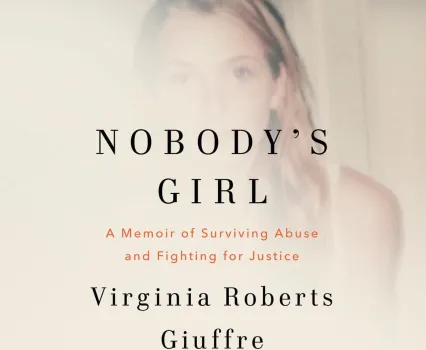
| The book’s title, Nobody’s Girl: A Memoir of Surviving Abuse and Fighting for Justice, summarizes the theme of this important new book about sexual abuse. It describes Giuffre’s horrible abuse by Jeffrey Epstein, Ghislaine Maxwell, and their cohorts. The last thing the author, Virginia Roberts Giuffre, told her co-author, Amy Wallace, right before Giuffre died by suicide, was that this book must be published “regardless of my circumstances at the time” (p. 11). |
| Nobody’s Girl is dedicated to Giuffre’s “Survivor Sisters and to anyone who has suffered sexual abuse.” There are at least 200 survivors of Epstein and Maxwell. Among those mentioned in the book are Maria Farmer, Annie Farmer, Courtney Wild, Sarah Ransome, Michelle Licata, Jena-Lisa Jones, Chauntae Davies, Anouska De Georgiou, Teala Davies, Teresa Helm, Marijke Chartouni, Jennifer Araiz, and Thysia Huisman. Maria Farmer recently received the Child Protector Award at CHILD USA’s annual dinner, which I was proud to attend. |
| Reading this book reminded me that listening to these survivors’ stories, and bringing them justice, is what the whole abuse debate should be about. It is not about Republicans or Democrats. Virginia’s story demonstrates that powerful men and women abused and trafficked children. Many politicians and lawyers still don’t protect children. Instead, they use their power to hide their abuse and label the survivors’ stories a hoax. Giuffre’s book puts our focus on empathy for the survivors who suffered and suffer from abuse’s legacy. She tells us that too often law helped the abusers, not the abused. It continues to do so today. Giuffre urges us to aim high—justice for survivors—instead of low—freedom for abusers. |
| Recently, Giuffre’s fellow survivors strongly repeated their claims of abuse as politicians vote whether they want to listen to their stories or block them. I repeat much of Giuffre’s story here because I want to keep everyone’s focus on the horrible suffering of abuse victims, dead and alive. Read her story so that you will remember why to stand for justice for survivors instead of freedom for abusers. All the abusers should be identified, even if they are powerful and wealthy, because the survivors’ well-being is more important than theirs. |
| “Is sex all anyone will ever want from me?” (p. 95). That’s the effect that constant abuse had on Guiffre’s self-perception. Her story is horror from start to finish. “When you grow up female, danger is everywhere” (p. 28). |
| The rape began with Virginia’s own father, who started in on her early. That brutal experience was repeated when her father’s friend, Forrest, who was abusing his own daughter, traded daughters with him. “Forrest was the first man to penetrate me with his penis. Not long afterward, my father did the same” (p. 56). Forrest later told her she must ask God for forgiveness for her sexual activity with him and her father. Meanwhile, her Mom “was willfully ignoring what was in front of her face” (p. 58). Mom knew, but did nothing. Virginia’s larger family ignored her claims of abuse even after she yelled it out in front of them. |
| This made Virginia leave her own family. She was raped in the streets. Ron Eppinger picked her up in his car, allegedly to help, and added her to his stable of escorts. He offered to be her “new daddy” (p. 28), which is disgusting, as her own daddy was a rapist. She was with Eppinger six months until he gave her away to someone else. The new man was arrested, and that brought her back in contact with her parents. |
| Big news. In summer 2000, Virginia’s father was working at Donald Trump’s Mar-a-Lago Club. He got her a job there as a $9-per-hour locker-room attendant. Her dad introduced her to Trump, who asked her if she babysat. She soon made extra money “minding the children of the elite” (p. 85). |
| Then, when she was almost 17 and walking to Mar-a-Lago, Ghislaine Maxwell ordered her driver Juan Alessi to pick Virginia up. “Unlike my father or Forrest or Ron Eppinger or the man Eppinger had given me away to, this was an apex predator” (p. 86). Yes, that is the beautiful and confident Ghislaine Maxwell who is an apex predator. G-Max brought Virginia to Jeffrey Epstein’s home in Palm Beach, Florida. The two adults coached the child on how to provide sexual massage and have sex. They used an electric vibrator on her. They paid her $200. Epstein told Maxwell, “she’s a keeper” (p. 95). They asked her to leave her job at Mar-a-Lago; she did. |
| With them she continued being abused, eventually having sex with women as well as men. Epstein warned her not to tell anyone their story, because they knew where her brother went to school, and “own[ed] the Palm Beach Police Department…so they won’t do anything about it” (p. 106). Imagine hearing threats to your beloved brother Skydy and police impotence from your abuser. It would leave you wondering whether there was any way you could ever seek justice. |
| One day Epstein took Virginia into a hidden closet, with walls full of hundreds of photos of naked girls. Giuffre is not sure if Epstein blackmailed the men he gave girls to, but she is sure he had a large library of videotapes in his homes. |
| As she grew used to the job, Epstein and Maxwell asked her to recruit more girls for them. She did. She felt horrible about it then and later because she knew the cruel things that would happen to those girls. She thinks she developed some Stockholm Syndrome in her dealings to justify her working for and with Epstein and Maxwell. |
| After they abused her for a while, they loaned her out to their friends. One was a psychology professor, “who was only the first of many academics from prestigious universities who I was forced to serve sexually” (p. 135). In her words, she serviced someone about to be elected governor of a Western state and a former U.S. Senator. Later the book says New Mexico’s Bill Richardson was the governor. Newspapers suggest that the second man was Maine Senator George Mitchell. There were plenty of dinner companions. President Bill Clinton was at the dinner table with her one night, as were Al and Tipper Gore, and Leslie Wexner of Victoria’s Secret. |
| Giuffre explains that the psychological trauma was worse than the physical abuse, as the two made her “complicit in my own devastation” (p. 97). She became their prisoner for more than two years. She explains that it is not easy for abuse victims to leave their abusers, because no one else loves or cares about them. Occasionally she thought her abusers cared. She argued they offered her a new family that might have been better than her own. She “was no expert on mothers, but in those early days, I sometimes imagined Maxwell as mine” (p. 117). All of this was complicated by the use of drugs, which also blurred her perspective and her health. |
| Giuffre mentions G-Max’s October 2000 trip to New York to see her old friend Prince Andrew. They joined Donald and Melania Trump, and German model Heidi Klum, at a swank party. Maxwell bragged she could get former president Bill Clinton on the phone, and that she and Epstein had visited the White House when Clinton was president. Maxwell said she’d given George Clooney a blow job. Bill Gates attended some of the events. |
| Prince Andrew was involved with her. The prince “seemed in a rush to have intercourse” (p. 147). She told her friend “I hadn’t wanted to have sex with the prince, … but I felt I had to” (p. 148). A second sexual encounter with the prince occurred a month later. And then a third time at Little Saint Jeff’s, Epstein’s private island. Virginia was 18, and once she, Epstein, the prince, and 8 other girls under 18 had sex together. A man, “a well-known Prime Minister” (p. 163), raped her more savagely than anyone had. News stories suggest that was Israeli Prime Minister Ehud Barak, but he has denied the allegations. She was trafficked to Marvin Minsky, an MIT scientist. French modeling agent Jean-Luc Brunel also abused her. Virginia explains she does not remember all the rapists’ names, but knows their faces. You don’t forget the face of a man who’s abusing you. |
| The book explains her fear that some of the abusers could do a lot of harm and really hurt her if she dared name them. She held back some names because of the abusers’ powers. |
| Things never went very well in her life of abuse. Then Epstein and Maxwell asked her to have their baby. However, that “was a bridge too far” (p. 166). She could not imagine doing that. Would she bear a child that the two would later abuse? No. |
| She went to Thailand on a trip for them, where she was to learn more massage. There she met her husband, Robbie Giuffre. They quickly married in 2002. She called Epstein to say she was never coming back to him. |
| She built her life with Robbie. They had three children, Tyler, Alex, and Ellie. Having a daughter made her more anxious to fight her abuser as she knew girls are never safe. |
| Then the agents began investigating Epstein and Maxwell. Maxwell told Giuffre she would be “taken care of” if she did not speak to the prosecutors (p. 216). It looked like there might be justice. But then there was a cancellation of the grand jury in Florida, and a non-prosecution agreement set by Alexander Acosta, who was Trump’s future Cabinet Secretary of Labor. |
| She filed a lawsuit against Epstein as Jane Doe 102 in May 2009. In November 2009, she had a confidential settlement and received $500,000. She reacts to criticism of such settlements, arguing that the DOJ, not Virginia Roberts Guiffree, let Epstein off the hook. She was happy to have a little money. A second settlement let her get back to her family, and buy things that would make them more comfortable and happier. |
| She worked with lawyers Brad Edwards, Brittany Henderson, David Boies, Sigrid McCawley, and Paul Cassell. Maurene Comey prosecuted Epstein and Maxwell, but Virginia did not testify at the trials because there were too many abusers who would question her claims of abuse. |
| As she grew older, she wanted her brothers to protect their children and for that reason told them about what their father had done to her. She eventually had a complete break with her dad, as well as a cautious reunion with her mother. She invited her children to watch an interview about the abuse with her so that they would begin to understand what she had been through. |
| Collaborator Amy Wallace identifies one of Giuffre’s goals: to eliminate the statute of limitations for sexual abusers of children. Eliminate meaning completely abolish. She recognizes “the ways that all too often our legal system protects those abusers” (p. 22). |
| The book begins and ends with husband Robbie’s assault of her. Because of their fights, she had a restraining order against her so that she could not see their children. Much of the tale of the book is about Virginia’s happiness with her husband, without whom she never would have escaped Epstein and Maxwell. Nonetheless, claims about her husband’s abuse of her are at the book’s ending and beginning. It makes the book even more complex to have this round of abuse as part of the terrible story. Giuffre announced the abuse and killed herself in April 2025. |
| She wanted her book to speak. It does. It reminds us how horrible sexual abuse is, and yet children repeatedly face it from their families, from teachers and from strangers. Things could have been better for Virginia Roberts Giuffre if her mother had protected her against her father. If the law had moved to protect victims sooner, and punished Epstein instead of protecting him, as the U.S. Attorney for the Southern District of Florida U.S. attorney did. With the commotion about the Epstein files today, all of us should listen more carefully to the awful tale Giuffre tells. |
| And do something about it. Start by ending those statutes of limitations, which deny justice to survivors of abuse. |
| Giuffre asks a question that we are all wondering about today. Where are the videos that the FBI took from Epstein’s house? Epstein “wanted to record men in compromising positions in order to blackmail them later” (p. 137). Why haven’t been people been prosecuted based on those videos? |
| |

 Have friends who like law? Forward this email.
  Like Verdict for legal discussions on Facebook.
  Follow @verdictjustia for news and updates on Twitter.


