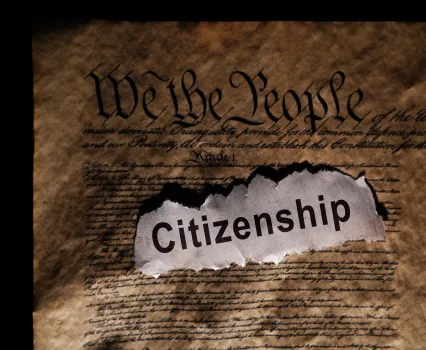
| Tomorrow, in Trump v. Barbara, the Supreme Court will hear oral argument on the question whether President Donald Trump’s executive order (EO) prospectively denying United States citizenship to persons born in the U.S. to parents who are neither citizens nor permanent residents is constitutional. The merits of the case have been broadly previewed elsewhere. For the record, I agree with the overwhelming consensus of constitutional scholars that the Citizenship Clause of the Fourteenth Amendment means what it says and that the EO is therefore unconstitutional. As Professors Vikram Amar and Jason Mazzone explained on Verdict, and as Professor Amar explained in a recent SCOTUSblog essay co-authored with his brother, Professor Akhil Amar, the fundamental error of the Trump administration’s argument to the contrary is that it reads the clause’s exception for persons not “subject to the jurisdiction” of the United States as turning on the status of an infant’s parents. | | The Trump administration’s view of citizenship has other difficulties as well. For one thing, as Professors (V.) Amar and Mazzone explained in another recent Verdict column, the EO also contradicts federal statutory language that was enacted in 1940 and re-enacted in 1952 against the backdrop of the Supreme Court’s expansive view of the Citizenship Clause. For another, upholding the EO would create chaos in a country in which birth certificates are typically issued at the state or local level without reference to parents’ citizenship. Even the citizenship of children born to U.S. citizen parents in hospitals in the United States would be open to question. Women in labor would need to remember to take their passports or birth certificates to the hospital, if they even have such documents. Indeed, as Professor Jacob Hamburger explained in a law review article last year, even that might not suffice, and it is only one of the bureaucratic SNAFUs that could ensnare anyone under the EO. | | To be sure, it would be possible to gradually transition to an orderly legal regime that does not grant citizenship to everyone born in the United States. Although the United States and most other countries in the Americas adhere to jus soli—in which birthplace is key—most countries in Europe and Asia follow a jus sanguinis regime—in which parentage is critical. There are also hybrid systems. | | Of course, even if it would be possible to transition instantaneously and seamlessly towards the legal regime envisioned by the EO, that would not mean that the Trump administration should win the Barbara case. It presents the question what the Constitution and federal statutes say about citizenship, not what an ideal U.S. citizenship policy should look like. | | Nonetheless, to the extent that there is legal wiggle room, policy views invariably come into play in adjudication. And even if—as I and nearly all other constitutional scholars believe—there is no wiggle room in which to fit the citizenship EO, the policy stakes are important because they affect what is sometimes called constitutional politics. It makes a difference whether the Supreme Court holds that the Trump EO is a perfectly good policy that happens to run afoul of unfortunately capacious constitutional language or that the EO violates a fundamental principle of American democracy. | | Accordingly, it is worth considering the policy stakes. | | Arguments Against and for Birthright Citizenship | | Opponents of jus soli argue that citizenship connotes membership in a political community and thus ought to require some prior connection. The parents of a child born in the United States to tourists who came here simply to give birth, or to people who crossed the border without authorization, have made no commitment to the country. A child born under those circumstances, the argument goes, is in some sense an American by accident of geography rather than by any meaningful tie. On this view, jus sanguinis better captures the sense of belonging to the political community than does jus soli. | | But that view is, for lack of a better word, unAmerican. Jus soli fits with other deeply-rooted American democratic practices. As Alexis de Tocqueville observed in the early nineteenth century, American rejection of primogeniture—in which birth order is critical to inheritance—contributed to an egalitarian culture. A similar principle animates the provisions of the Constitution (in Article I, Sections 9 and 10) forbidding both the federal government and the state governments from granting titles of nobility. The Constitution also forbids (in Article III, Section 3) “corruption of blood” as punishment for treason. Each of these practices and provisions rejects the notion that a person’s status should turn on parentage. The same is true of the Fourteenth Amendment’s Citizenship Clause and the common law principle it enshrined. Thus, in rejecting parental connection as the sine qua non for membership in the national political community, jus soli resonates with other foundational principles of American constitutional democracy. | | Opponents of jus soli also sometimes raise a concern that it creates perverse incentives. The so-called “anchor baby” argument comes in two distinct forms. The first involves undocumented immigrants who, it is claimed, cross the border partly in the hope that a child born on U.S. soil will eventually provide a path to legal status for the parents. The second involves “birth tourism” by relatively affluent foreign nationals. | | Yet the “anchor baby” arguments are theoretical, not practical. Citizen children of undocumented immigrants cannot, as a legal matter, anchor their parents for 21 years. Under 8 U.S.C. § 1151(b)(2)(A)(i), that’s the minimum age at which a citizen child can apply for a green card for a non-citizen parent. An undocumented pregnant woman who crosses the border to give birth thereby confers U.S. citizenship on the baby but risks being separated from the child for decades. True, the Obama administration sought to address that hardship with a program called Deferred Action for Parents of Americans and Lawful Permanent Residents that would have allowed undocumented parents of U.S. citizen children to avoid deportation for renewable three-year periods, but it was blocked by the courts before going into effect and then rescinded during the first Trump administration. Thus, the prospect of U.S. citizenship for their children is much less of a lure for undocumented immigrants than critics suggest. | | Meanwhile, birth tourism appears to be a statistically insignificant phenomenon. The government does not collect or report data on the issue, but an organization that favors restrictive immigration policies (and thus could be expected to give as high a figure as possible) estimated the number as between 20,000 and 26,000 such births per year in 2016-2018. That is well under one percent of all annual births. | | In any event, to the extent that children born to undocumented immigrants and non-citizens temporarily in the United States swell the citizen population, that is a benefit, not a cost. In 2024, the last year for which data are available, the total number of births in the United States was approximately 3.6 million. That came to a birth rate well below replacement level. Indeed, the birth rate has been below replacement level and falling since the 1970s, a trend that will, in the long run, create serious demographic problems of the sort already bedeviling low-birth-rate countries like Japan. Excluding children born to persons in the country without documentation or temporarily will only worsen the demographic collapse. | | What’s Really at Stake | | Prominent Republican pundits and politicians—including Vice President J.D. Vance—repeatedly have worried publicly about the harmful consequences of a declining birth rate. Whether their concerns are justified is not clear. It is true that a shrinking population means fewer working-age people to pay and care for aging retirees, but artificial intelligence and other productivity advances could offset that phenomenon, while a smaller human population would make fewer demands on the resources of a warming planet. Nonetheless, right or wrong, fears of population collapse on the right are real. So why would the same pundits and politicians who decry population stagnation or decline favor policies that exacerbate the problem? | | One need not speculate about the answer. From the moment Donald Trump emerged as a national political figure in 2015 spouting false claims about Mexico “sending” criminals to the United States, he and the movement he heads have tied restrictive immigration policies to racist fears and conspiracy theories that nonwhite people from the global south are “replacing” white Americans. From their perspective, more nonwhite U.S. citizen children born to non-citizen parents make matters worse, not better. Cutting back on birthright citizenship is of a piece with the Trump administration’s restrictions on immigration. | | Under very different circumstances, it might be possible to offer sound policy arguments for jus sanguinis or a hybrid approach to determining citizenship. In the contemporary United States, however, the efforts to narrow birthright citizenship rest on odiously racist views. Thus, if and when the Supreme Court rejects Trump’s citizenship EO, the ruling should be celebrated not only as a vindication of the Constitution’s meaning but also as the triumph of a deep principle of American democracy. |
|


 Have friends who like law? Forward this email.
  Like Verdict for legal discussions on Facebook.
  Follow @verdictjustia for news and updates on Twitter.


