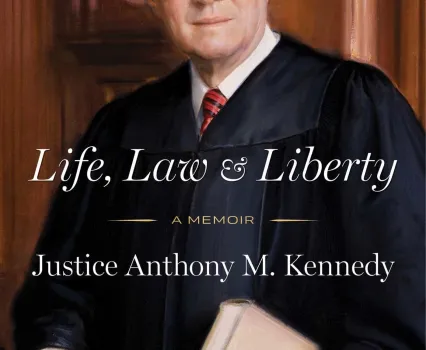
| I was unusually engaged by retired Justice Anthony Kennedy’s memoir, Life, Law & Liberty, published in October 2025. May I say a bit about myself and explain why? | | Most of my life in law is coextensive with Kennedy’s tenure on the Supreme Court from 1987 through 2018. I was a senior in college when President Ronald Reagan nominated Kennedy to serve on the Court after the Senate voted down Judge Robert Bork by a 58-42 vote and Judge Douglas Ginsburg withdrew from consideration. I graduated from law school in 1992, the same year Kennedy joined Justices Sandra Day O’Connor and David Souter to uphold Roe v. Wade, the 1973 decision establishing a federal constitutional right to abortion. In the late twentieth century, substantive due process was a big deal. (With all due respect to my alma mater, it seemed like we had spent three years trying to distinguish Roe and Griswold v. Connecticut from Lochner v. New York.) | | Then, for more than a quarter of a century, I practiced and taught law in the era of the Kennedy Court. As a median justice with Justice O’Connor, then the sole median justice after she retired in January 2006, Kennedy cast the decisive vote and wrote the Court’s opinions in, among other cases, gay rights decisions, Bush v. Gore, and Citizens United v. FEC. It is no exaggeration to say that, as a citizen, I (and we) lived in Justice Kennedy’s world. | | This aspect of Kennedy’s tenure led to him being labeled the Court’s “swing” justice, a label he rejects. “The cases swung,” he writes, “not me.” Still, as Professor Michael Dorf, a former law clerk to Justice Kennedy, observed, he and O’Connor occupied the middle between “generally reliable conservative and generally reliable liberal justices.” | | Furthermore, as a civil procedure professor, I found Kennedy—again, with all due respect—a bit exasperating. He wrote the opinion for a 5-4 Court holding in Ashcroft v. Iqbal that the plausibility pleading standard applies to all civil cases, a decision that continues to generate strongly controverted views, if not controversy. His plurality opinion in McIntyre Machinery, Ltd. v. Nicastro so muddles the law of specific personal jurisdiction that I sometimes skip the case to avoid unduly confusing students in their first month of law school. | | Hence, I came to the memoir with curiosity and a bit of skepticism about the justice who determined the contours of the law in my lifetime. I finished the book with nothing but admiration for the man. Kennedy tells the story of his life with grace, modesty, and clarity. He was an accomplished lawyer and a dedicated judge and is an ethical person. Nonetheless, I found his memoir a bit frustrating, especially in light of our current political and legal landscape, a subject Kennedy occasionally addresses in his book. | | Thumbnail Sketch of the Justice as a Young Man | | Born in 1936, Kennedy grew up in Sacramento, California, and understands himself to be a product of the West. This instilled in him a respect for both liberty and equality. “The Western experience taught that each person is entitled to be treated no differently from the next and should have the opportunity to prove his merit, her character, his resourcefulness, her strength,” he writes. | | Kennedy’s father was a lawyer, and his mother immersed herself in civic projects while raising Anthony and his brother and sister. He was an excellent student who served as a page in the California Senate while growing up. Kennedy matriculated at and graduated from Stanford, then, believing “that the bulk of my life would be spent in Sacramento,” matriculated at Harvard Law School. He found the study of law fascinating and graduated cum laude. | | Kennedy’s best law school story involves Dean Erwin Griswold, Ted Williams, and the Internal Revenue Code. Here is an abbreviated version in Kennedy’s words: | Griswold was my professor for Federal Income Taxation. That spring, …Williams was playing baseball for his last year [1960]…. I bought two tickets for an afternoon game…two days before the final exam…. [I] invite[d] one of my classmates to go, and, during any lull in the game, we could prepare for the exam. One of us would bring the casebook, the other a copy of the Internal Revenue Code. The game was about to begin. A commanding voice a few seats behind said, “You do not bring the Revenue Code to a baseball game.” …[T]he comment had come from Dean Griswold himself.
| | Kennedy did well in the class. Subsequently, he and Griswold discussed the possibility of Kennedy returning to Harvard for a fourth year to get an advanced degree and teach, or co-teach, a class. As Kennedy recounts, Griswold asked, “if you were to teach, what course would it be?” Kennedy replied, “Almost any subject but constitutional law.” At the time, Kennedy explains, the subject was fascinating but did not seem “relevant for my expected career in practicing largely business law.” | | Kennedy returned to California and did practice business law with a large San Francisco law firm. However, in November 1963, his father died, and Kennedy decided to return to Sacramento to take over his father’s law practice. He loved practicing law in his hometown, began teaching constitutional law at McGeorge Law School, and developed a friendship with Governor Ronald Reagan and his wife, Nancy. | | Judge, then Justice | | In 1975, President Gerald Ford appointed Kennedy to the United States Court of Appeals for the Ninth Circuit. He was 38 years old. Kennedy writes about his rapid ascent with modesty. Noting that the American Bar Association rated him “qualified”—not the highest “well qualified” recommendation—Kennedy acknowledges the reasonableness of the rating given his age and lack of experience before the federal court of appeals. | | Kennedy served on the Ninth Circuit for twelve years. Perhaps his most well-known opinion came in Chadha v. INS, in which the court held that the one-house legislative veto violated separation of powers in a deportation case. The Supreme Court affirmed in a 1983 decision that is a staple of constitutional and administrative law casebooks. | | Then, in 1987, Kennedy was appointed to the Supreme Court by his good friend President Reagan after the Senate voted down Judge Bork to replace Justice Lewis Powell and Judge Ginsburg withdrew from consideration shortly after being nominated. The confirmation process for Kennedy is a relic of a bygone era. In the aftermath of the controversy attendant to Bork’s confirmation, neither the President nor the Senate wanted a fight. Accordingly, the Senate confirmed Kennedy unanimously in February 1988—an election year. | | The Justice | | Kennedy succeeded Justice Lewis Powell on the Supreme Court, joining three other Reagan appointees—O’Connor (to replace Potter Stewart), then-Justice William Rehnquist (to replace Chief Justice Warren Burger), and Antonin Scalia (to replace Rehnquist). The Court became more conservative as a result of these appointments. | | Kennedy generally voted along conservative lines and enjoyed a long tenure as a swing vote, then the swing vote, on the Court. The list of cases here is long and may be said to begin in 1989 with Texas v. Johnson, the free speech case involving flag burning, and runs through his last term in 2018 with Trump v. Hawaii, involving presidential power. | | Nowadays, among those who view the current Court as too conservative, the conventional wisdom is that Kennedy gaveth on abortion, gay marriage, and the death penalty and tooketh away in Bush v. Gore and on campaign finance, voting rights, and the Second Amendment. Perhaps the most common criticism of Kennedy’s jurisprudence is that he lacked consistency. Another, to which I subscribe, is that he often wrote too broadly. | | In his memoir, Kennedy reiterates his views clearly and succinctly on a number of these topics, including speech, gay rights, and abortion. The most interesting chapter discusses his view on prisons. Kennedy cast the decisive vote in Brown v. Plata, in which he joined the liberal justices in upholding a lower court order requiring California to reduce its prison population after finding “serious constitutional violations in California’s prison system” that “persisted for years” and “remain[ed] uncorrected.” | | More than a decade after Plata, Kennedy strikes a liberal note when he writes, “Given the challenges and costs [associated with counseling and rehabilitation assistance for prisoners], some legislators might conclude it too complicated and costly, so it is easier to simply to keep the inmates locked up. This is unacceptable for both practical and moral reasons.” | | The Current State of Our Law and Politics | | Kennedy’s memoir landed in the fall, with Trump’s second term continuing to inspire hyper-partisanship and prompt Supreme Court controversy. While talking about his book, Kennedy has lamented the rise of partisanship on the Court and the vitriol in our political discourse. | | Kennedy is temperate, even anodyne, in his comments on the current state of our politics and the Supreme Court. His greatest lament seems to be the decline in civility in our political and, to some extent, legal discourse. | | One anecdote from his time as a justice stands out. Shortly after Kennedy was appointed to the Supreme Court and arrived in Washington, White House staff advised that “they had secured a position in the Department of Education” for his wife, Mary. “[T]he beginning salary was probably three times what she had been making as a teacher.” | | Kennedy conferred with Mary, and they declined the offer. As he explains, “we deemed it improper to receive or even appear to receive a financial benefit because of my position.” In our current era in which lucrative gifts to and transactions with individual justices have generated criticism of the Court, the Kennedys’ sensitivity to appearances is worth noting. | | Kennedy’s career was blessed by serendipity. He was President Reagan’s third choice for the Supreme Court in 1987, breezed through Senate confirmation in the aftermath of the Bork battle, and enjoyed a long tenure as the justice with the decisive vote. There even is serendipity in the timing of his memoir, which has been received warmly by commentators longing for the days of a less dogmatic conservative Court. (NPR’s Nina Totenberg’s report is just one example.) | | After reading Life, Law & Liberty, I admire its author. Nevertheless, Kennedy’s memoir is a bit exasperating because, in my view, he fails to fully account for his role in the current state of our law and politics. Kennedy cast the critical fifth vote in cases in which the Court struck down laws intended to strengthen democracy. He wrote the majority opinion in Citizens United, in which the Roberts Court began dismantling campaign finance regulations, and he voted with the majority in Shelby County v. Holder, in which the Court began gutting the Voting Rights Act. Starting with these precedents, the Roberts Court has weakened democracy by entrenching monied interests and invalidating equality protections. | | At the same time, Kennedy’s successors on the Court—not just Brett Kavanaugh, his replacement, but also Neil Gorsuch, who clerked for Kennedy (and then-retired Justice Byron White)—provided votes to overturn Casey and Roe, cases establishing a woman’s federal constitutional right to abortion. Whither gay rights? | | The tides of serendipity swept Kennedy into prominence as the most important Justice on the Court for an extended time. That era is over, and the political and legal currents are now carrying him to the margins of irrelevance. The most important justice of his time has written a memoir that is a eulogy for a bygone era. |
|

 Have friends who like law? Forward this email.
  Like Verdict for legal discussions on Facebook.
  Follow @verdictjustia for news and updates on Twitter.


