| Ladies and gentlemen, the administrative state is burning. (Hat tip to Jonathan Mahler’s The Bronx is Burning, his book about New York City in 1977.) |
| How are administrative law professors responding to this extraordinary development? Earlier this year, Professors Shalev Roisman and Oren Tamir published an article in the Michigan Law Review reviewing administrative law casebook supplements after the 2023-24 Supreme Court term to provide “Pictures of a Revolution” in administrative law. |
| The inspiration for the article was the Supreme Court’s 2023-24 term, in which the Court overruled Chevron U.S.A. Inc. v. Natural Resources Defense Council, Inc., and issued a number of other decisions hostile to the administrative state. These decisions reinforced the Court’s restriction of agency discretion in its articulation and application of the Major Questions doctrine two years before. |
| Describing these recent judicial developments as the “Roberts Court Revolution” (“RCR”), Professors Roisman and Tamir examined how the administrative law casebook authors accounted for them in their casebook supplements. As they explain, “Looking closely at casebooks can provide an indispensable 'window through which we can see the contemporary landscape of legal thought’ about a particular field, both in general and especially at times when a field is going through a period of dramatic change.” |
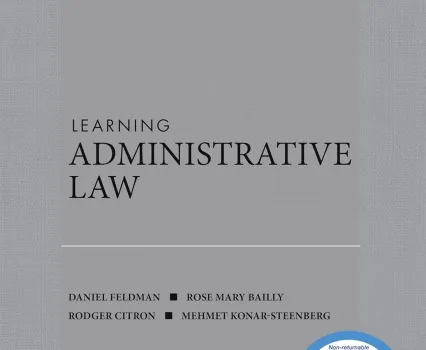
| Along with three co-authors—Dan Feldman, Rose Mary Bailly, and Mehmet Konar-Steenberg—I too have been navigating the RCR the past few years. After two years of work, we turned in our manuscript for Learning Administrative Law in August 2024, having done our best to account for the significant administrative law decisions decided by the Supreme Court in the 2023-24 term. |
| Professors Roisman and Tamir did not discuss our book—it’s not a casebook. Nevertheless, I found their approach instructive and now wish to evaluate Learning Administrative Law by the criteria they employed in their article. |
| At a high level, Professors Roisman and Tamir ask, are the authors for or against the Revolution? We were against, and we presented that view in our textbook. One benefit of co-authorship is the opportunity to have your views questioned and to learn from your colleagues. At the same time, it sometimes is a challenge to reconcile or accommodate different viewpoints. |
| Accordingly, I must note that we did not entirely agree on the scope of the RCR. My co-author Professor Feldman viewed the Court as akin to an arsonist and believed that the majority was trying to burn the administrative state to the ground in the 2023-34 term. I agreed that the Court’s recent decisions were dramatic and certainly reshaped administrative law. However, even after the 2023-24 term, I believed that the administrative state essentially still existed and that it was governed by law, though it was clear that the former was under attack as the Court significantly revised the latter. |
| We accommodated both views in the introduction, referring to “damage” to the foundation of administrative law and acknowledging that some “have suggested, with mordant humor, that we should present this book as an obituary of administrative law.” |
| Due to our publication deadlines, we could not account for—and therefore could do no more than acknowledge—President Donald Trump’s re-election in November 2024 and subsequent blitzkrieg on the administrative state after his inauguration in January 2025. I may have been right about where we were prior to the most recent presidential election but Professor Feldman is certainly correct about where we seem to be now, especially with the Supreme Court greenlighting many of Trump’s initiatives through its rulings in favor of the administration on the emergency docket. |
| In their evaluation of casebook supplements, Professors Roisman and Tamir asked more specifically (1) Did the authors take a “trees” or “forest” approach? (2) How did the authors describe the end of Chevron deference? And (3) How did they address the Major Questions doctrine? |
| Regarding Learning Administrative Law, as to the first question, we did both, though we focused more on the trees because of the press of time with the publisher. That is, we absolutely saw the confluence of cases as part of a larger assault on the administrative state but devoted most of our efforts to describing the Court’s recent decisions, especially those decided in the 2023-24 term. |
| As to the second and third questions, we saw the two developments as related. We described the key points of Loper Bright Enterprises v. Raimondo, a 2024 case in which the Court overruled Chevron prospectively and replaced Chevron deference with Skidmore deference. Under Chevron, a court reviewing agency action was required to defer to the agency’s interpretation under certain circumstances (specifically when the authorizing statute was silent or ambiguous and the agency’s interpretation was reasonable). That is no longer true, though under Skidmore, the court nonetheless may consider the agency’s views for their persuasive value. Hence our acknowledgment that Loper Bright may have only “a modest effect on the outcome of cases in the lower courts.” |
| Nevertheless, we wrote, Loper Bright has to be understood in the context of other developments, most importantly the Major Questions doctrine, first articulated by the Supreme Court in 2022. Under the Major Questions doctrine, the burden is now upon Congress to meet the higher bar set by the Court for delegating discretionary agencies authority to address issues of “deep economic and political significance.” |
| Even as we reviewed the page proofs for our textbook this spring, we knew that the law was continuing to significantly change. The Roberts Court Revolution is continuing in President Trump’s second term. Currently the scope of the president’s authority under Article II is being enlarged as the Supreme Court enters orders allowing the Trump administration to drastically restructure the federal government. The Court’s emergency docket rulings only sometimes provide a terse explanation. Presumably when the cases are litigated fully on the merits docket, the Court will explain its decisions. |
| One possibility, as the United States Court of Appeals for the Federal Circuit’s recent decision invalidating President Trump’s use of emergency powers to impose certain tariffs suggests, is that the Supreme Court’s recent restrictions on the administrative state may prove just as limiting for President Trump as for his predecessors. As we wrote in our introduction: “If you live long enough, everything comes full circle: The Chevron doctrine gave legal support to President Ronald Reagan’s agencies when they were sued in court. Loper Bright’s overruling of Chevron doctrine now gives federal judges more legal authority to set aside actions taken by President Donald Trump’s agencies.” |
| No matter what the Court decides when it ultimately decides the many recent cases challenging the legality of the Trump administration’s actions, we’ll have our work cut out for us when we turn to the second edition. It will be published in a very different political and legal landscape from the one that existed back in 2022, when we started working on the book. |


 Have friends who like law? Forward this email.
  Like Verdict for legal discussions on Facebook.
  Follow @verdictjustia for news and updates on Twitter.


