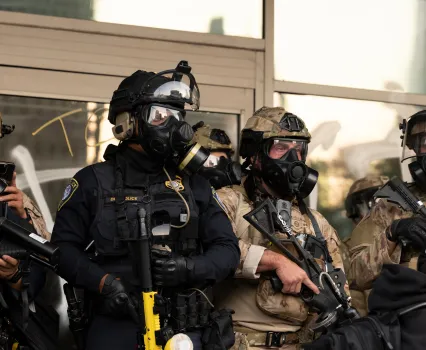
| Just weeks ago, an Immigration and Customs Enforcement (ICE) agent fatally shot Renee Good during Operation Metro Surge, the Trump administration’s immigration crackdown in Minneapolis. At around 9am on Saturday, a Customs & Border Patrol agent shot and killed Alex Pretti. These were, respectively, the nineteenth and twentieth incidents in which federal immigration enforcement authorities have shot someone in the last few months. | | While every fatal shooting by an officer should trigger administrative and legal investigations to determine liability, we need not wait for those processes to play out to draw a broader conclusion here. What we’ve seen in Chicago, Memphis, Portland, Minneapolis, and other cities leads to one inexorable conclusion: | | What federal immigration enforcement authorities are doing isn’t policing. | | While others have analyzed potential constitutional violations, we focus on a different crisis: a seemingly intentional disregard for professional norms that erodes public trust and endangers communities. It defies reality to suggest that the entirety of the federal immigration apparatus is unfamiliar with the practices developed by dedicated police practitioners over decades. Instead, administration officials seem willing to ignore these long-standing professional norms to promote the unchecked expansion of political power. Ignoring the standards that local, state, and federal police leaders have recognized and respected for decades isn’t normal, and it isn’t appropriate. | | This isn’t a policy disagreement. We can support targeted immigration enforcement while expecting it to be performed professionally, lawfully, and safely. And this is no mere philosophical dispute. Federal immigration authorities’ deviations from long-standing professional norms are doing incalculable damage to critical police-community relations, putting officers and community members in unnecessary danger, and undermining, rather than advancing, public safety. | | We are not the only policing experts to make these observations. The day after the Pretti shooting, the International Association of Chiefs of Police—the oldest, largest professional policing organization in the world—released a statement that started by pointing out “the need for stability, professionalism, and respect for constitutional principles.” The IACP went on to emphasize that “effective public safety depends on comprehensive training, investigative integrity, adherence to the rule of law, and strong coordination among federal, state, and local partners.” The IACP statement reaffirmed their “commitment to the constitutional protections that safeguard individuals from unlawful or unreasonable searches and seizures, recognizing that public trust and effective policing depend on faithful adherence to these fundamental rights.” Let us be clear: the IACP is no progressive outlier in policing. Rather, it is perhaps the most traditional, establishment-oriented policing organization in the world, a standard-bearer for conventional wisdom and police orthodoxy. | | Their concerns are well-founded. The Trump administration’s approach deviates—often egregiously—from professional policing across at least three dimensions: poor operational planning, unsound field tactics, and the failure of agency leadership to respond responsibly to critical incidents. We examine each of these in detail below to show how these departures compromise both public trust and officer safety. | | Poor Operational Planning & Lack of Collaboration | | For decades, federal law enforcement agencies—including the Federal Bureau of Investigation; Bureau of Alcohol, Tobacco, Firearms, and Explosives; the Drug Enforcement Administration; the United States Marshals Service; the Secret Service, and a host of others—have worked collaboratively with state and local officials. | | Collaboration comes in the form of joint agency task forces; since their emergence in the 1970s, hundreds of joint agency task forces have focused on a wide range of public safety issues including vehicle thefts, drug trafficking, kidnapping and crimes against children, robberies, gangs and organized crime, opioid fraud and abuse, violent crimes, fugitive apprehension, financial crimes, and counterterrorism, among others. Interagency collaboration is an important force multiplier, expanding local access to investigative resources and giving federal agents access to intimate local knowledge that they would otherwise lack. In this way, joint agency cooperation can facilitate operations that are greater than the sum of their parts. | | Collaboration can come in the form of deconfliction; when federal agencies engage in independent operations, they provide the local authorities with advanced notice about the location and general nature of their activities. Deconfliction helps avoid the kind of catastrophic mistakes that can occur when the local police respond to calls about non-uniformed, visibly armed federal agents. Collaboration also involves information sharing, both through formal mechanisms like the National Network of Fusion Centers and communications through more routine contacts between agency personnel. Information sharing helps agencies align their priorities and efficiently use their limited resources. | | Despite both the known benefits of—and the risks of ignoring—interagency collaboration, federal immigration authorities have bypassed established channels. Instead, they demand compliance and view any divergence from their demands as obstructive refusal by the very agencies that should be their local partners. Instead of easing local tensions, increasing the overall effectiveness of enforcement operations, DHS has been sending in swarms of agents that seem to lack any meaningful experience or training in local policing, have no ties to local communities, and express no concern for the mess they leave behind. | | The lack of collaboration creates unnecessary fear in the community and largely avoidable challenges for local public safety officials | | It also gets in the way of enforcing immigration laws against the one group for whom there is broad public support for targeted enforcement: individuals who have recently committed serious violent offenses. The 56 Fugitive Apprehension Task Forces organized by the US Marshals Service have long focused on locating and apprehending the “most dangerous fugitives.” These task forces depend heavily on their local partners; city and county officers and investigators almost invariably have more information and better contacts with the community, enabling more efficient apprehension operations. By aligning priorities, information, and resources, targeted enforcement operations have proven effective; in 2024, for example, they resulted in the arrest or clearance of 9,762 sex offenders and 5,337 homicide suspects. | | By locking out state and local partners, federal immigration officials have deprived themselves of precision. They have deprived themselves of a scalpel—highly targeted police attention has long been known to be the most effective form of enforcement action—and fallen back on the hammer, using blind, drag-net style enforcement tactics that are demonstrably overbroad and less effective. According to official data collected by the Trump administration, most individuals in immigration detention do not have any criminal record. That’s no surprise when federal immigration officials abandon any pretense of precision by focusing on day laborers at Home Depot, conducting worksite raids at restaurants, scoping out schools and hospitals, and making apparently random traffic stops of people of color (including off-duty officers). | | Unsound Tactics During Field Operations | | Professional policing relies on clear identification to maintain legitimacy and safety. For generations, standardized uniforms and badges have served to prevent tragic misidentifications—including “blue on blue” shootings between officers and defensive violence from community members who reasonably mistake plain clothes agents for criminals. | | In contrast, recent federal immigration operations have seen agents operating in plain clothes and masks, often refusing to identify themselves even when asked. Local police agencies have fielded calls from panicked residents reporting kidnappings-in-progress, sending officers to respond with lights and sirens only to learn that federal immigration authorities were operating in plain clothes and unmarked vehicles. This lack of transparency endangers everyone; in one incident in Fullerton, California, a local officer nearly fired upon an unidentified ICE agent who had drawn a weapon on a civilian. By abandoning these identification norms, the administration creates a “friend or foe” ambiguity that unnecessarily escalates the risk of fatal error. Worse, the lack of identification has led criminal actors to take advantage of public confusion by pretending to be ICE agents; the FBI’s Office of Partner Engagement released a Public Safety Awareness Report about impersonation, writing, “These criminal impersonations make it difficult for the community to distinguish between legitimate officers conducting lawful law enforcement action and imposters engaging in criminal activity, which damages trust between the local community and law enforcement officers.” | | Perhaps the most startling deviation from long-standing police practices is the frequency of federal agents shooting at moving vehicles—a practice strictly limited for decades. National consensus among organizations like the IACP and the Fraternal Order of Police emphasizes that shooting at a moving vehicle is tactically unsound: it rarely stops the car and often creates an unguided hazard if the driver is incapacitated. Standard training is clear: it is safer to step out of a vehicle’s path of travel than to shoot at it. Despite this clear, consistent professional expectation, federal immigration authorities have shot at moving vehicles at least ten times since August. | | Agents’ poor tactics may be contributing to those shootings. Professional policing cautions against overly aggressive action by, for example, attempting to force entry into vehicles or breaking vehicle windows unless there is a clear and immediate threat justifying such force. Someone who merely refuses to exit a vehicle immediately upon an officer’s initial demand does not present such a threat. Professional norms dictate that when a subject is non-compliant but not fleeing, officers should prioritize de-escalation over tactics that could trigger fearful, active resistance. That is not what video footage and subsequent reporting from recent federal immigration operations show. Instead, as one story describes, “Footage of the incidents shows agents swarming vehicles, smashing windows and trying to pry open car doors within seconds of approaching drivers,” and almost always doing so without establishing the degree of situational control that such inherently dangerous techniques demand. | | Another well-established tactical principle emphasizes that officers should avoid taking positions directly in front of or behind a vehicle. The IACP’s Model Policy on Motor Vehicle Stops is unequivocal: “At no time should the officer or others stand in front of, between, or behind the stopped vehicles.” For decades, police training has described stepping into a vehicle’s path of travel as “a very poor tactic” that is “ill-advised” and contrary to “common sense.” The reasons are obvious: the human body can’t possibly stop a vehicle, so there is no tactical benefit to stepping in front of a vehicle. And the tactical risks of doing so are substantial; officers can be struck, run over, or dragged. Those risks are serious, but easy to avoid so long as officers stay out of a vehicle’s path of travel. Inexplicably, videos of immigration enforcement operations show federal agents stepping into or positions directly in front of operable vehicles, predictably increasing the likelihood of a shooting. | | Leadership Failures After Critical Incidents | | Professional police leaders follow a strict protocol after critical incidents: share known facts, identify unknowns, and avoid speculation. Former DHS officials and even Border Czar Tom Homan have said as much. Despite this, leadership from the Department of Homeland Security and Customs and Border Protection have issued definitive, exonerating conclusions within hours of shootings—far sooner than any meticulous investigation could allow. | | For example, DHS Secretary Kristi Noem publicly framed Alex Pretti, the most recent individual shot by federal immigration authorities, as someone who arrived “to inflict maximum damage and to kill law enforcement.” This after the release of videos showing Pretti holding a phone in the moments before agents took him down and apparently not reaching for his gun. Customs and Border Patrol Commander Greg Bovino similarly speculated about Pretti’s supposed intentions, portraying the incident as an averted massacre and praising agents for “taking him down before he was able” to shoot. Such premature statements do not merely “get the message out”; they contaminate investigations and irreparably damage public trust. | | This lack of accountability is further compounded by the propagation of legal misinformation. Vice President JD Vance’s assertion that agents are “protected by absolute immunity” is legally incorrect. While absolute immunity is a real legal doctrine—it precludes certain government actors (including prosecutors and judges operating in the scope of their official duties) from being sued—it does not apply to federal law enforcement officers. They can assert qualified immunity in federal civil rights cases, and they can argue that they have Supremacy Clause immunity if they are criminally prosecuted by state authorities. Both of these doctrines are limited: qualified immunity only applies when the scope of the constitutional rights under consideration has not been “clearly established,” and Supremacy Clause immunity only applies when a federal officer is acting within the scope of their duties in a way that is necessary and proper. No legal or logical basis supports the claim that federal agents enjoy absolute immunity. | | By claiming agents are untouchable, the administration signals that oversight is performative and outcomes are preordained. This is exemplified by the Department of Justice’s decision to sideline its own Civil Rights Division in the Renee Good investigation, declaring that there was “no basis to open a criminal civil rights investigation” and declining to pursue the standard inquiry that every professional police organization would expect as routine. That decision was so contrary to standard procedure that it sparked a wave of resignations from seasoned federal prosecutors and agents. The fact that seasoned prosecutors and agents feel compelled to leave rather than participate in—or to be blocked from—investigating a federal agent’s use of force is deeply concerning. | | Conclusion | | This critique is not a disagreement over immigration policy; one can support targeted enforcement while insisting that it be performed professionally, lawfully, and safely. Indeed, those who value effective enforcement should be most alarmed by what is happening. Dragnet tactics, chaotic and unnecessarily violent operations, and premature exonerations do not advance public safety; they leave communities terrified and confused, place local police officers at risk, and put federal agents in unnecessary danger. The consequences are grave, and as we have seen just this week, fatal. | | The current state of federal immigration enforcement is not the unavoidable friction of difficult work. It is the foreseeable result of intentional choices to ignore well-established professional norms. These principles—codified by organizations like the IACP and the Police Executive Research Forum—are taught in academies and reinforced by decades of experience precisely because they protect both the public and the police. Abandoning these long-standing principles, threatening state and local officials, sidelining highly experienced and deeply dedicated public servants, precluding accountability by actively inhibiting any meaningful review—these decisions are not normal. History suggests these actions are the hallmarks of authoritarianism. | | When an administration abandons professional norms and sidelines the career professionals dedicated to them, it undermines the rule of law. If the executive branch will not demonstrate the competence, restraint, and accountability required of modern policing, then Congress, the courts, and the public must demand it. |
|





 Have friends who like law? Forward this email.
  Like Verdict for legal discussions on Facebook.
  Follow @verdictjustia for news and updates on Twitter.


