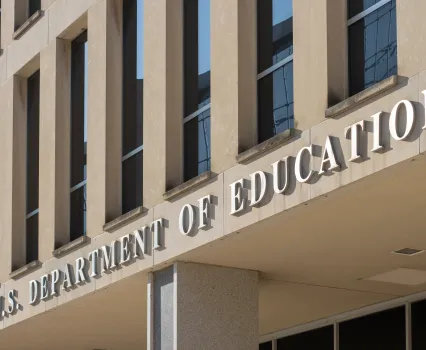
| The Supreme Court on Monday allowed the Trump administration to proceed with its plan to dismantle the Department of Education, at least while a lawsuit challenging the Administration’s actions moves forward. The ruling validates the Trump administration’s wholesale takedown of a multi-billion-dollar Department that Congress created, funded, and vested with authority, in direct contravention of federal law. | | If all this leaves you with a little whiplash, there’s good reason. Just two years ago, this same Supreme Court ruled that President Biden lacked authority to cancel about $430 billion in federal student loan debt for about 43 million borrowers. In issuing relief, President Biden drew on the Higher Education Relief Opportunities for Students Act of 2003 (the “HEROES Act”), which authorizes the Secretary of Education to “waive or modify any statutory or regulatory provision applicable to the student financial assistance programs” that the Department manages. But the Court ruled in Biden v. Nebraska that President Biden’s plan was neither a “waiver” nor “modification” of federal student loan terms, and that the Act didn’t provide sufficiently explicit authority for the President to issue this kind of sweeping relief. The Court struck the plan. | | Now contrast that ruling with the Court’s decision on Monday. The case arose when the Trump administration fired over 50 percent of Department of Education staff in one fell swoop, dismantling key Department functions that Congress codified in federal law. For example, the move terminated an entire office that Congress charged with managing the Department’s “bilingual education programs”; all Department employees that specialized in funding for K-12 education and federal IDEA grants, including an entire office that provided technical assistance for complying with the IDEA; 7 of the 12 regional offices of the Office of Civil Rights; and most of the office responsible for certifying schools so that their students could obtain federal financial aid. The Secretary announced that the mass termination was “the first step on the road to a total shutdown,” just as President Trump promised throughout the campaign and into his presidency. (Most recently, on March 20, 2025, President Trump issued an executive order that directed the Secretary to “take all necessary steps to facilitate the closure of the Department of Education and return authority over education to the States and local communities” “to the maximum extent appropriate and permitted by law.” The next day, he announced that his Administration would transfer certain critical Department functions to other agencies.) | | A group of 20 states and the District of Columbia sued, arguing that the moves violated federal law. They said, correctly, that Congress created the Department of Education and its offices, vested them with statutory authority, and funded them at levels that Congress deemed appropriate for the work they did. They pointed out that only Congress, not the President, could undo this structure. They claimed that President Trump’s actions therefore violated the separation of powers, federal law, and the President’s Article II duty to “take Care that the Laws be faithfully executed.” The states argued that the President’s actions directly harmed them, because states relied on the continued, statutorily-required functions of the Department. | | The district court agreed and issued a preliminary injunction; and the First Circuit declined to stay it pending appeal. The government asked the Supreme Court to intervene on an emergency basis, and on Monday, a six-justice majority stayed the injunction. The ruling came without explanation, as is typical on the Court’s emergency (or “shadow”) docket. | | The Supreme Court’s intervention allows the Administration to continue to dismantle the Department, at least pending appeal. But given the scope of the Administration’s actions, it will be well-nigh impossible to recreate the Department even if the plaintiffs ultimately win. In other words, the Court allowed the Trump administration effectively and unilaterally to dismantle an entire federal Department, even though Congress created it, specified its functions, and funded it, all in federal law. And the Court did this just two years after it ruled that President Biden lacked statutory authority for his comparatively modest attempt simply to halt the Department’s collection efforts on certain federal student loans. (Maybe President Biden should’ve ignored federal law, rather than citing it, and just fired all Department employees who collected federal student loans.) | | If the Court had bothered to provide any reasons for its decision, it might have said that the plaintiffs in the case lacked standing, or that the courts lacked the power to provide the plaintiffs with their requested relief. After all, those were the only arguments that the Administration proffered in the case; it didn’t argue the underlying authority for its actions. But remember, the Court reached mightily to overcome similar jurisdictional issues in Biden v. Nebraska. In that case, the Court held that a state had standing to sue on behalf of a nonprofit corporation that the state created, even though that corporation wanted nothing to do with the lawsuit. Even if the Court decided the Trump case only on jurisdictional grounds, the ruling still stands in stark contrast to the Court’s approach in the Biden case. | | In all, President Trump’s unilateral dismantling of the Department of Education is far more significant than President Biden’s student-loan-cancellation program. And unlike President Biden’s program, President Trump’s actions don’t even have a plausible basis in law. (Again, the Trump administration didn’t even defend its actions on the merits at the Supreme Court.) The Court’s disparate treatment is alarming, to say the least, and once again raises the specter that this Court is operating as an arm of the Trump administration. |
|


 Have friends who like law? Forward this email.
  Like Verdict for legal discussions on Facebook.
  Follow @verdictjustia for news and updates on Twitter.


