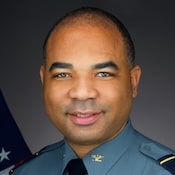
Excerpt from the Keynote Address of Chief Tarrick McGuire (Alexandria, VA)
American Society of Evidence-Based Policing Conference 10th Annual Conference
May 21, 2026 at American University (Washington, DC) |
| America has faced extraordinary challenges in recent years, and in many ways American policing has been both on the frontlines and at the center of these challenges. We were first responders during the COVID-19 pandemic. We witnessed deeply troubling, highly publicized incidents of unjustified police use of force, especially against unarmed community members. We heard continuous calls for police reform and sweeping policy changes amid national protests and a concurrent police recruitment and staffing crisis. We witnessed an attack on our nation’s capital, resulting in the deaths of five officers (one fallen in the line of duty and four who later died by suicide). And we lived the heartbreaking reality that more than a thousand officers have not returned home to their families since 2020 alone. |
| In the midst of carrying the weight of these challenges, I recently found myself sitting in the basement archives of Virginia Theological Seminary, carefully touching the typed pages of Letter from a Birmingham Jail written by Martin Luther King Jr. The letter, written on the edges of a newspaper and toiletry paper, and later transcribed by Dr. King’s secretary, was a response to several clergy who, concerned about potential backlash, criticized Dr. King’s non-violent exercise of his First Amendment rights as unwise and untimely. |
| As I sat there reading those pages, I realized something profound: while I was reading the letter, in many ways, the letter was reading me and speaking to me. Dr. King’s letter says, in its closing sentence, “An injustice anywhere in a threat to justice everywhere.” |
| We have God-given rights, recognized by our Constitution. Rights that we, as law enforcement, have sworn to protect. And “we” means all of us. No one living in the United States can ever be considered outside the protection of our founding pledge. |
| Although this letter was written in 1963, it has so much relevance in 2026. |
| Not merely as a historical artifact. Not merely as words preserved in an archive. But as a living challenge to leadership. A demand for conscience, courage, and democracy itself. |
| In that quiet room, holding those pages, I was reminded that Dr. King did not write this letter from the comfort of an office, a university lecture hall, or a position of political safety. He wrote it from confinement. From isolation. From a jail cell in Birmingham, Alabama, a city that had become synonymous with segregation, intimidation, and violence against Black Americans who sought to uphold the Constitution’s promise of dignity. And yet, despite those conditions, the letter did not communicate despair. It communicated resolve. |
| It was a declaration that democracy requires courageous participation. It was a warning that silence in moments of injustice becomes complicity. And perhaps most importantly, it challenged leaders, especially institutional leaders, to decide whether they would preserve comfort or pursue justice. |
| Dr. King wrote those words in response to those who urged patience, who believed that the time was not yet right, that justice should be delayed for the sake of order. But King understood something that remains painfully relevant today: order without justice is not peace. |
| He reminded America that “justice too long delayed is justice denied.” That charge still echoes through every public institution. It echoes in civil rights advocacy. It echoes in academia. It echoes in policing. And it echoes in the ongoing struggle to protect democracy itself. |
| Dr. King lamented what he called the “appalling silence of the good people.” He was not merely criticizing the extremists who openly defended segregation. He was challenging those who preferred calm to commotion. His words remind us that justice requires courage. Democracy is not protected by rhetoric alone. Democracy survives only when leaders are willing to confront difficult truths, even when doing so is unpopular, politically inconvenient, or professionally risky. That is the essence of bold leadership. |
| Dr. King’s warning remains relevant today. We live in a time where public trust in institutions is fragile. Communities across this nation are demanding legitimacy, fairness, accountability, and humanity. Those demands cannot be met through performative statements or recycled strategies that fail to address the complexity of modern society. |
| If we are serious about protecting democracy and strengthening legitimacy, we must go deeper. |
| We must examine how immigration enforcement impacts public trust in local policing. We need to understand how fear of deportation impacts witness cooperation, community engagement, and community participation in violence prevention efforts. |
| We need to reflect on the psychological effects of chronic stress, trauma, and moral injury in policing – particularly the emotional and ethical strain officers experience when public expectations, political pressures, and operational realities collide. |
| We need to understand how misinformation, social media amplification, and digital disinformation campaigns erode institutional legitimacy and accelerate distrust between communities and law enforcement. We need to examine the relationship between constitutional policing and democratic resilience, to acknowledge how protecting civil liberties influences long-term public cooperation and social stability. |
| We need to improve police recruitment and leadership development, to cultivate emotionally intelligent, constitutionally grounded, service-oriented leaders prepared for the complexities of modern democracy. |
| The future demands a public agenda for policing rooted not only in effectiveness and efficiency, but in legitimacy, dignity, constitutional protection, and democratic sustainability. |
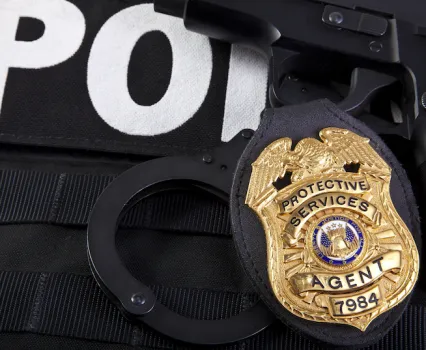
| To my colleagues in policing: this moment requires more than operational leadership. It requires moral leadership. The badge we wear is a symbol of authority. It is a reminder of obligation. It is a promise. Promises only matter when people can trust them. And that trust can only be earned when communities believe law enforcement sees their humanity, not merely their criminality. |
| In many ways, our nation is once again at such a moment as it was in 1963. To rise to this moment requires leaders willing to reject false narratives. It requires that we come together to confront the difficult issues that many would prefer to ignore. |
| This is a challenging time. But with challenge comes an opportunity for our profession to become an important catalyst in forming the more perfect Union promised to us in the Constitution, If only the leaders in our profession are willing to be bold. |
| Dr. Howard Thurman once said that, at the point of death, the ideal is for family members to be at your bedside praying for you as you cross over. But instead of your family, imagine if your dreams surrounded you. The ideas and ideals that you brought into the world and gave life to, will live on. Those that came to you but that you never brought into existence, will die with you. |
| I encourage each of you to live out your ideas and your ideals. Do not let them die and do not give up. No matter how hard it gets. Do not give up. |

 Have friends who like law? Forward this email.
  Like Verdict for legal discussions on Facebook.
  Follow @verdictjustia for news and updates on Twitter.


