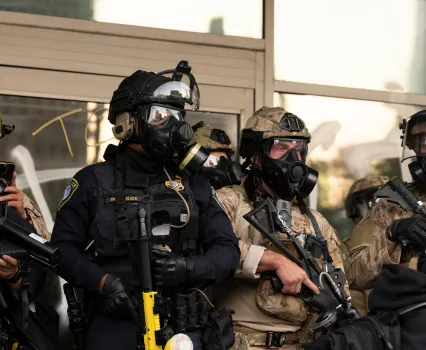
| California’s ban on ICE officers’ mask-wearing is about to be tested in the courts and on the campaign trail. | | As I explained in an earlier column, last September, California passed into law a measure (SB 627) that seeks, subject to some limited exceptions, to prohibit ICE officers (along with state and local law enforcement) from covering their faces (i.e., wearing masks) when engaging with members of the California public. The law, which was slated to take effect last week, on January 1, 2026, punishes violations as misdemeanors. The federal government filed suit in federal court in November to block implementation of the statute, and California Governor Gavin Newsom has promised to hold off enforcement efforts at least until the federal district judge to whom the case has been assigned (federal district court judge Christina Snyder) has ruled on the federal government’s request for a preliminary injunction. The parties’ briefing is ongoing, and the court has a hearing on the motion for preliminary relief scheduled for January 12. Of course, the grant or denial of a preliminary injunction is just the first step in federal litigation, but if the district judge errs and does not grant the U.S. Department of Justice’s request for relief, I would expect the federal government to seek relief in the U.S. Court of Appeals for the Ninth Circuit and, as needed, the Supreme Court. Whether at the district court level or at a higher court, I (and most all the constitutional law profs I have spoken with, across the ideological spectrum) would expect SB 627 to be enjoined. | | I say this because, as I explained in much greater detail in the earlier column, the Supreme Court has made clear that state governments cannot, absent federal consent, regulate federal agents on the job either directly or discriminatorily. As the Court put the point just a few years ago, the Constitution’s principles of supremacy “prohibit state laws that either 'regulat[e] the United States directly or discriminat[e] against the Federal Government’” (emphasis by the Court itself). So even if SB 627’s inclusion of state/local officers within the ban on face masks means the statute doesn’t “discriminate” against the federal government (an argument I find unconvincing), SB 627 would still be prohibited (absent federal consent) because it undeniably regulates the federal government “directly,” insofar as it applies directly to federal officers on the job and tells them directly how they can, or cannot, discharge their duties. As much as I may dislike ICE’s masking policies, unless someone can successfully demonstrate ICE is violating the Constitution in doing what it is doing, the choice of whether to do it is up to the federal government, not the states. | | SB 627’s clear invalidity (unless California can point to some evidence that the federal government has chosen to submit to laws like it) is commanded not just by recent (and also more venerable) Supreme Court precedent, but also by constitutional, structural common sense. Could we imagine upholding state laws in Alabama or Mississippi in the 1950s and 1960s that sought to prohibit all law enforcement personnel (including federal agents) from entering onto high school or university grounds, absent permission from the principal/chancellor of the school? Such laws would clearly flout undeniably valid federal efforts at desegregation by the federal courts and executive branch. | | Meanwhile, as the SB 627 case is percolating in district court, one of the leading candidates to replace Governor Newsom as California’s governor after an election this fall, U.S. Representative Eric Swalwell, publicly announced last week that if he is elected governor he will deny ICE officers who wear masks from obtaining California drivers’ licenses, the idea apparently being that, without the ability to drive vehicles in the state, ICE officers would be unable to carry our their controversial operations. More specifically, Swalwell reportedly told MS NOW that “[i]f the governor has the ability to issue driver’s licenses to people in California, if you’re going to wear a mask and not identify yourself, you’re not going to be eligible to drive a vehicle in California.” I have spent time with, and am generally impressed by, Representative Swalwell (when I was dean at the University of Illinois College of Law, he came and spoke at an all-day symposium), but this particular idea he floated is deeply flawed. Indeed, and ironically, it is even more obviously unconstitutional than is SB 627. | | Over 100 years ago, in Johnson v. Maryland (1920), a postal employee using roads within the state to deliver the mail “was tried, convicted, and fined for so driving without having obtained a license from the state” and the “naked question [before the Supreme Court was] whether the state has power to require such a [federal] employee to obtain a license by submitting to an examination concerning his competence and paying three dollars, before performing his [federal] official duty in obedience to superior [federal] command. . . . [T]he question is whether the state can interrupt the acts of the general government itself.” In a 7-2 ruling by Justice Oliver Wendell Holmes, the Court emphatically rejected state authority to require federal employees to obtain state drivers’ licenses to perform federal job duties, even though other drivers in the state could be punished if they drove without licenses. According to the Court: | It seems to us that the immunity of the instruments of the United States from state control in the performance of their duties extends to a requirement [of a state driver’s license]. Such a requirement does not merely touch the government servants remotely . . .; it lays hold of them in their specific attempt to obey orders, and requires qualifications in addition to those that the [federal] government has pronounced sufficient.
| | The Johnson Court did go on to say that federal agents, even while on the job, are not immune from all general obligations imposed by state law, but as I explained in my previous column, the state laws that federal officials must while on the job obey are those that the federal government would, given historical considerations and good sense, want its employees to heed. In the context of SB 627, no one has, as far as I can tell, yet adduced evidence that Congress has taken actions with the intent or expectations that federal officials should or will comply with laws like SB 627. | | I say Representative Swalwell’s proclamation is ironic because much of the modern doctrine insulating federal officers from state regulation builds on the analysis of Johnson. Given this, even as a political candidate, Mr. Swalwell would have been better off invoking a different setting than driver’s licenses, where the road to state control has already been explicitly blocked by the Court. |
|


 Have friends who like law? Forward this email.
  Like Verdict for legal discussions on Facebook.
  Follow @verdictjustia for news and updates on Twitter.


