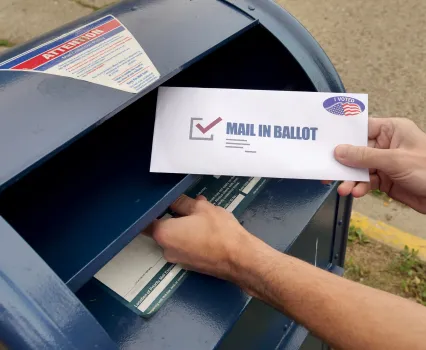
| Last week (on March 31), President Trump issued an Executive Order—entitled “Ensuring Citizenship Verification and Integrity in Federal Elections”—that directs the Department of Homeland Security (DHS) and the U.S. Postal Service (USPS) to take various steps ostensibly to make sure that non-citizens are prevented from casting mail-in ballots in federal elections. The executive order directs DHS, working together with the Social Security Administration, to “compile and transmit to the chief election official of each State a list of individuals confirmed to be United States citizens who will be above the age of 18 at the time of an upcoming Federal election and who maintain a residence in [that] State.” The executive order also requires USPS to initiate (and conclude within 120 days) a rulemaking process to produce regulations to ensure “that the USPS shall not transmit mail-in or absentee ballots from any individual unless those individuals have been enrolled on a State-specific list.” In addition, each state is obligated under the executive order to inform USPS, no later than 90 days before an upcoming federal election, if it plans to use mail-in ballots transmitted via USPS. If so, each such state is required to give, no later than 60 days before the election, a list of voters to whom the state intends to provide a mail-in ballot, so that this list can be cross-checked against the DHS list. Presumably, the regulatory and technological system USPS is tasked with setting up will prevent USPS from transmitting a federal ballot for anyone whose name does not appear on both lists. The executive order goes on to mention various ways for individuals who seek to vote but whose names might be absent from the federal lists to access and provide relevant information. And the executive order also mentions various enforcement mechanisms, including the withholding of federal funds to noncompliant states and potential criminal sanctions for anyone, including state election officials, who are involved in the “production, shipment or distribution of ballots” in violation of federal law. | | The executive order was immediately criticized by many election-law analysts and is already facing legal challenges. (Indeed, there are press reports of at least three or four cases having already been filed late last week.) In the space below, and in the spirit of the upcoming law school final exam season, I try to identify (and provisionally analyze) some key issues that people should keep in mind as litigation begins to unfold. | | My first observation involves timing. It seems nigh impossible that the system the executive order contemplates (even if it were legally permissible) could be crafted and put into smooth operation in time for use in the fall 2026 election. Any agency rule USPS adopts would probably not be finalized until June or July, which is only four months before the November election date. After the rule goes into effect, USPS would have to devise, test, and put into effect the required technology in just a handful of months, and then deploy this technology in just a handful of weeks between early September (by which time states are supposed to provide their lists) and Election Day. (Indeed, since voters need to know their options somewhat in advance of Election Day, the window for USPS to put their system into effect is probably closer to a month, from early September to early October.) For those of us who remember the technological rollout of the online exchanges provided for under the Obamacare statute, and the enduring impression that rollout created about the tech-savviness of federal instrumentalities, this timeline seems way too ambitious. | | But that doesn’t mean that people won’t or shouldn’t take the executive order seriously as the midterm elections approach. Indeed, even though, as noted above, USPS will likely not conclude its rulemaking process and adopt a final rule for several weeks or a few months, lawsuits (presumably in federal court) seeking to block the process that the executive order attempts to initiate have already been filed well before any final USPS rule has issued. And as these suits are taken up in court, federal judges will right off the bat have to confront what we constitutional lawyers call “justiciability.” More specifically, federal judges will be required to determine whether the plaintiffs (state election officials or would-be voters who are concerned their names are not going to be on the relevant state-specific list or political parties fearful that they will be damaged by the scheme the executive order creates, etc.) have an adequate injury to confer “standing,” and whether the cases they present are sufficiently timely, or “ripe.” | | All of this brings me to my second observation: While standing and ripeness requirements (and the related notion that a case should not be decided after a dispute becomes in the real world irrelevant, or “moot”) as prerequisites for litigating in federal court are important safeguards against judicial overreach, as my colleague Evan Caminker and I have written in recent legal scholarship, the federal courts (including the Supreme Court) have frequently (although certainly not invariably and not self-consciously) relaxed these justiciability constraints when challenges to election rules are involved. This (what we call) “election exceptionalism” makes eminent sense for several reasons – even though it hasn’t been acknowledged, much less explained by the federal courts themselves. | | For starters, it is imperative that people be able to seek redress in courts prior to the holding of elections to guarantee that the elections will in fact be conducted in compliance with the Constitution and other binding law; when an election is conducted under a cloud of constitutional uncertainty, the legitimacy of the results of that election—and of government officials who are elected or the policies that are adopted—are drawn into question. And when people question the democratic legitimacy of their elected officials, it is hard for democracy to endure. Moreover, it is often impossible (for practical and optical reasons) for courts to provide meaningful remedies after the fact, with respect to elections that are already concluded but that are then later shown to have been conducted with constitutional infirmities. And finally, if a challenge is brought close in time to an upcoming election—in order to ensure an actual, ripe injury to the plaintiff that will readily satisfy conventional justiciability requirements, the Supreme Court has said (in a series of cases known as the Purcell doctrine) that the challenge should not be entertained by federal courts, because judicial intervention to alter election logistics (even to bring them in conformance with the Constitution) too temporally near an impending election can frustrate expectations and reliance interests by voters, candidates and election officials about how the election will be administered. That, in turn, could dampen voter turnout and diminish the credibility and thus the legitimacy of elections. | | Some of the instincts behind the Purcell doctrine make intuitive sense, but when you add all of this up, the only sensible and democratically healthy solution is for federal courts to entertain election-related challenges well in advance of the next election (or in some instances, when non-intrusive remedies are possible, even after an election is over and a dispute might be otherwise be thought of as moot). And this is true even if the plaintiffs making a challenge allege harms that are in some respects speculative or contingent. In the context of the executive order under consideration here, that means federal courts should perhaps be open to considering legal challenges on the merits even before USPS undertakes a notice-and-comment period and issues a final rule. Given the control the President can exert over USPS and the detail with which the executive order directs USPS and DHS to act, the ultimate issuance and basic contours of a final rule seem not to be in much real doubt. If that is true, then, as the Supreme Court observed a decade ago in Susan B. Anthony List v. Driehaus (the most important recent justiciability case in the election realm), a “substantial risk that the harm will occur” that is sufficient for standing and ripeness would seem to be present here. | | My third observation (or set of observations) relates to the likely merits of legal challenges to the executive order. There are many possible grounds on which to contest the validity of the executive order. The threat to withhold federal funding from states that do not comply with the terms of the executive order, when the President rather than Congress is the one attaching the new terms (and when states were not made aware, by Congress, of these terms when the federal dollars were first offered and accepted), implicates serious questions under existing spending clause doctrine. The complexity of the contemplated scheme and the confusion the scheme might cause for voters and state election officials (both of whose conduct might be problematically chilled, especially in light of the specter of criminal enforcement) raise questions about interference with what the Supreme Court has called “the fundamental right to vote.” So too do inevitable and likely non-trivial mistakes in the federally compiled lists and the resulting denial (or chilling) of voting rights for significant numbers of persons. Another arguably problematic aspect of the executive order is that it requires states to configure balloting envelopes in particular ways and to compile lists of voters in ways and on timelines that states might not otherwise undertake to do, which could raise questions of whether state election officials are being “commandeered” into helping implement federal law. To be sure, the Printz v. United States case involving impermissible federal commandeering of state executive officials bracketed the question of demands from the federal government to states to turn over existing information, but last week’s executive order seems to require not just that states turn over information in a form that they already have it, but to go to the trouble (and on a particular, potentially challenging, timeline) of compiling information in ways they might not otherwise have done. (In the context of requests under federal and state “freedom of information” laws, that distinction between existing documents and the creation of new forms of information is sometimes important.) One rejoinder here might be that states aren’t being forced to do anything; they are simply being told what they must do in order to avail themselves of a federal service—USPS mail delivery. But would Printz have come out differently if the Brady Act had not said local sheriffs must conduct background checks, but instead had said that unless sheriffs conducted background checks, they couldn’t ever drive local police vehicles on federally funded and maintained highways? A better rejoinder by the Trump administration might be that the Constitution itself not only empowers states, but also obligates them, with respect to federal elections. Article I, section 4, and Article II, section 1 (which say that states “shall” prescribe election regulations and “shall” appoint presidential electors) seem, by their terms, to require that states do affirmative things, such that commandeering arguments by states in the federal-election realm are not, as a general matter, very powerful. | | As interesting and challenging as all these questions are, perhaps the most obvious and fundamental claim plaintiffs will likely raise is that even if the federal government has power to regulate states and the USPS and DHS, the president, in particular, lacks any authority to issue this executive order. The question of where presidential power comes from in this arena is challenging for the Trump administration since the Constitution gives states (in Article I, section 2) the power to prescribe voter qualifications for congressional elections, and, as noted above, gives states (in Article I, section 4) power to prescribe the times, places and manner of congressional elections unless and until Congress by statute makes or alters such regulations, and gives states (in Article II, section 1) virtual carte blanche with respect to the selection of presidential electors. Certainly, there is nothing in the Constitution that gives the President specifically any role (apart from the veto he wields in the federal lawmaking process) in substantively regulating congressional or presidential elections. So it seems likely that the President must, at the end of the day, be able to point to some constitutionally permissible federal statute that, read fairly and against the backdrop of federalism clear-statement rules and the so-called “major questions doctrine” and the non-delegation principles that underlie it, confers on the President authority to participate in the process by which states conduct federal election contests. | | We must wait and see precisely which statute or statutes President Trump’s lawyers will invoke that the administration believes the executive order, to quote Article II of the Constitution, “faithfully execute[s].” But one statute mentioned in the executive order itself (and in the larger debate about non-citizen voting) is 18 U.S.C. § 611, enacted in 1996 as part of the Illegal Immigration Reform and Immigrant Responsibility Act (IIRIRA), which provides that: “It shall be unlawful for any alien to vote in any election held solely or in part for the purpose of electing a candidate” for federal office. | | At first blush, if federal law permissibly prohibits non-citizens from voting in federal elections, perhaps the President has the power, via executive order, to make meaningful that prohibition. | | One rejoinder to that notion might be that Congress has delegated to the states, and not the federal executive, the task of who should and should not receive federal ballots, consistent with § 611. Even assuming that federal law validly proscribes non-citizen voting, the President’s proposed method of implementing that proscription may not fairly be subsumed within § 611. For example, a federal statute criminalizing armed robbery of federally insured banks would not generally be read to authorize the President, on his own, to require all such banks to install metal detectors to reduce the incidence of such crimes. And in the realm of § 611, we are dealing with a federalism tradition in which Congress has chosen to leave many federal-election-related matters to state governments. The way that tradition informs interpretation of particular federal statutes will likely be a big topic. | | But a second rejoinder to the invocation of § 611 is to deny the validity of the statute at all. As noted above, Congress is given power in Article I, Section 4, to make or alter regulations of the “times, places and manner” of congressional elections, but not any power to regulate who is eligible to vote in federal elections. To answer the “who” (rather than the “when and “how”) question, we must turn to Article I, Section 2. It says that voter qualifications for congressional elections in each state track “the Qualifications requisite for [voters] of the most numerous branch of the State Legislature.” In other words, if a person is eligible to vote in a state legislative election, she is eligible to vote in a congressional election. And such voter eligibility for state elections is up to states to decide (assuming they are not violating any other provision in the Constitution, such as the Fifteenth Amendment, prohibiting racial discrimination in voting.) Indeed, that is one reason neither § 611 nor the executive order seeks to apply to state elections. | | Now it just so happens that state law over the past 100 years, at least as facially written, limits voting to citizens only. But that wasn’t always the case. At the founding and throughout much of the nineteenth and into the early twentieth centuries, many states permitted aliens to vote in various local, state, and federal elections. There is nothing unconstitutional about a state permitting non-citizens to vote, in state (or federal) elections. Nor can the President in the executive order purport, under the President’s “take care” power, to be enforcing (modern) state-law rules that prohibit non-citizens from voting (insofar as these state laws are effectively incorporated into federal law by virtue of Article I, Section 2), because the precise and nuanced meaning of such state-law prohibitions must come from state institutions (like state courts) rather than the federal government. In other words, the extent to which a state in fact seeks to deny the franchise to non-citizens is determined not just by state constitutional and statutory law as written, but also by how state law has been applied and administered by state executive and judicial officials. As long as a state is interpreting and applying its own laws in ways that don’t violate some independent federal constitutional provision, states (under Article I, section 2) are the masters of state law. Under Moore v. Harper, all that Article I, Section 2 requires is that states follow their own law, whatever that law may be. Yet the content and contours of that state law are ordinarily left up to state (rather than the federal) courts, and certainly not to the President. (All of this is even more true for presidential-elector selection, since under Article II, Congress is given no role and since states don’t even have to hold elections for presidential electors—states can consult whomever they choose, including aliens in the state, to decide which electors to appoint.) | | One possible comeback to all this is that § 611 should be viewed not as an election regulation but instead as an immigration regulation. If § 611 said that, as a condition for entering into or remaining in the United States, non-citizens must promise never to vote in a federal election, we might have a complicated issue of whether such a statute was a permissible regulation of immigration (under Congress’ broad immigration authority) or instead an impermissible incursion into state power under Article I, Section 2. (In McCulloch v. Maryland, the Supreme Court observed that “should Congress, under the pretext of executing its powers, pass laws for the accomplishment of objects not intrusted to the [federal] Government, it would become the painful duty of this tribunal. . . . to say that such an act was not the law of the land.”) | | But there is at least some reason to question whether § 611 as written really can be understood as a statute about eligibility under immigration law to enter or remain in the United States at all, as distinguished from a law about voting. Importantly, while violation of § 611 can affect immigration status, the sanctions available under the statute go well beyond immigration removal and extend to criminal incarceration. It is possible that these criminal sanctions, which can’t be easily defended on an immigration-regulation basis, might be severable, but it is also possible that the criminal-law character of § 611 should inform whether we think of it primarily as an immigration statute rather than a voter-qualification statute in the first place. | | The upshot is that the constitutional basis for § 611 (and the extent to which it gives the President broad discretion, including compelling states to participate, in enforcement) has never been given a close look by the courts, much less a Supreme Court that prides itself on abiding by the text, structure, and history underlying the Constitution’s enactment. If § 611 does end up figuring prominently in the defense of President Trump’s executive order, all that could change. | | In addition to all this, note that President Trump’s executive order goes beyond immigration status in its treatment of the “who gets to vote” question. The executive order, for purposes of its directives to DHS, USPS, and states, defines eligible federal voters (to be included in DHS’s contemplated lists), as U.S. citizens who maintain residence in a state and “who will be above the age of 18 at the time of an upcoming Federal election.” First off, residency in a state is generally a matter of state law, as to which DHS has no expertise or authority to override state officials. Moreover, there is no requirement that states limit voter-eligibility to people over 18. The 26th Amendment says people 18 and over can’t be denied the right to vote on the basis of age, but it does not say states cannot—for purposes of state or federal elections—permit people younger than 18 to vote. No state currently allows 17-year-olds to vote in statewide (and thus congressional) elections, but some states do permit municipalities to include younger voters in local elections. And again, there is no federal bar to states allowing people under 18 to vote statewide. So in invading the state-law province of state residency and in effectively depriving states of the option to let 17-year-olds vote, the executive order would seem to go beyond anything the federal government can do, even if there were a federal statute that clearly tried to. Perhaps this part of the executive order could be severed, but all of this goes to show the order, like many other recent executive orders (think birthright citizenship), is not carefully crafted and very well might not survive judicial review. |
|


 Have friends who like law? Forward this email.
  Like Verdict for legal discussions on Facebook.
  Follow @verdictjustia for news and updates on Twitter.


